Zurbarán's Saints: Sculptural Stillness in Golden Age Spain

Seville's painter of austere devotion
Francisco de Zurbarán arrived in Seville in the early seventeenth century, at a moment when the city was among the wealthiest and most religiously fervent in Spain, its port controlling much of the trade with the Spanish American colonies and its churches and monasteries expanding rapidly to accommodate a booming, pious population. Zurbarán found his footing painting for exactly the kind of clients that environment produced in abundance: monastic orders seeking large cycles of paintings for their cloisters and refectories, confraternities commissioning altarpieces, and private patrons wanting devotional images for personal prayer. Unlike the more overtly emotional, theatrical Baroque style associated with contemporaries in Italy, Zurbarán developed a quieter, more contained visual language, built around solid, clearly lit forms set against deep, undefined dark backgrounds — a style perfectly suited to the contemplative, disciplined spirituality of the religious orders who became his most consistent patrons.
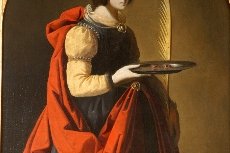
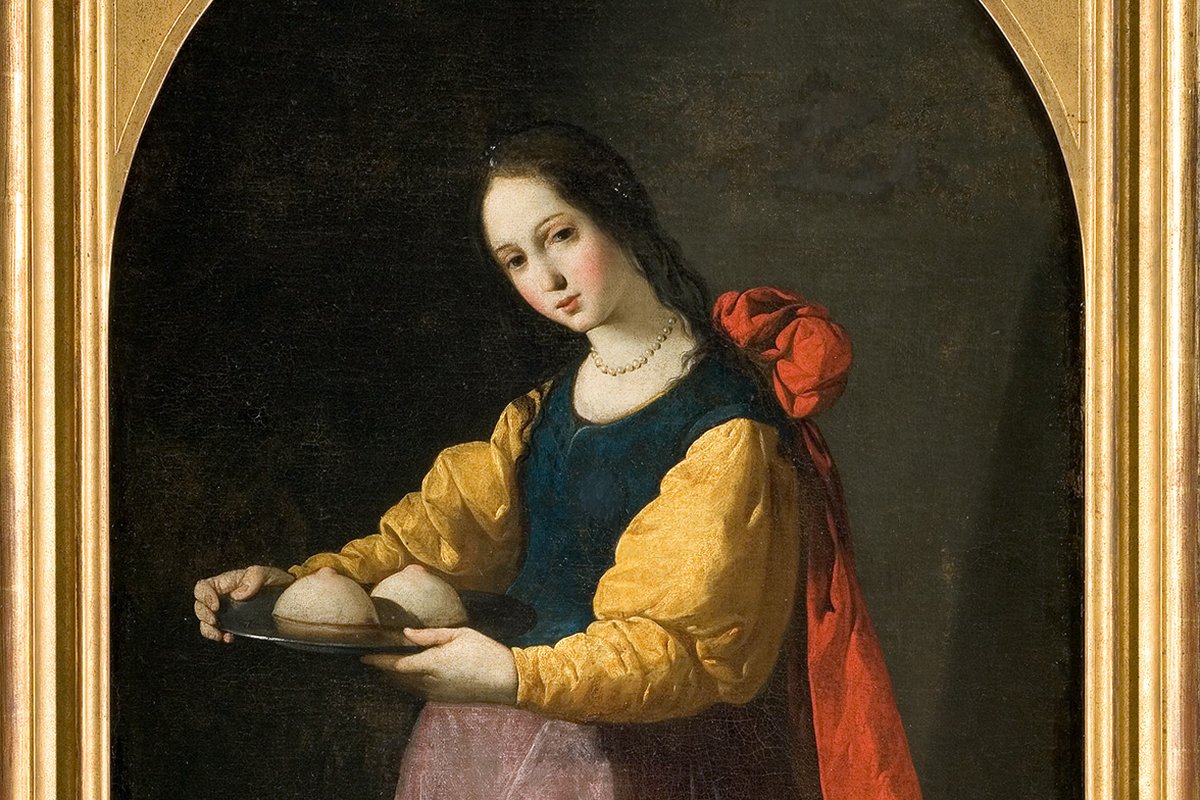
Francisco de Zurbarán, "Saint Lucy," c. 1636 — public domain.
Monks rendered with startling physical presence
Some of Zurbarán's most celebrated works depict individual friars and monks, often shown alone, in prayer or quiet contemplation, wrapped in the heavy woolen habits of their orders. These paintings are notable for how convincingly Zurbarán renders the physical weight and texture of coarse fabric, using strong directional light to carve deep folds and sharp contrasts of light and shadow across the cloth, an effect many historians have compared to sculpture in painted form. The figures themselves are typically still, self-contained, and psychologically withdrawn, conveying a sense of interior spiritual absorption rather than outward dramatic gesture — an approach well matched to the Counter-Reformation ideal of contemplative monastic holiness that Zurbarán's clerical patrons wanted reflected back at them on their own cloister walls.
The virgin martyrs in fashionable dress
Among Zurbarán's most distinctive and widely reproduced works is his extended series of paintings depicting young female virgin martyrs of the early Church — Saint Lucy, Saint Agatha, Saint Agnes, Saint Catherine of Alexandria, and others — each identified by the traditional attribute of her martyrdom, yet dressed not in the ancient clothing of their historical period but in elaborate, fashionable Spanish garments of Zurbarán's own seventeenth century. The effect is a deliberate, almost startling juxtaposition: contemporary elegance and material richness paired with symbols of brutal ancient sacrifice, a combination that made the series enormously popular both in Spain and, especially, among wealthy patrons in Spanish America, where demand for such paintings was strong enough that Zurbarán's workshop produced numerous versions and variants to meet export orders.
Still life within sacred painting
Zurbarán's skill extended into passages of still life embedded within his larger religious compositions — a bowl of fruit, a folded cloth, a carefully arranged set of vessels rendered with the same intense, focused clarity he brought to his figures. This attentiveness to material objects reflects a broader Spanish Golden Age fascination with still-life painting as its own respected genre, and it reinforces the overall sense in Zurbarán's work that every element within a composition, sacred figure or humble object alike, deserved the same unflinching, patient observation. That approach to material stillness sits alongside other symbolic traditions explored on this site, such as the lily in religious art, where ordinary objects carry deliberate devotional meaning within a composition.
A career eclipsed by changing taste
Zurbarán's austere, sculptural style dominated religious commissions in Seville through the 1620s and 1630s, but by the 1640s a younger generation of painters, most notably Bartolomé Esteban Murillo, began offering patrons a softer, more atmospheric, emotionally warmer alternative that increasingly won favor with Sevillian religious institutions. Zurbarán responded by leaning more heavily on export commissions to Spanish American markets, where his established style remained in demand, and he eventually relocated to Madrid later in life seeking royal and court patronage. He died there in 1664, in comparatively modest financial circumstances relative to his earlier prominence, a reminder of how quickly artistic fashion could shift even for an artist whose technical mastery was never seriously in doubt.
Rediscovery and lasting reputation
Zurbarán's reputation experienced a significant revival beginning in the nineteenth century, when French and other European collectors and critics, drawn to the stark clarity and quiet intensity of his work, helped reestablish him as one of the major figures of Spanish Golden Age painting alongside contemporaries such as Diego Velázquez. Today his paintings hang in major museum collections across Europe and the Americas, and his particular gift — rendering religious stillness with an almost tangible physical weight — continues to be recognized as one of the most distinctive contributions to seventeenth-century Catholic devotional art.
Part of what keeps Zurbarán's work compelling to modern viewers is precisely the restraint that once made it seem old-fashioned next to Murillo's warmer, more sentimental religious scenes. There is no forced emotion in a Zurbarán monk or martyr, no theatrical appeal for the viewer's sympathy — only a steady, patient act of looking, applied equally to a face, a folded robe, or a simple clay jug. That discipline mirrors the very spirituality his monastic patrons practiced, and it gives his paintings a durability that outlasted the shifting fashions of his own century, ensuring his saints still command quiet attention in galleries from Madrid to Mexico City.
Trivia
Who was Francisco de Zurbarán?
Why is Zurbarán's style often described as sculptural?
What is distinctive about Zurbarán's paintings of virgin martyrs?
Who were Zurbarán's main patrons?
How did Zurbarán's career change later in his life?
Related Reading