The Lily in Religious Art

A flower with one job
Most symbols in Christian sacred art accumulated layers of meaning over centuries, picking up new associations as they traveled through different regions and eras. The lily is unusually focused by comparison — in the overwhelming majority of Christian paintings, it means one thing: purity, and specifically virginity, most often the Virgin Mary's. That narrow, consistent focus is part of why the flower shows up so reliably in exactly the same handful of scenes across hundreds of years of Western art.
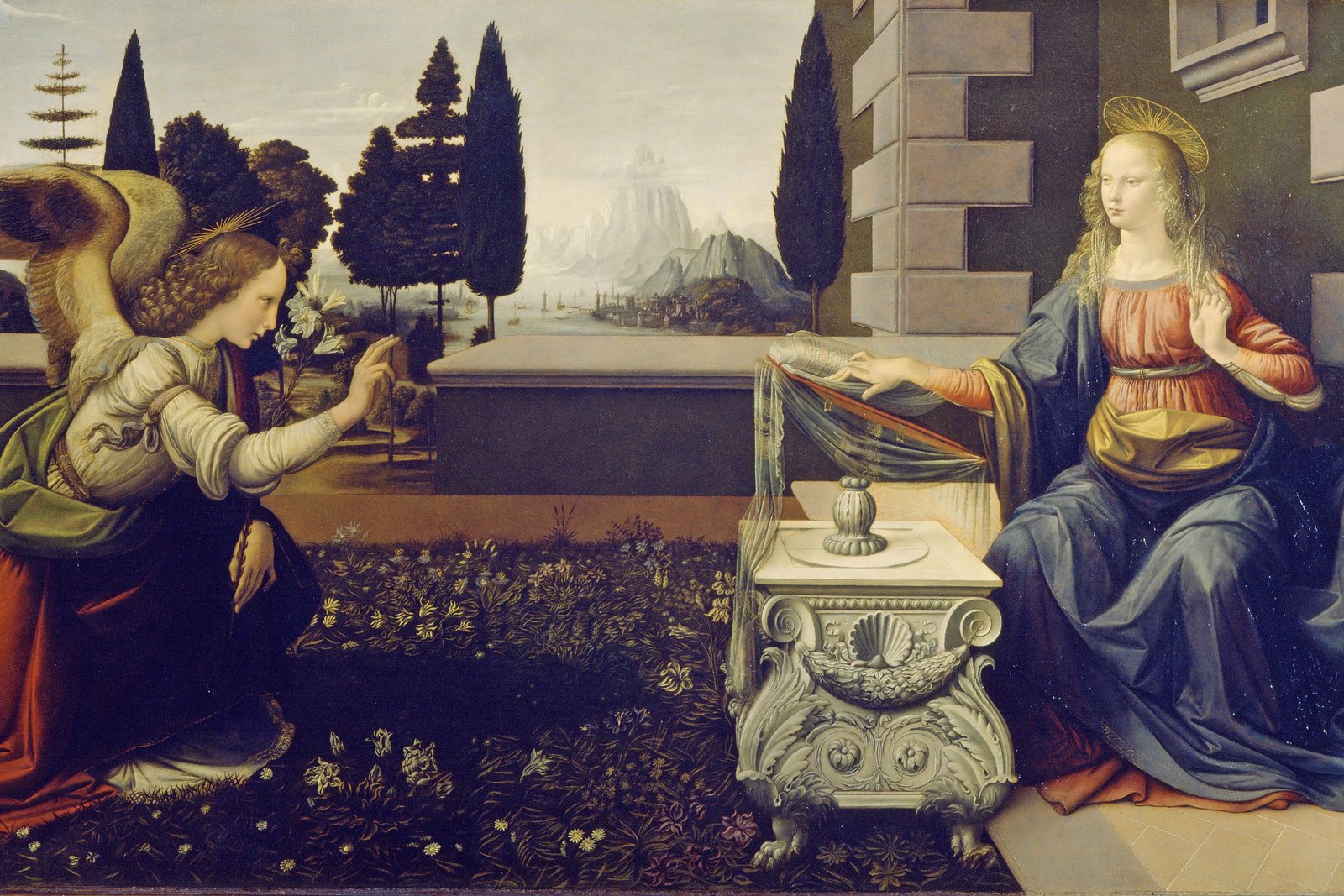
Leonardo da Vinci, "Annunciation," c. 1472-1475, Uffizi Gallery, Florence — public domain.
The Annunciation: the lily's home scene
No scene features the lily more consistently than the Annunciation — the moment the angel Gabriel appears to Mary with the news that she will conceive and bear a son. Luke's Gospel records the angel's greeting simply: "coming to her, he said, 'Hail, favored one! The Lord is with you'" (Luke 1:28, NABRE). Painters, working from that spare text, needed a way to visually declare what the words alone implied — that Mary would conceive while remaining a virgin — and the white lily became the standard solution. Leonardo da Vinci's Annunciation, shown above, places the device exactly where centuries of painters before and after him did: Gabriel kneels at left holding a lily stem upright between himself and Mary, positioned almost like a boundary marker at the center of the composition, visible proof of purity offered at the very moment the miraculous conception is announced. The flower typically appears in a vase on a pedestal or held directly in Gabriel's hand, but its placement is almost always the same — between the two figures, impossible to miss.
Saint Joseph's blossoming staff
A second, distinct lily tradition attaches to Saint Joseph, Mary's husband, though this one comes from pious legend rather than the Gospels themselves. According to a story that circulated widely in the medieval period and drew on earlier apocryphal writings, several suitors for Mary's hand each brought a wooden staff to the Temple, and God indicated his choice by making Joseph's staff alone burst into bloom with lilies — a sign the other suitors' staffs did not produce. Painters and sculptors picked up the detail eagerly, and Joseph is frequently shown from the late medieval period onward holding a flowering staff or a simple lily stem, a quiet visual echo of Mary's own purity attributed to her husband as well. It's worth being clear that this staff legend is tradition, not doctrine or scripture — a detail worth knowing before treating it as historical fact, even though it has shaped devotional art for centuries regardless.
Purity, not the only meaning
While the lily's dominant meaning in Christian art is purity, it isn't the flower's only appearance in scripture. In the Gospel of Matthew, Jesus uses wildflowers as an image of trusting providence rather than virginity at all: "Why are you anxious about clothes? Learn from the way the wild flowers grow. They do not work or spin. But I tell you that not even Solomon in all his splendor was clothed like one of them" (Matthew 6:28-29, NABRE) — a passage popularly known, in an older translation's phrasing, as "consider the lilies of the field." This passage belongs to a separate strand of lily symbolism, tied to God's care for creation rather than to Mary's purity, and artists illustrating this specific Gospel passage — usually in scenes showing Christ teaching a crowd — use the flower differently than painters working on an Annunciation scene. The two traditions coexist in Christian art without much overlap, distinguished almost entirely by which scene the lily appears in.
Lily and rose together
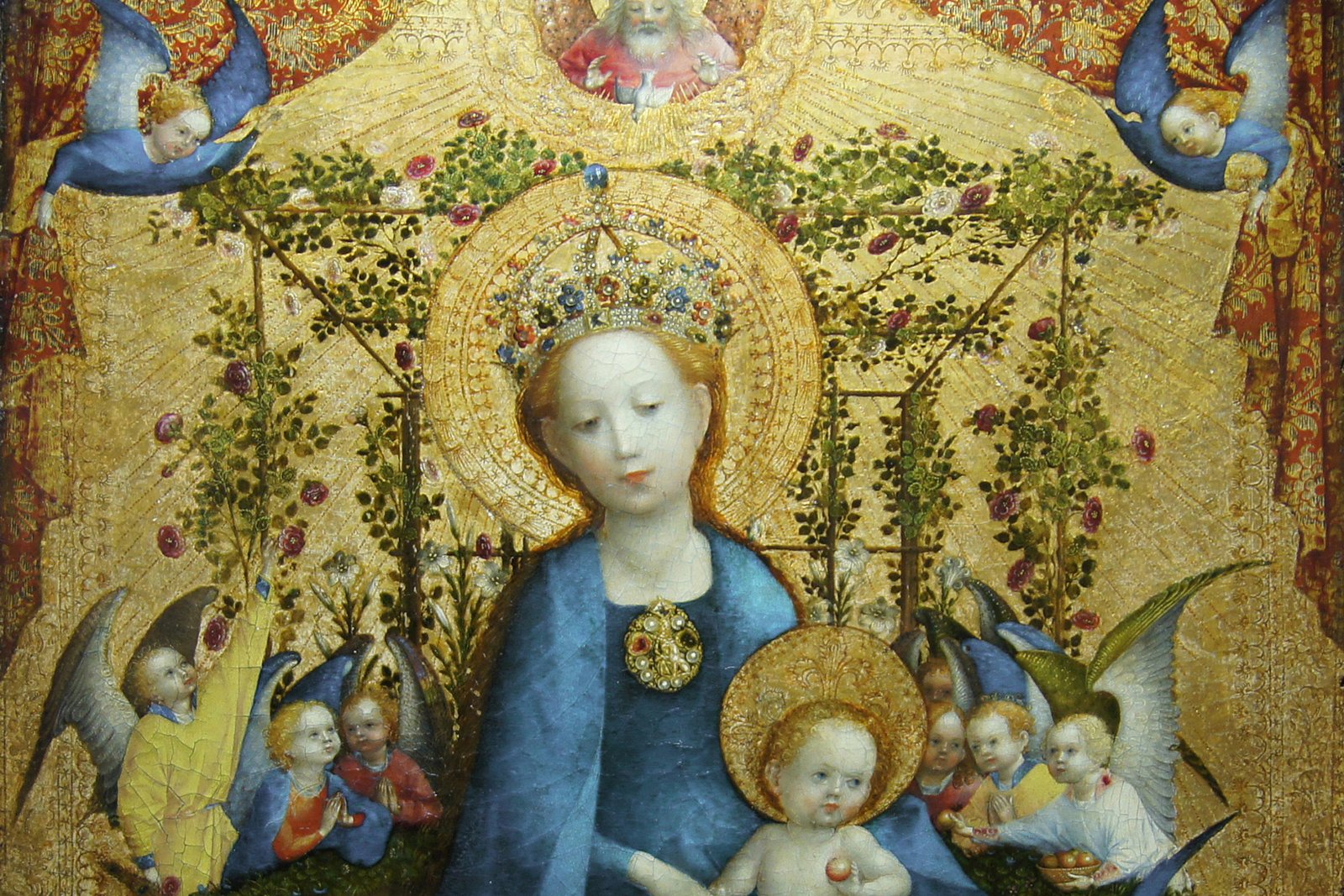
Marian art rarely relies on the lily alone. Roses appear constantly alongside it, particularly in later medieval and Northern Renaissance painting, carrying a related but distinct set of meanings tied more to beauty, joy, and eventually Mary's sorrows than to virginity specifically — a symbolism explored further in The Rose in Marian Art. When both flowers appear in the same composition, as they frequently do in devotional gardens and Madonna paintings surrounded by symbolic plants, the effect is cumulative rather than redundant: each flower reinforces a different facet of how medieval and Renaissance Christians understood Mary, purity and joy held together in the same painted garden.
Why the symbol survived so cleanly
Part of what has kept the lily's meaning so stable across centuries, compared to symbols that drifted or multiplied over time, is how narrowly artists used it. A painter reaching for a lily wasn't choosing from a wide menu of possible meanings — the flower was doing essentially one job, in essentially one type of scene, for hundreds of years running. That consistency is exactly why the sight of a single white lily, even stripped from its original painting and reproduced on a holy card or a modern print, still reads instantly as a marker of the Annunciation and the purity it announced.
Trivia
Why is the lily associated with the Virgin Mary?
Why does Saint Joseph sometimes hold a flowering staff or lily?
Is the lily mentioned in the Bible itself?
What other flowers appear alongside the lily in Marian art?
You May Also Like
Related Reading