Guido Reni's Saint Michael the Archangel

A commission for a small Capuchin church
Guido Reni was already one of the most sought-after painters in Italy by the 1630s, celebrated for a refined, classicizing style that set him apart from the more dramatic, shadow-heavy Baroque of contemporaries like Caravaggio. When Cardinal Antonio Barberini, a member of one of Rome's most powerful families, commissioned Reni to paint an altarpiece for the Capuchin Franciscan church of Santa Maria della Concezione, the friars received something considerably grander than the modest simplicity their order typically favored in art and architecture. Reni delivered the finished painting in 1636, and it remains in that same church today, still functioning as the altarpiece it was made to be rather than having been relocated to a museum collection, as so many Old Master paintings eventually are.
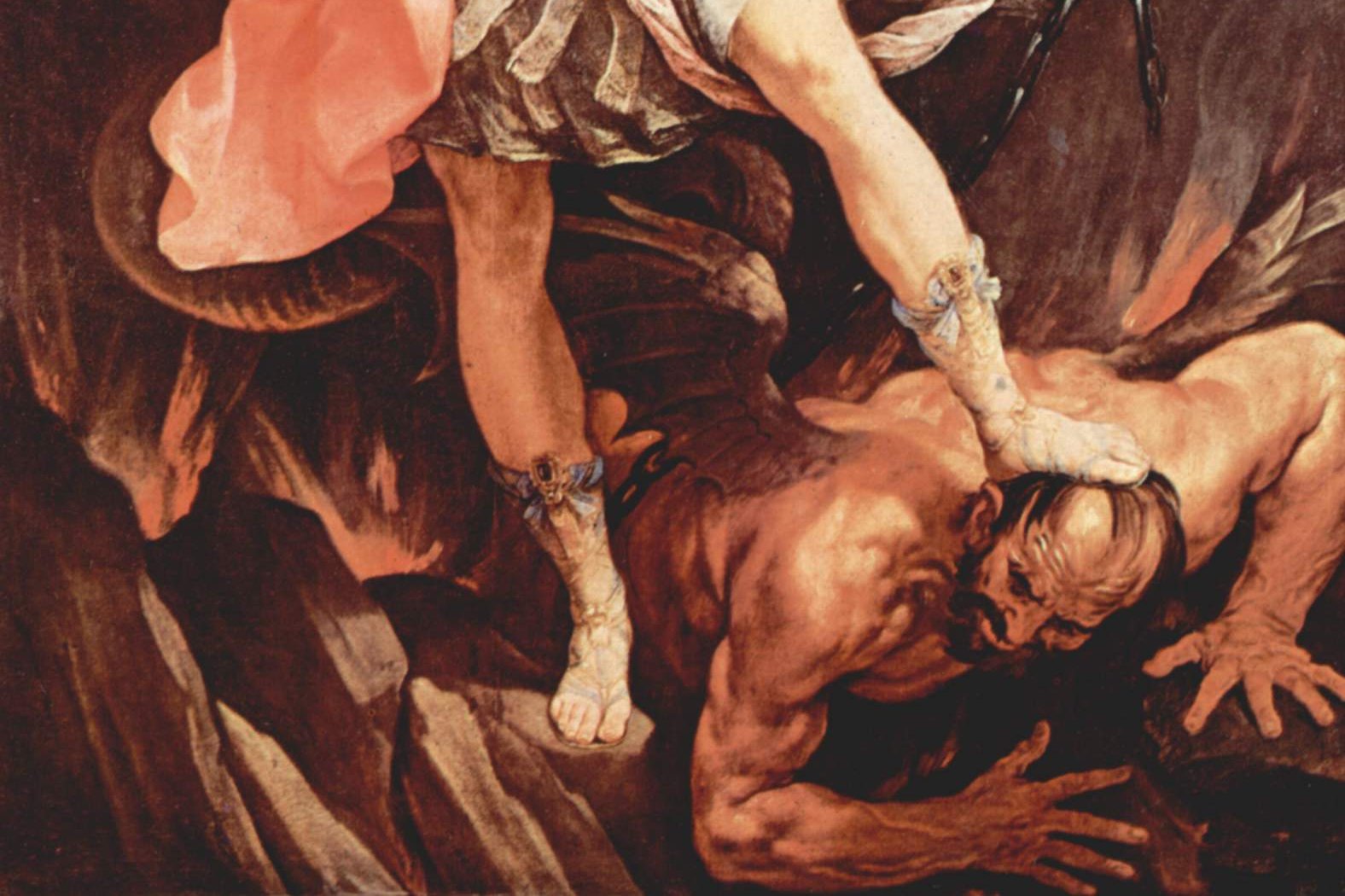
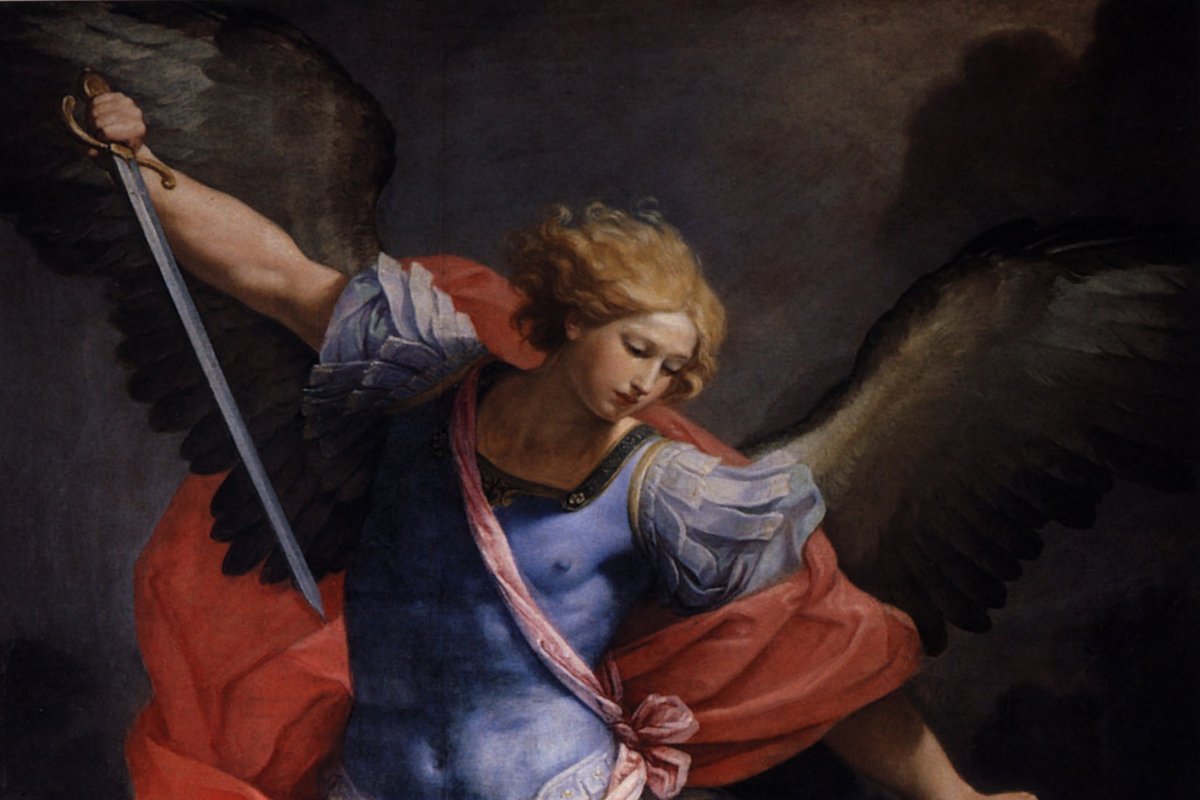
Guido Reni, The Archangel Michael, 1636, Santa Maria della Concezione, Rome — public domain.
The subject was the Archangel Michael's defeat of Satan, drawn from the Book of Revelation's account of war breaking out in heaven, in which Michael and his angels cast down the dragon identified with the ancient serpent and the devil. It was a natural subject for a Roman church in this period — Michael's cult was strong throughout Italy, and images of his triumph over evil carried obvious resonance for a Church still actively engaged in the theological and political battles of the Counter-Reformation.
A composition that became a template
What Reni produced was, in its own moment, a striking departure from some earlier depictions of the subject, which often emphasized violent motion and dramatic struggle. His Michael stands calm and composed, dressed in Roman-style armor rather than medieval plate, wings spread but body still, sword raised almost gracefully rather than in the middle of a violent downward strike. One foot rests firmly on the demon writhing beneath him, but there's no sense of ongoing combat in Michael's face or posture — the battle is already, definitively, won. This restraint, characteristic of Reni's broader classicizing sensibility, gave the image an authority and stillness that proved extraordinarily influential.
Engravers and print-makers across Catholic Europe reproduced Reni's composition for centuries afterward, and it became something close to a default visual formula for depicting Michael's triumph — the pose, the armor, the calm expression, the demon underfoot, all traceable back to this single Roman altarpiece. Later devotional art, holy cards, and even some modern religious imagery still echo Reni's basic arrangement, whether or not the artists making it were consciously aware of the source.
The demon's face and a persistent legend
One detail of the painting has generated more storytelling than almost any other: the face of the demon beneath Michael's foot, twisted in an expression some viewers have long read as bearing a specific, recognizable likeness rather than a generic demonic grimace. A popular art-historical anecdote, repeated since at least the eighteenth century, holds that Reni deliberately painted the demon's face to resemble a rival or critic — most often connected in the retelling to Gian Lorenzo Bernini, the dominant sculptor-architect of Baroque Rome and, by many accounts, someone with whom Reni had a professionally competitive relationship.
It's a satisfying story, and it has been told often enough that many visitors to the church arrive already expecting to see a specific grudge immortalized in paint. Whether it holds up as documented history is another matter — contemporary sources from Reni's own lifetime do not conclusively confirm the identification, and art historians generally treat the tale as an appealing but unverified tradition rather than an established fact. What can be said with more confidence is that Reni gave the demon an unusually individualized, almost portrait-like face rather than a generic monstrous one, which is very likely exactly what set this particular legend in motion in the first place, whether or not any specific real person was ever actually intended.
A painting still doing its original job
Unlike many celebrated Old Master paintings that have long since left their original context for the controlled environment of a museum gallery, Reni's Archangel Michael has remained exactly where it was installed nearly four centuries ago, still serving as the altarpiece of an active church. Visitors to Santa Maria della Concezione today see it in essentially the same setting its original congregation did, above an altar in a working Capuchin church, rather than isolated on a museum wall — a rare continuity that lets the painting still function as what it was made to be: not simply a masterwork of Baroque composition, but a devotional image meant to focus a congregation's prayer toward the archangel it depicts.
The church itself adds an unusual second attraction that many visitors encounter only after viewing Reni's painting: a crypt beneath the nave decorated with the skeletal remains of thousands of Capuchin friars, arranged in elaborate patterns across several small chapels, a memento mori tradition the order maintained for centuries as a deliberate meditation on mortality. Reni's calm, victorious archangel above the altar and the friars' bones below make for a striking pairing — one image asserting triumph over death, the other insisting, with equal directness, that death comes for everyone regardless.
Trivia
Where is Guido Reni's Archangel Michael located?
Is the story about Reni depicting a rival as the demon true?
Why did this painting become so influential?
What biblical passage does the painting illustrate?
What order commissioned the painting?
You May Also Like
Related Reading