Saint Bernadette's Incorrupt Body: What the Exhumation Records Actually Say

A relic unlike a splinter of wood or a strip of cloth
Most of the objects venerated as sacred relics on this blog are fragments — a sliver of wood, a scrap of cloth, a bent nail. Bernadette Soubirous's body is a different category of relic entirely: an entire human being, preserved, examined, documented by medical professionals, and placed on permanent public view in a convent chapel in Nevers, France. That difference is exactly what makes the historical record around her worth reading carefully, rather than repeating the word "incorrupt" as though it settles every question on its own.
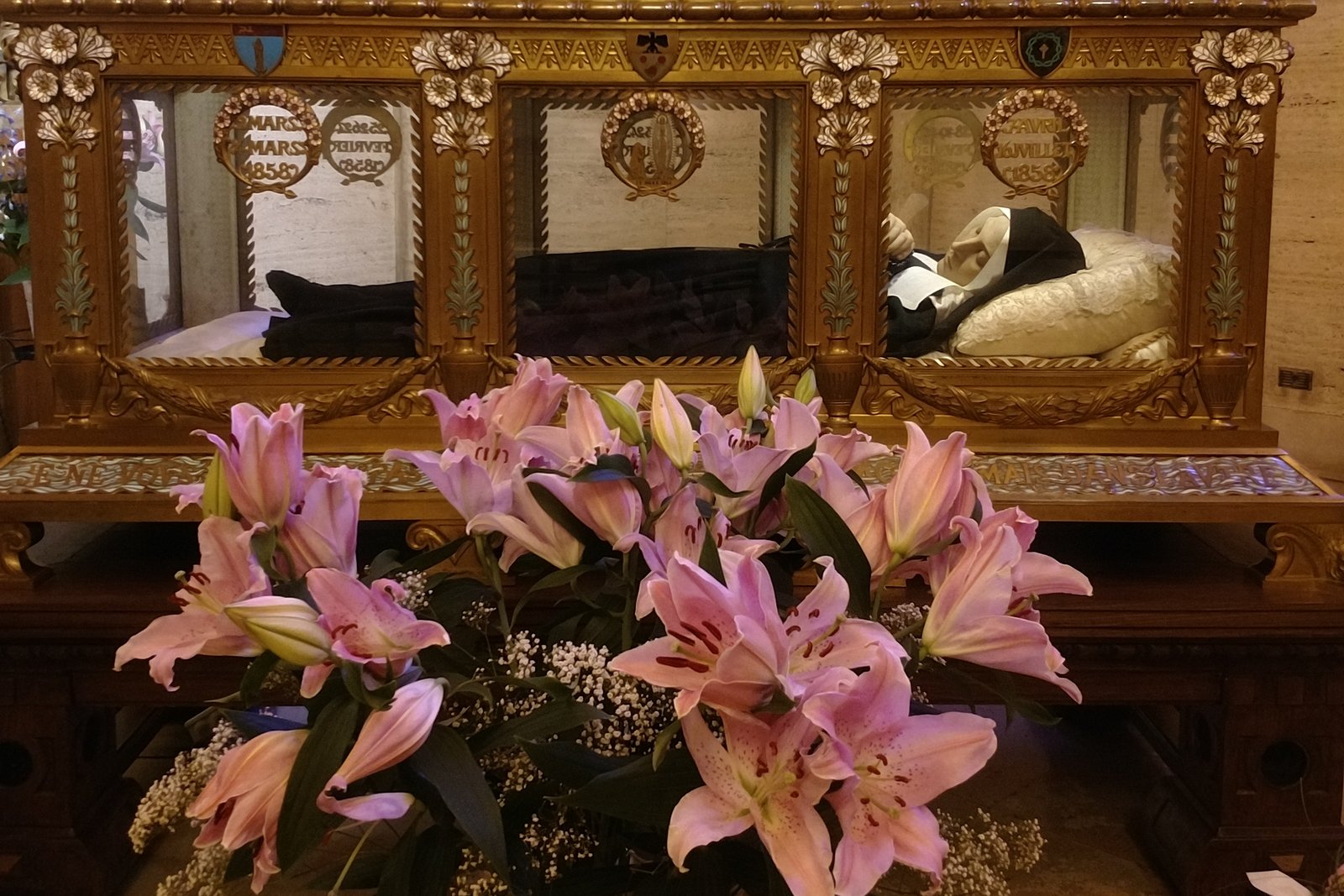
Photograph by Jabonsbachek, Saint Bernadette's incorrupt body — CC BY-SA 4.0, via Wikimedia Commons.
Bernadette herself needs little introduction to readers of this blog — the fourteen-year-old who reported eighteen apparitions of the Virgin Mary at the Massabielle grotto in Lourdes in 1858, who spent her adult life trying to disappear from the fame those visions brought her, and who died at the Convent of Saint-Gildard in Nevers in 1879 at only thirty-five. (Her full biography is covered in Saint Bernadette Soubirous and Nevers and the Shrine of Saint Bernadette elsewhere on this site.) She was beatified in 1925 and canonized in 1933, under Pope Pius XI. This article focuses narrowly on the relic itself: what three official exhumations actually found, what was done to prepare her body for display, and what the Church does and doesn't claim about any of it.
Three exhumations, three different findings
Canonization causes of this era routinely required exhuming a candidate's remains for formal identification and examination, and Bernadette's body was opened three times as her cause advanced: in 1909, 1919, and 1925.
At the first exhumation, on September 22, 1909, thirty years after her burial, the examining physicians found the body largely intact — clothed in her habit, without significant odor, the face, hands, and forearms exposed for inspection showing skin still clinging to the underlying muscle and bone. The face was noted as a dull white color, which the examiners attributed partly to carbon deposits that had seeped into the coffin. That same report, however, recorded something easy to leave out of popular retellings: within a few hours of exposure to open air, the exposed skin had already begun visibly darkening.
The second exhumation, on April 3, 1919, found a markedly different state. The attending doctor's report describes the body as "practically mummified," covered with patches of mold and a notable layer of what appeared to be calcium salts; skin had disappeared from some areas entirely, though it remained present over most of the remains. This is not the language of a body frozen in flawless, lifelike preservation — it is a clinical description of a corpse that had continued, in its own way, to change over the decades in the ground.
By the third exhumation in 1925, ahead of her beatification, officials judged that the blackened tinge to the face, together with sunken features, would make an unsettling impression if the body were displayed to the public as it then appeared. That judgment led directly to the step most visitors to Nevers today don't realize happened at all.
The wax mask: what pilgrims actually see
Before Bernadette's body went on permanent public display, officials had an exact imprint of her face molded, and sent a cast — along with surviving photographs taken during her lifetime — to the Parisian firm of Pierre Imans, a well-known maker of fashion mannequins. Imans's workshop produced thin wax coverings for her face and hands, shaped to follow her actual features as closely as the casts and photographs allowed, to be laid directly over the discolored, altered skin beneath.
That wax covering is what pilgrims see today when they look into the glass and gilded reliquary at Saint-Gildard: a careful, deliberate restoration of a recognizable likeness, not her bare, untouched skin. The Church and the shrine itself have never hidden this. The convent's own accounts of the 1925 preparation describe the wax plainly as a conservation measure, intended to present a peaceful, venerable image to the faithful rather than to claim her face had survived forty-six years in the ground unchanged. Readers who want the full exterior picture of the reliquary and chapel can find it in this blog's companion article on Nevers and the Shrine of Saint Bernadette.
What "incorrupt" is actually claiming — and what it isn't
The word "incorrupt" carries a lot of popular weight it doesn't quite earn in cases like this one. It's sometimes used to suggest a body preserved in a state indistinguishable from the moment of death, untouched by decades underground — a claim the 1919 report alone makes impossible to sustain for Bernadette specifically. What the three exhumation records actually document is something more modest and, in its own way, more interesting: a body that resisted the ordinary pace of decomposition far more than expected, while still visibly changing — darkening, losing some skin, developing mineral deposits — across the thirty, forty, and forty-six years between burial and each inspection.
Crucially, the Catholic Church does not treat this kind of preservation as proof of sanctity, nor does it require it. Canonization causes rest on different evidence entirely — a documented record of heroic virtue during life, and typically miracles, usually healings, attributed to the candidate's intercession after death and investigated by medical and theological experts. Bernadette's own canonization in 1933 followed that standard path; her body's condition was recorded as a matter of historical interest, not cited as the miracle itself. Many other canonized saints' remains show entirely ordinary decomposition, and that fact has never been treated as evidence against their holiness. The veneration the Church encourages toward relics generally — including the bodies of saints — rests on different theological ground: it honors what Bernadette's life pointed toward, not a forensic claim about her tissue (see the Catechism of the Catholic Church, nos. 957, 1674, and 2300, which locate relic veneration within the communion of saints and the Church's hope for the resurrection of the body, alongside its ordinary respect for human remains).
A working chapel, still visited
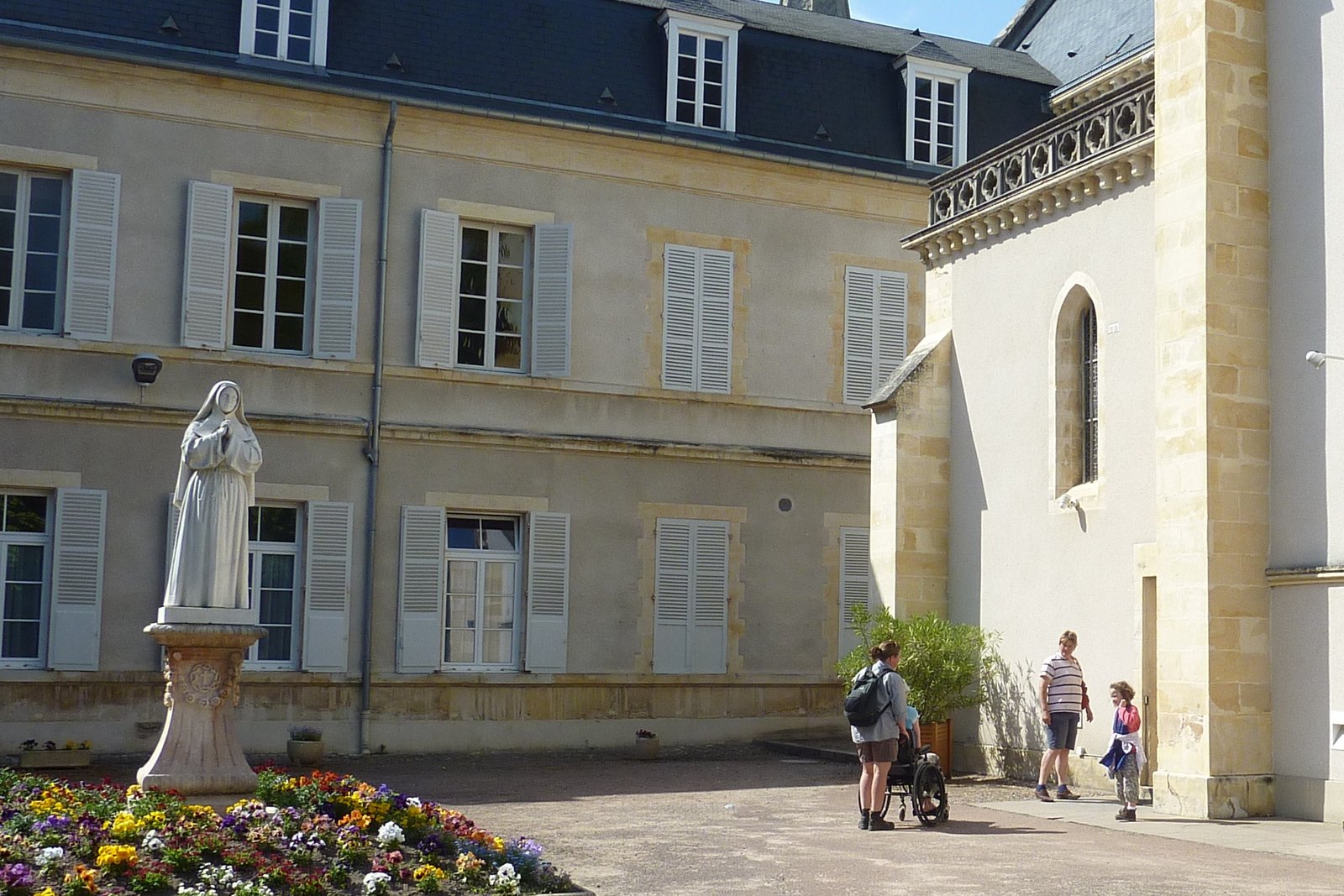
None of this has diminished Nevers as a destination. The Convent of Saint-Gildard remains an active motherhouse of the Sisters of Charity of Nevers, and Bernadette's reliquary sits inside its working chapel rather than in a separate museum setting. Many pilgrims visiting Lourdes, roughly 250 miles to the southwest, extend their trip to Nevers specifically to see where Bernadette spent the quiet, difficult final thirteen years of her life and where her body has remained on view since August 1925.
What draws them is, in the end, closer to what drew earlier generations to venerate a splinter of the True Cross or a strip of cloth than it might first appear: not a scientific guarantee about the exact physical state of an object, but a tangible point of contact with a specific life the Church has recognized as holy. The exhumation records, read honestly, don't undercut that. They simply insist that the history behind the glass is a documented one — with real doctors' reports, a real craftsman's wax, and real decades of ordinary change — rather than a legend too perfect to need defending.
Trivia
Is Saint Bernadette's body really incorrupt?
Is the face on display at Nevers Bernadette's real, unaltered face?
Does the Catholic Church require incorruption as proof of sainthood?
Where can pilgrims see Saint Bernadette's body today?
Related Reading