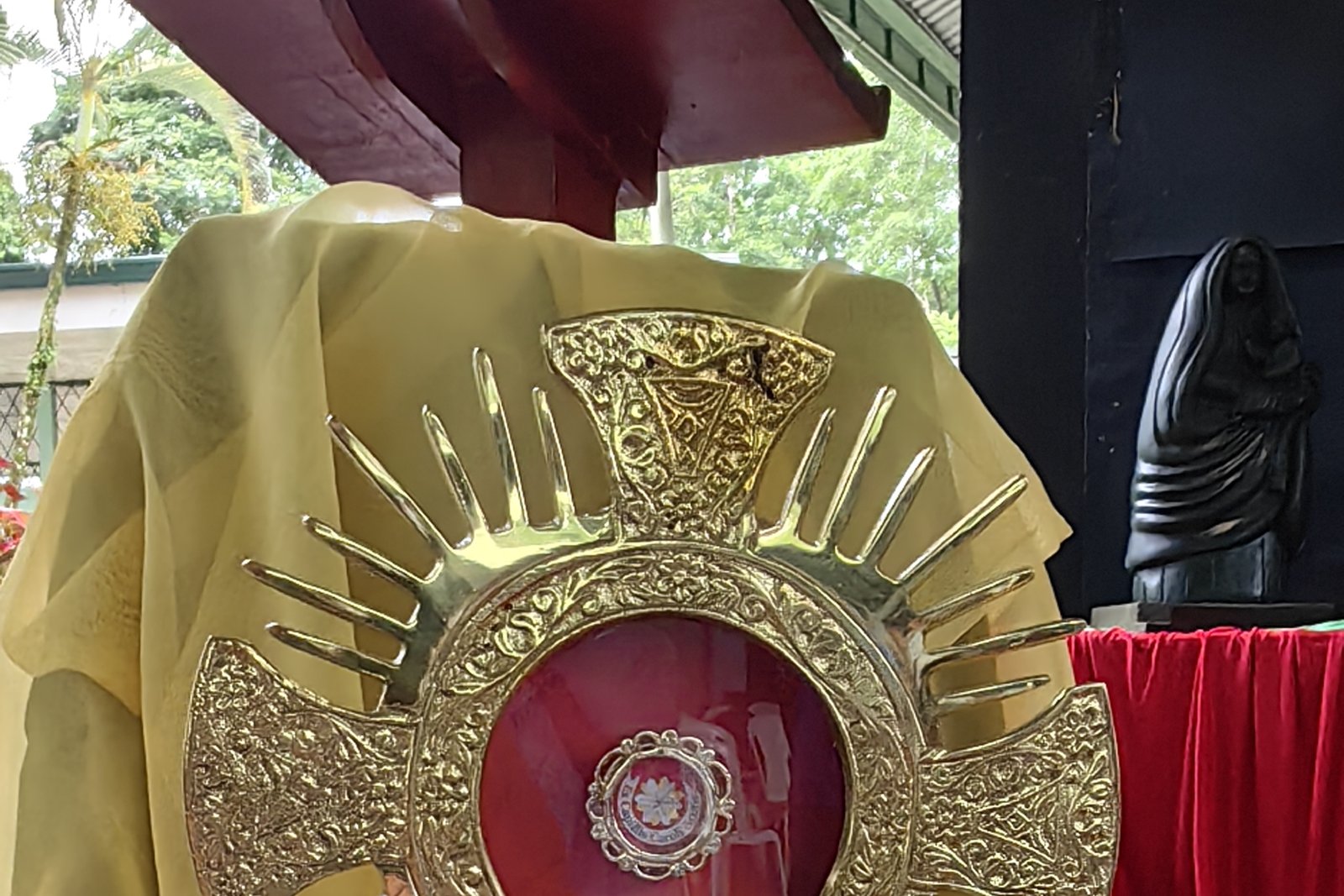
The Corporal of Bolsena: The Relic Behind Corpus Christi

A doubting priest on the road to Rome
The story, as it has been told for more than seven centuries, begins with an ordinary problem: a priest who no longer felt certain about the thing he was asked to believe every time he said Mass. Tradition names him Peter of Prague, a Bohemian priest making the long pilgrimage to Rome sometime around 1263. He is said to have carried with him a private, nagging doubt about transubstantiation — the Church's teaching that at the moment of consecration, the bread and wine of the Mass truly become the Body and Blood of Christ, even though their outward appearance doesn't change.
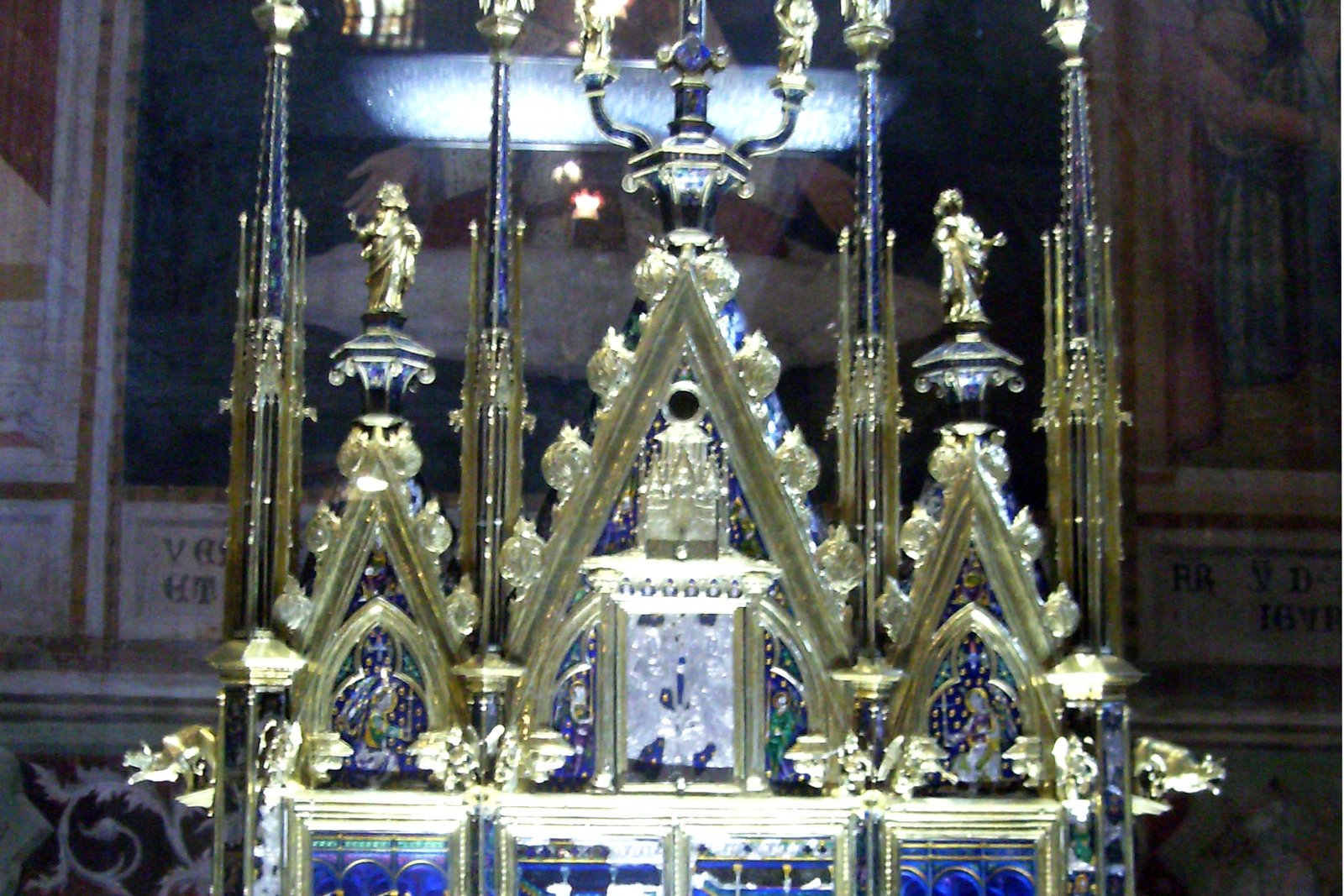
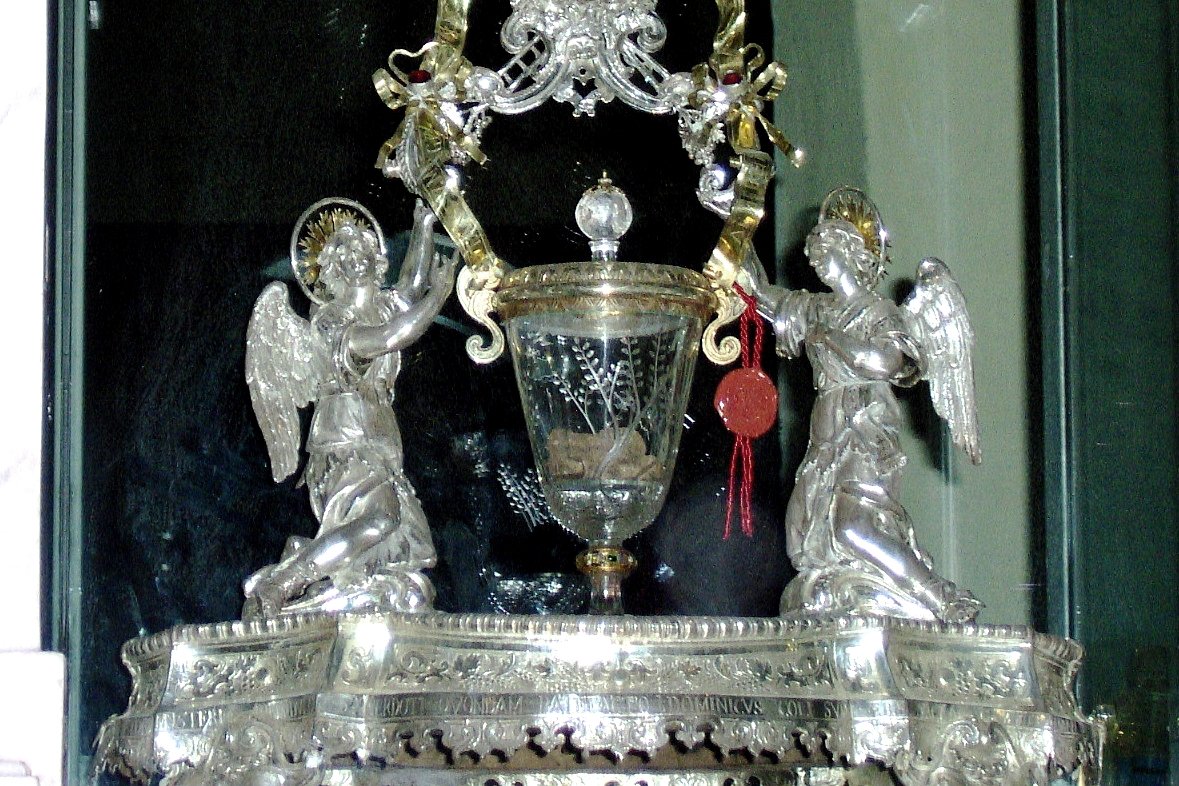
Photo by Abxbay, Orvieto Cathedral reliquary of the Corporal (2011). Public domain (CC0), via Wikimedia Commons.
Passing through the small lakeside town of Bolsena, in Umbria, Peter stopped to celebrate Mass at the altar of the church of Santa Cristina, built over the tomb of an early virgin martyr. According to the account that later took shape — the Catholic Encyclopedia notes it is first recorded on a marble slab in that same church, and in more detail on the enamel reliquary made decades afterward — Peter had barely finished speaking the words of consecration when blood began seeping from the host, staining the corporal, the small linen cloth spread beneath the chalice and host at every Mass. Shaken, he is said to have folded the cloth around the stained host and carried it the short distance to Orvieto, where Pope Urban IV was then in residence.
A pope's investigation, and a new feast
Urban IV was no stranger to Orvieto; the city served more than once as a papal refuge in the turbulent thirteenth century, and he was staying there when word of the event reached him. Tradition holds that the pope sent the Bishop of Orvieto to investigate, and that the bishop returned with the corporal and the relic was received with solemn ceremony into the city.
What happened next is historically certain, even if the miracle that supposedly caused it is not: on August 11, 1264, Urban IV issued the papal bull Transiturus de hoc mundo, establishing the feast of Corpus Christi — the solemn celebration of the Real Presence of Christ in the Eucharist — for the entire Latin Church. Devotion to the Eucharist already existed, including a more local feast promoted earlier by the Belgian nun Juliana of Liège, but Urban's bull was the first to extend a universal feast dedicated specifically to the Blessed Sacrament.
Here the story requires an honest caveat the skill guiding this article insists on: the Catholic Encyclopedia's own article on Orvieto states plainly that "the Miracle of Bolsena is not supported by strong historical evidence." Urban's bull never mentions it, and neither do two contemporaneous biographies of the pope — one of them, by Thierricus Vallicoloris, describes the pope's time at Orvieto and the founding of Corpus Christi in detail without a single reference to a bleeding host. The earliest clear record of the Bolsena story is the inscription in the church of Santa Cristina, which the Encyclopedia dates after Thomas Aquinas's 1328 canonization — more than sixty years after the events it describes. In other words: the miracle and the feast are inseparable in popular memory and in the art and architecture built to commemorate them, but historians cannot show that the miracle, as later told, actually caused the pope to act. What's certain is the feast itself, and the corporal's veneration as an object connected to it ever since.
Thomas Aquinas and the hymns of Corpus Christi
Whatever prompted Urban IV's bull, he turned to the greatest theologian of his age to give the new feast its words. Thomas Aquinas, already renowned for the Summa Theologiae, was commissioned to compose the liturgical texts for Corpus Christi — the prayers, readings, and hymns that would shape how the feast was celebrated across the Latin Church. Tradition credits Aquinas with several hymns still sung today, among them Pange Lingua Gloriosi and its final two verses, Tantum Ergo Sacramentum, which remain a fixture of Eucharistic adoration in Catholic parishes worldwide. The pairing of a scholastic philosopher's precision with devotional poetry is itself part of why Corpus Christi became one of the most theologically dense feasts on the calendar — a celebration built, quite literally, by the Church's leading expert on what the Eucharist actually is.
A cathedral built to hold a cloth
Perhaps the clearest sign of how seriously Orvieto took its relic is the building raised to house it. Construction of the Cathedral of Orvieto began in 1285 — within a generation of the reported miracle — specifically, according to local tradition recorded by the Catholic Encyclopedia, to provide a worthy home for the corporal. The result is one of the most celebrated Gothic churches in Italy, its striped marble nave and its facade of biblical reliefs and mosaics drawing visitors who may never have heard of the relic inside.
The corporal itself is kept in a dedicated side chapel, the Cappella del Corporale, in a large reliquary of silver and gold commissioned from the Sienese goldsmith Ugolino di Vieri and completed around 1337-1339. Its surface is covered in enamel panels narrating both the Passion of Christ and the Bolsena story — making the reliquary itself one of the oldest surviving pictorial records of the tradition, predating by decades any written account beyond the church inscription. The chapel's walls carry frescoes by Ugolino di Prete Ilario from the 1350s depicting the miracle in detail.
Orvieto's other great chapel, dedicated to the Virgin and known as the Cappella Nuova or Cappella di San Brizio, holds an entirely different but equally famous set of frescoes: Fra Angelico began work there in 1447, and Luca Signorelli completed the cycle decades later with his dramatic scenes of the Last Judgment, the damned, and the Resurrection of the Dead — paintings art historians have long linked to Michelangelo's own approach to the Sistine Chapel ceiling. The two chapels, one built around a relic and one around an apocalyptic vision, make Orvieto Cathedral a single building holding two of the most intense devotional art programs of the late Middle Ages and Renaissance.
The procession that still happens every year
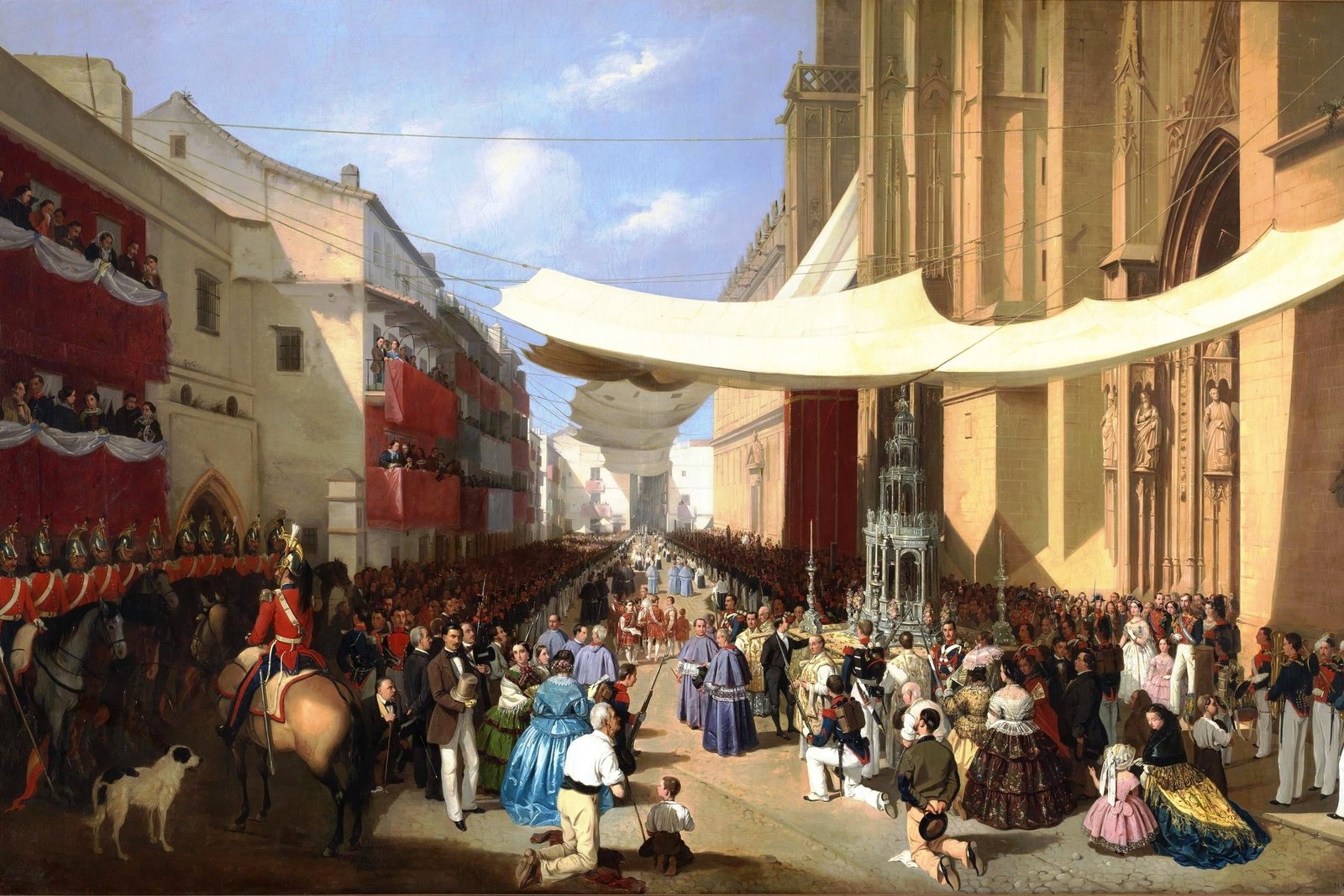
The connection between relic and feast has never been merely historical. Orvieto still carries the Corporal of Bolsena through its streets every year on the feast of Corpus Christi, in a procession that draws pilgrims and visitors from well beyond Umbria, following a devotional pattern repeated in cities across the Catholic world on the same feast — and reflecting the Church's broader, longstanding encouragement of venerating relics as an aid to faith, not as objects of certainty about their own material history (Catechism of the Catholic Church, no. 1674).
That last distinction matters here more than with most relics. The Church has never required belief in the Bolsena miracle as a condition of faith, and it doesn't need to: the doctrine the feast celebrates — that Christ is truly present in the Eucharist — rests on Scripture and centuries of theological teaching that predate 1263 by more than a millennium, going back to Christ's own words in the Gospel of John: "I am the living bread that came down from heaven; whoever eats this bread will live forever" (John 6:51, NABRE). Whether or not a doubting priest's host actually bled onto a piece of linen in a small Umbrian town, the corporal that bears his name has spent over seven hundred years pointing toward that older, larger claim — which is, in the end, the only thing the pilgrims filing past the reliquary each June are really there to see.
Trivia
What is the Corporal of Bolsena?
Who was Peter of Prague?
Did Pope Urban IV institute the feast of Corpus Christi because of this miracle?
Why was Thomas Aquinas involved?
Can anyone see the Corporal of Bolsena today?
Related Reading