The History of the Monstrance: From Simple Pyx to Golden Sunburst

A vessel built to answer a doubt
The story usually told about the monstrance's origin doesn't start in a goldsmith's workshop — it starts with a crisis of conscience. According to a tradition recounted by sources like the National Catholic Register, a priest traveling toward Rome in 1263 stopped in the town of Bolsena, on the shore of a lake in central Italy, still unsettled by doubts about whether the bread he consecrated at Mass truly became the Body of Christ. While celebrating Mass there, the host is said to have begun to bleed, staining the altar linen. The linen — known today as the Corporal of Bolsena — was carried to nearby Orvieto, where Pope Urban IV happened to be in residence, and a cathedral was eventually built there specifically to house it. (The relic itself, and the fuller legend surrounding it, is covered in more depth in our article on the Corporal of Bolsena-Orvieto.)
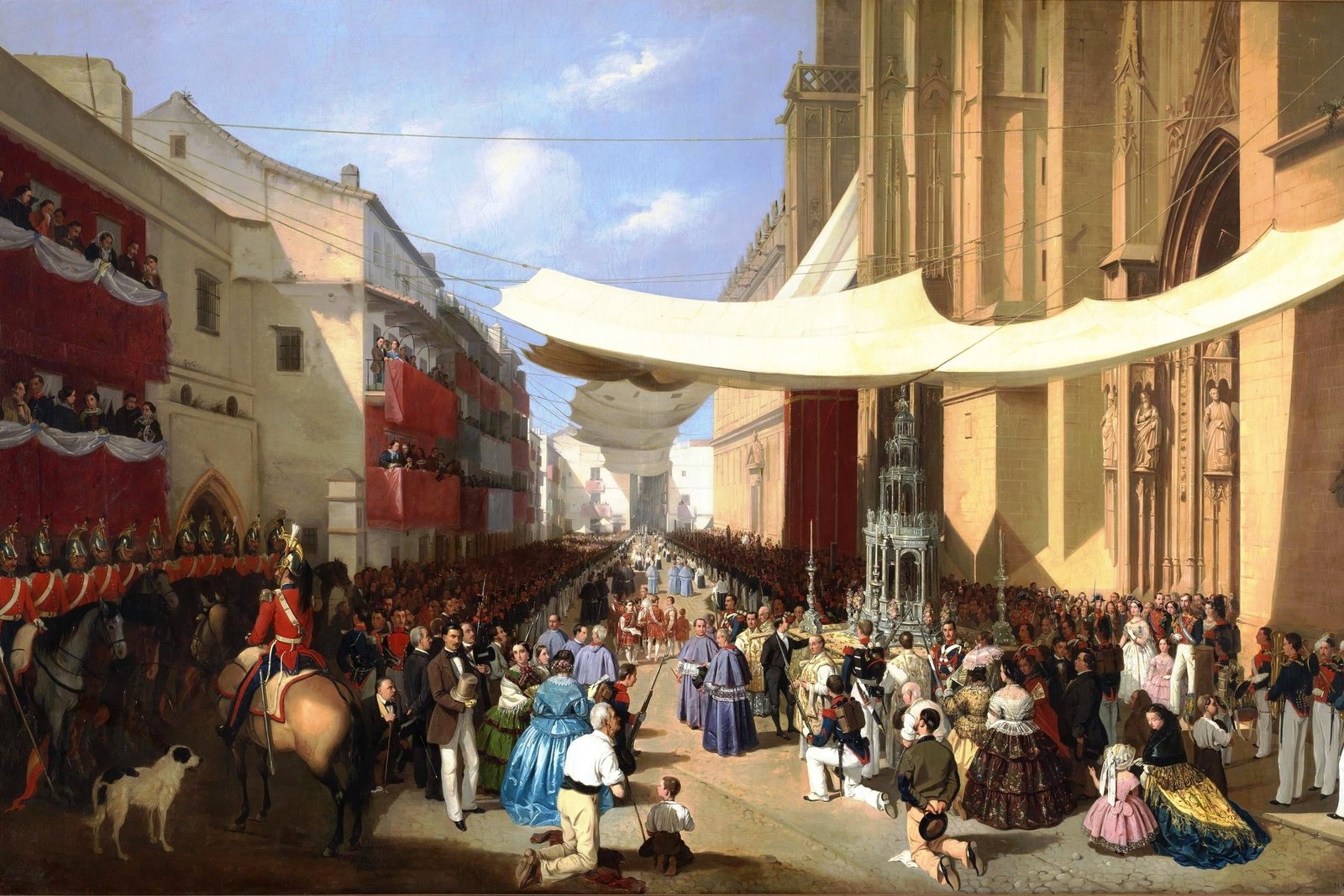
Manuel Cabral y Aguado Bejarano, The Corpus Christi Procession in Seville (1857), Museo del Prado. Public domain, via Wikimedia Commons.
Whatever role that particular event played, the documented historical fact is that Urban IV, within a year of the alleged miracle, issued the bull Transiturus de hoc mundo in 1264, establishing the feast of Corpus Christi — the Feast of the Body of Christ — for the whole Latin Church. He was acting on a cause that had already been pressed on him for years by Saint Juliana of Mont Cornillon, a nun near Liège in modern Belgium who had long campaigned for a feast dedicated specifically to the Eucharist, reportedly after a recurring vision of the Church as a full moon with one dark spot — the missing feast. Urban had known Juliana's cause personally; before his election as pope, he had served as Archdeacon of Liège, where her campaign began. He commissioned Saint Thomas Aquinas to compose the liturgical texts for the new feast, texts still used in the Mass and Office of Corpus Christi today.
A feast built around processing with the Eucharist through city streets created a very practical problem: how do you carry the host so that it is both protected and visible? That question is what the monstrance was invented to answer.
From reliquary shapes to the radiant sunburst
Before any vessel existed specifically for this purpose, churches adapted what they already had. The Catholic Encyclopedia's entry on the subject explains that the ciborium — the covered cup normally used to store hosts for Communion — was sometimes modified for processions by extending its sides with a cylinder of crystal or glass, letting the host be seen without being removed from its container. For a time, a single vessel could serve both for distributing Communion and for carrying the host visibly.
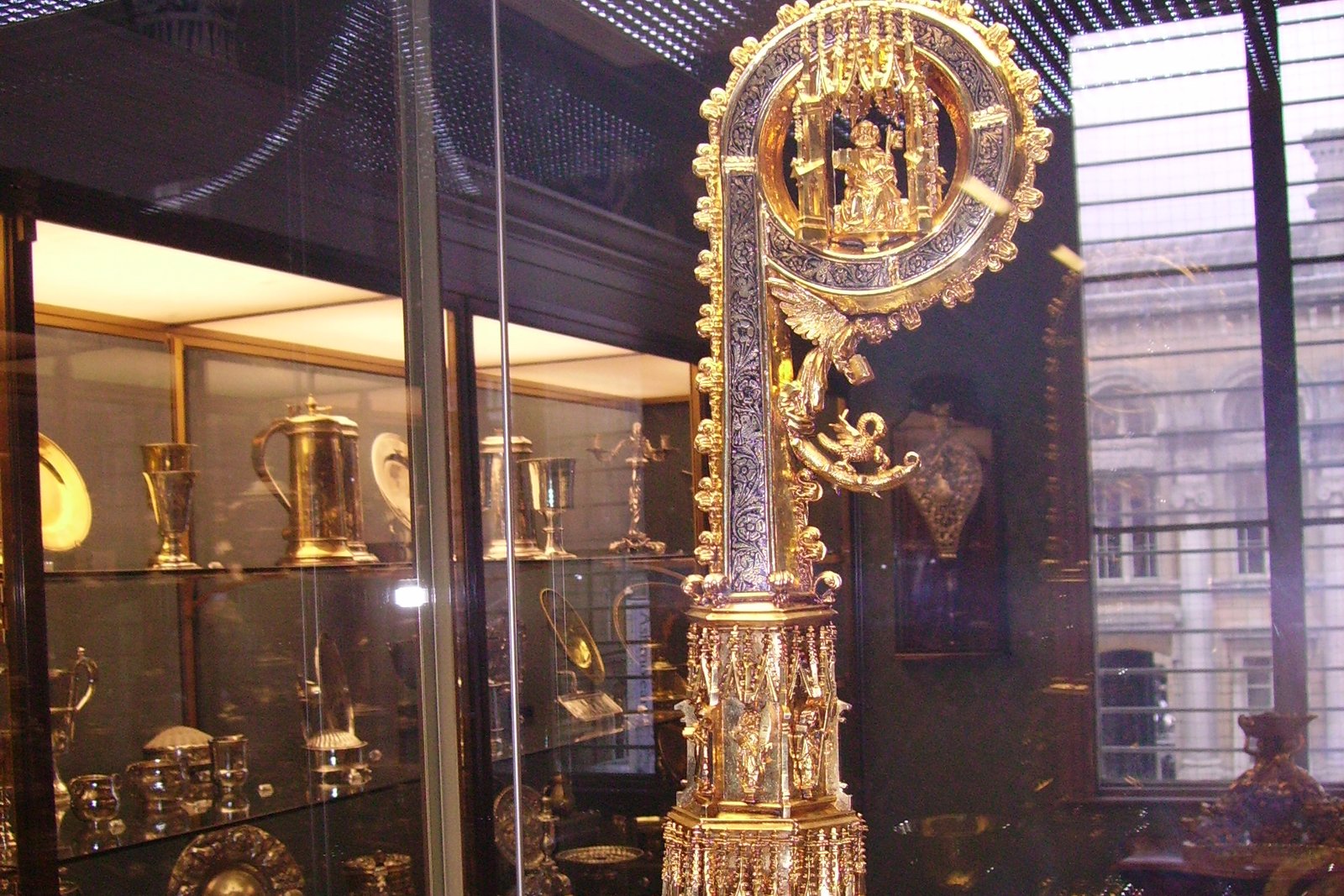
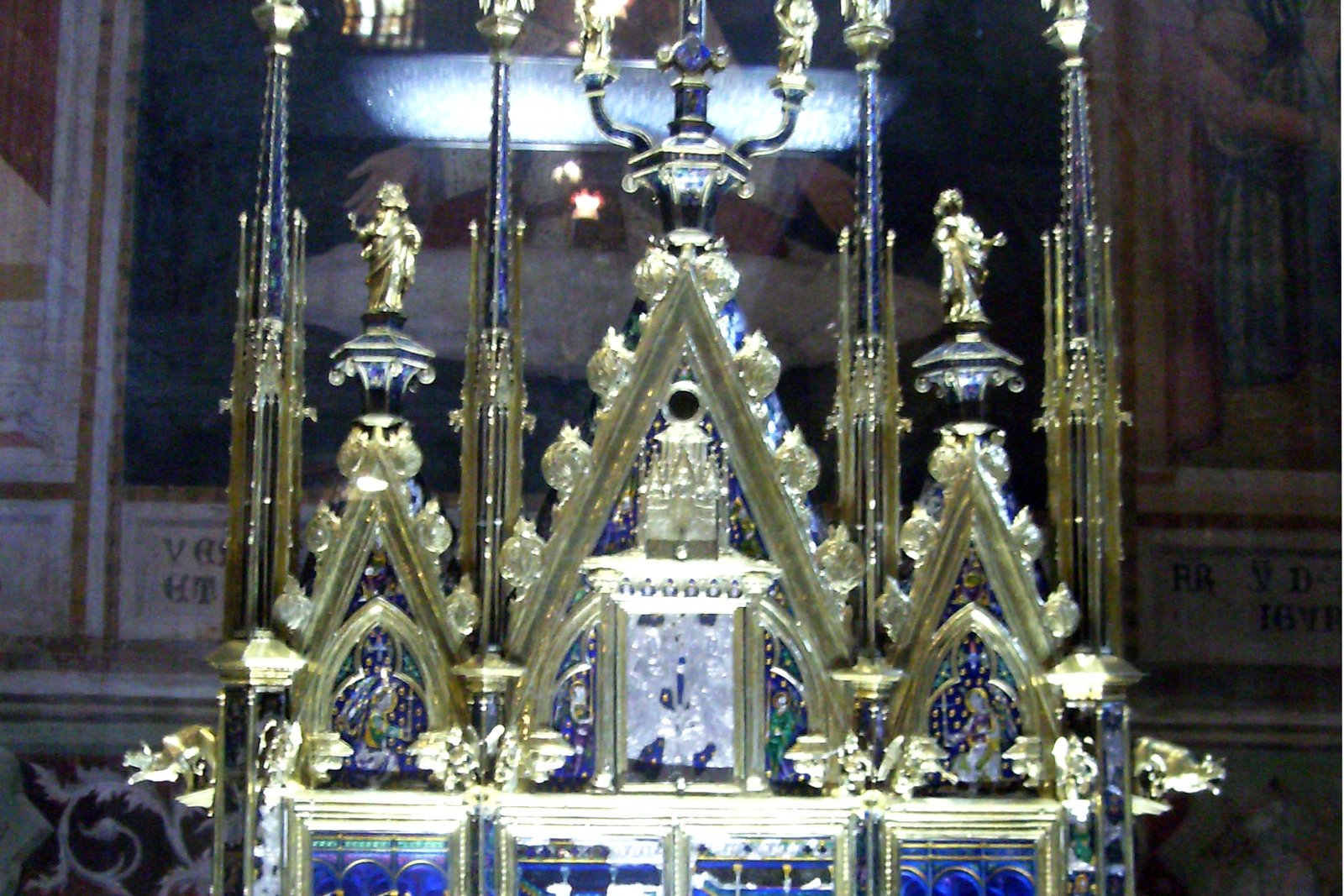
As the practice of formally exposing the Blessed Sacrament for adoration spread through the thirteenth century, a vessel built for that purpose alone became worth the investment. Early monstrances kept the upright cylindrical shape, often raised on a base with architectural details — small towers, niches, and statues, not unlike a miniature Gothic cathedral — with the host held upright inside a metal clip called a lunette. One of the oldest surviving examples the Catholic Encyclopedia points to is an octagonal monstrance from Bari, inscribed with the words "Hic Corpus Domini" ("Here is the Body of the Lord"), which may date to the thirteenth century itself. By the fifteenth century, monstrances had become a standard fixture in the inventories of larger churches across Europe, whereas they're essentially absent from thirteenth-century church records.
The design that eventually became standard — and the one most people picture today — emerged once churches realized the vessel could do more than simply hold the host steady: it could also direct the viewer's attention toward it. Goldsmiths began surrounding the central glass compartment with radiating metal rays, like a sun, so that wherever a worshiper's eye landed, it was led back to the center. The Catholic Encyclopedia dates this sunburst form to the fifteenth century, and notes it has remained, "for several hundred years," the most common style in practical use. The symbolism was not subtle, and it didn't need to be: Christ describes himself in the Gospel of John as "the light of the world" (John 8:12), and a monstrance built as a golden sun made that identification visible at a glance, even to someone who couldn't read a word of Latin.
Spain's outsized ambitions
If the sunburst shape became the rule, Spain became famous for breaking its scale. Starting in the sixteenth century, Spanish cathedrals and goldsmiths began commissioning ostensoria of a size nobody had previously attempted — six, seven, even eight feet tall, weighing hundreds of pounds, built less like a portable vessel than a piece of architecture in miniature.
The most celebrated example is the Great Monstrance of Toledo Cathedral, begun by the German-born goldsmith Enrique de Arfe in 1517 at the commission of Cardinal Cisneros and finished only after further work by his son and grandson, themselves goldsmiths. Standing more than ten feet tall and covered in gold and silver, it carries roughly 260 statuettes depicting scenes from the life of Christ, arranged across tier upon tier of Gothic tabernacle work — according to a tradition recorded by multiple sources, one of its largest gold elements was said to incorporate gold Columbus brought back from the New World, though that detail is a long-repeated claim rather than a documented metallurgical fact. Because a piece this large and heavy couldn't practically be used for everyday exposition, its inner housing — the part that actually touches and displays the host — was built to detach from the towering outer frame, so the same Eucharist could be shown simply for routine adoration and then mounted inside the full monument for the grand Corpus Christi procession through Toledo's streets each year.
Seville followed a similar pattern. The monstrance made in 1587 by the sculptor and silversmith Juan de Arfe — a descendant of the same Arfe family responsible for Toledo's — is still carried through Seville's streets every Corpus Christi, a scene captured in more than one nineteenth-century Spanish painting, including the elaborate 1857 canvas by Manuel Cabral y Aguado Bejarano shown at the top of this article: a monstrance tower rising above a crowded procession route shaded by awnings stretched between the balconies of the cathedral quarter.
How the monstrance is used today
Outside of the annual spectacle of a Corpus Christi procession, the monstrance's more common role today is quieter. In Eucharistic adoration, a host is placed in a monstrance and set on or near the altar so that the faithful can come, kneel, and pray in its presence for an extended period — anywhere from a few minutes to, in the case of continuous "perpetual adoration" programs now maintained in many parishes, around the clock. Benediction of the Blessed Sacrament follows a related but distinct pattern: after a period of exposition, a priest or deacon raises the monstrance and traces the sign of the cross over the congregation, imparting a blessing with the Eucharist itself before the host is returned to the tabernacle, the cabinet where it is normally reserved.
The theological reasoning behind all of this — why Catholics kneel before a disc of bread displayed in a golden frame — rests on the doctrine of the Real Presence: the belief that after consecration at Mass, the bread and wine genuinely become the Body and Blood of Christ, not merely a symbol of them. The Catechism of the Catholic Church states plainly that "the Catholic Church has always offered and still offers to the sacrament of the Eucharist the cult of adoration, not only during Mass, but also outside of it, reserving the consecrated hosts with the utmost care, exposing them to the solemn veneration of the faithful, and carrying them in procession" (CCC 1378). Under that belief, the monstrance isn't decorative excess for its own sake — it's a frame built, quite literally, to let people look directly at what they understand to be God.
A vessel, not a relic
It's worth being precise about what the monstrance itself is, as distinct from what it holds. The vessel is not a relic in the way a fragment of the True Cross or a martyr's bone is a relic — it has no claimed physical connection to a biblical event. Its value is entirely functional and symbolic: a well-made monstrance exists to serve the Eucharist, not to be venerated in its own right, however elaborate the goldsmith's work inside it became over the centuries. That distinction is part of why monstrances were, and still are, commissioned anew in every era and every regional style — Gothic tabernacle towers in Toledo, Baroque sunbursts in Rome and Vienna, simpler modern designs in many parishes today — without any sense that an older design was somehow more "authentic." What stays constant across eight centuries of goldsmiths' work is the purpose: building a frame bright enough, and clear enough, to hold a small piece of bread in full view of a whole church.
Trivia
What is a monstrance used for?
Why is a monstrance usually shaped like a sunburst?
When was the monstrance invented?
What is the connection between the monstrance and the feast of Corpus Christi?
What is the largest or most famous historic monstrance?
Related Reading