The Miraculous Medal: Catherine Labouré's Vision and Its Meaning

A novice wakes to a child at her bedside
On the night of July 18, 1830, a twenty-four-year-old novice named Catherine Labouré was woken in her dormitory at the motherhouse of the Daughters of Charity on the Rue du Bac in Paris by a child's voice calling her to the chapel. She later said she followed the child — whom she took to be her guardian angel — down candle-lit corridors to find the chapel ablaze with light, as if for midnight Mass. There, she reported, the Virgin Mary sat and spoke with her for hours, telling her that "times were evil" and that sorrows would come upon France and the world, while also entrusting her with a mission whose shape would not become clear until later that same year.
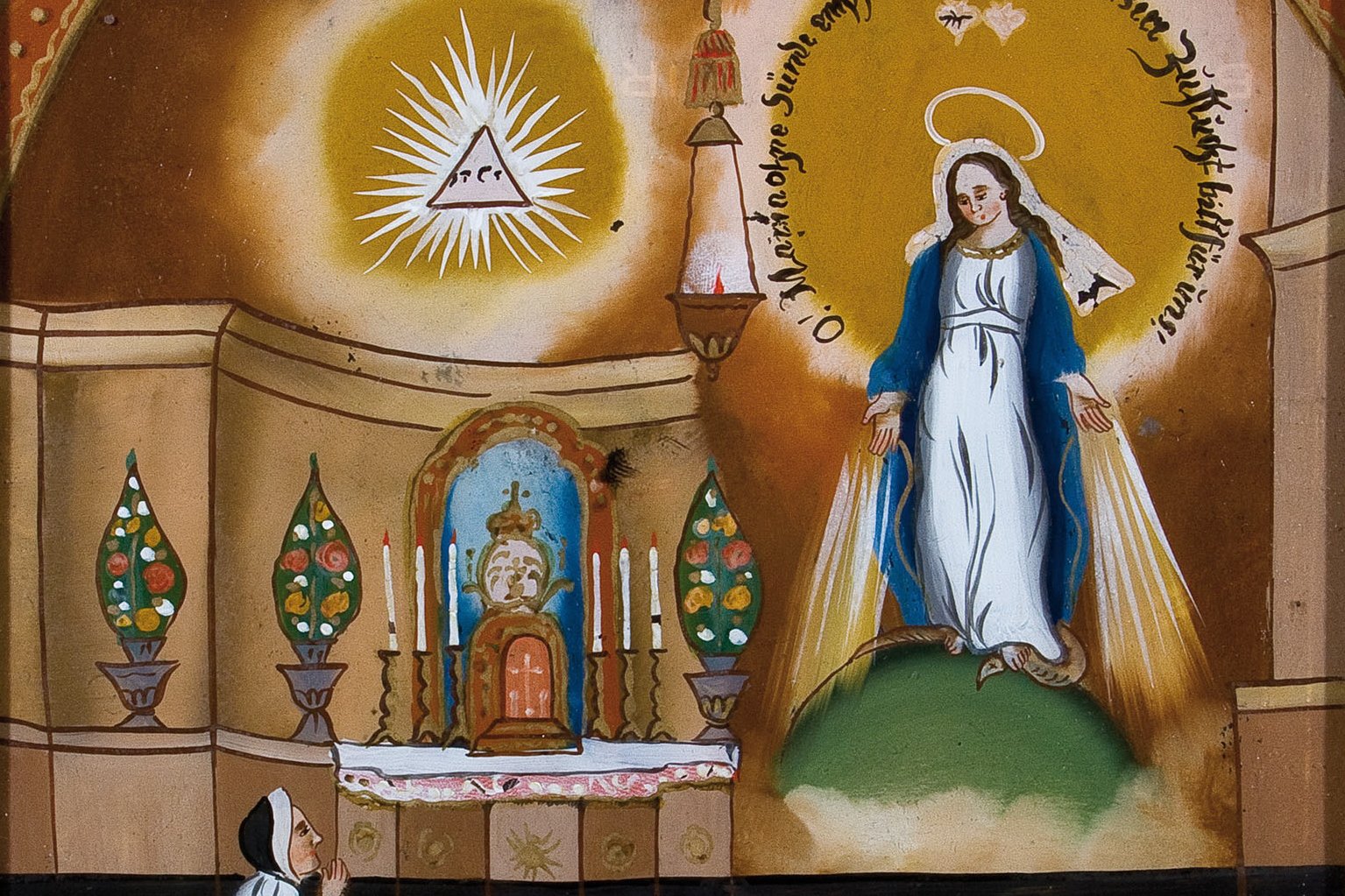
Alois Gege (1795-1864), Der Erscheinung S. Mariä zu Paris 1830 (Hinterglasbild), mid-19th century. Public domain, via Wikimedia Commons.
The apparition that mattered most for what came after happened four months later, on November 27, 1830. Catherine said Mary appeared to her standing on a white globe, dressed in white and blue, with rings on her fingers from which streams of light poured down toward the globe at her feet — except, she noticed, from some of the rings no light came at all. When she asked why, she was told, according to her own account, that those were the graces people forgot to ask for. Framing the whole image, an oval of golden letters spelled out a short prayer, and Mary's instruction, as Catherine recorded it, was direct: have a medal struck exactly as she had seen it, and "all who wear it will receive great graces."
What the medal actually shows
The front of the medal — the side most people recognize instantly — reproduces that vision closely: Mary standing on a globe, her feet crushing a serpent, hands open and radiating light downward, encircled by the words "O Mary, conceived without sin, pray for us who have recourse to thee." The serpent under her feet echoes the Genesis image of the woman whose offspring would strike at the serpent's head (Genesis 3:15), a connection long drawn by Catholic tradition between Mary and that promise.
The reverse carries a denser cluster of symbols: a capital M, with a bar and small cross rising from its crossbar, and beneath it two hearts side by side — one wrapped in a crown of thorns, representing the heart of Jesus, and one pierced through by a sword, representing the sorrowing heart of Mary. Around the entire design run twelve stars, generally read as a reference to the twelve apostles, and by extension to the whole Church gathered around Christ and his mother. None of this was invented by a later designer working from vague notes — Catherine insisted, across years of supervised interviews with her confessor, that the medal's artist reproduce the vision precisely, down to the placement of the stars.
From a parish workshop to a Paris sensation
Catherine's confessor, Father Jean-Marie Aladel, was cautious for nearly two years before bringing the request to the Archbishop of Paris, who approved it. The first medals were struck in June 1832 by a Parisian goldsmith, and Catherine herself reportedly examined the earliest cast to confirm it matched what she had seen.
What happened next was not engineered by anyone — it simply spread. Catholics in Paris and then across France began attributing a wave of healings, conversions, and smaller favors to the medal within just a few years of its distribution, and by the mid-1830s it had already picked up the popular nickname that stuck for good: the Miraculous Medal. Millions of copies were produced within Catherine's own lifetime, making it, by some estimates, among the most widely distributed religious objects ever made — remarkable given that the visionary herself asked to remain anonymous and did so successfully for forty-six years, only revealing her identity to her own superior shortly before her death in 1876. She was canonized by Pope Pius XII on July 27, 1947.
The conversion that made the name famous
Of all the stories attached to the medal, one in particular cemented its reputation internationally. In January 1842, Alphonse Ratisbonne — a young Frenchman from a wealthy Jewish banking family, visiting Rome and openly hostile to the Catholic faith of relatives who had converted before him — was challenged by an acquaintance, Baron Théodore de Bussières, to wear a Miraculous Medal and recite a short Marian prayer called the Memorare, half as a joke and half as a dare. Ratisbonne agreed, he later said, purely to prove the whole thing was nonsense.
On January 20, 1842, while waiting inside the church of Sant'Andrea delle Fratte in Rome for an errand unrelated to any of this, Ratisbonne reported an overwhelming vision of the Virgin Mary bathed in light. He emerged from the church transformed, asked for baptism, and was received into the Catholic Church that same year, investigated and approved through a formal canonical inquiry ordered by Pope Gregory XVI. Ratisbonne went on to become a Catholic priest and co-founded a religious congregation; his sudden, dramatic turnaround did more than any pamphlet to carry the medal's reputation for the miraculous far beyond Paris.
The medal and the dogma of 1854
There is a detail in the medal's own inscription that Catholics have long found striking: the words "conceived without sin" were circulating by the millions on a small oval of stamped metal nearly a quarter-century before Pope Pius IX formally defined the Immaculate Conception — the teaching that Mary was preserved free from original sin from the first moment of her existence — as dogma, in the December 8, 1854 bull Ineffabilis Deus. The medal did not create that belief; devotion to Mary's sinless conception has deep roots stretching back centuries earlier in the Church's piety, as the Catholic Encyclopedia's own history of the doctrine traces. What the medal's sudden, massive popularity did was put that specific wording into ordinary Catholic hands and mouths at exactly the moment the question of a formal definition was gathering momentum in Rome — a devotional current many historians and churchmen alike have noted as significant, without claiming the apparition itself was the dogma's formal source.
A medal still worn today
Nearly two centuries after a frightened novice watched light pour from a woman's open hands in a Paris chapel, the Miraculous Medal remains one of the most commonly worn religious items among Catholics worldwide — pinned to lapels, hung from rearview mirrors, sewn into the linings of coats, slipped onto newborns and the dying alike. Its shrine still stands at 140 Rue du Bac, where Catherine Labouré's body lies incorrupt beneath glass, visited by a steady stream of pilgrims who come to see, in person, the chapel where the vision is said to have begun. For a devotion that started with one young woman's quiet, repeatedly doubted testimony, it has had an outsized and enduring reach.
Trivia
Who was Catherine Labouré, and what did she see?
What is the prayer written on the Miraculous Medal?
What do the symbols on the back of the medal mean?
Why is it called the 'Miraculous' Medal?
Is the Miraculous Medal connected to the dogma of the Immaculate Conception?
Related Reading