The Relics of Saint Teresa of Avila: A Body Divided Across Europe

A reformer whose body outlived her reputation for simplicity
Teresa of Avila died in 1582 at Alba de Tormes, in the Spanish province of Salamanca, a few years after a long and demanding career spent founding Discalced Carmelite convents across Castile and reforming an order she believed had grown too comfortable. (Read her fuller story in our article on Saint Teresa of Avila.) She is remembered today as one of the great mystics of the Catholic tradition and, since 1970, as a Doctor of the Church — the first woman ever given that title. What's less often told is what happened to her body after death, because almost nothing about it followed an ordinary path.
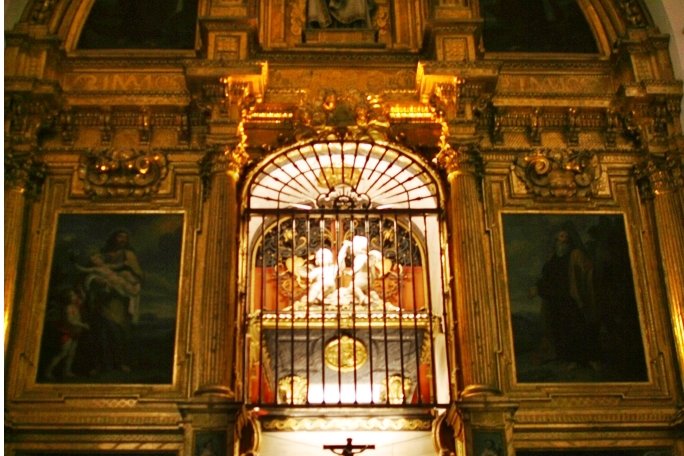
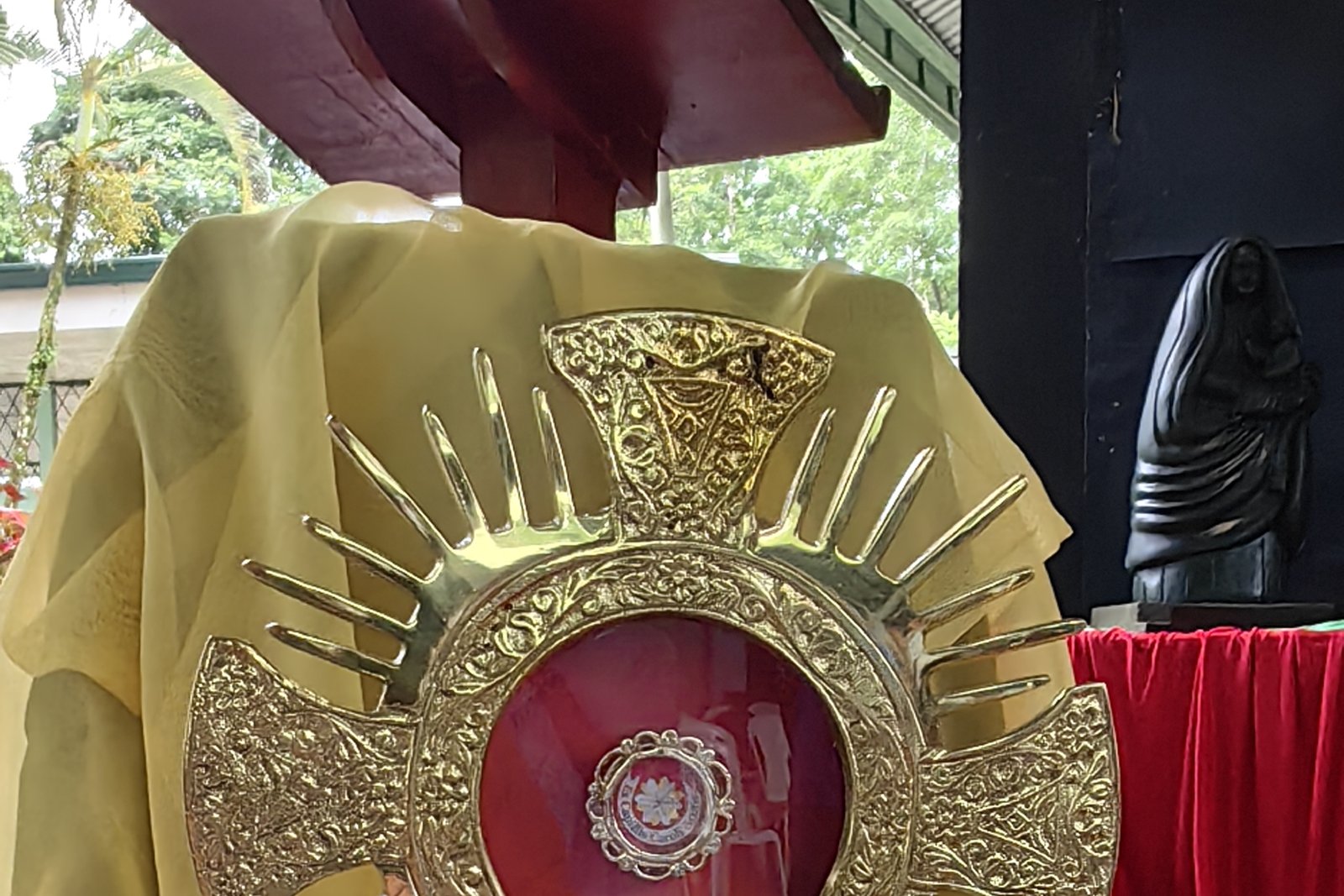
Photo by Bocachete, reliquary shrine of Saint Teresa of Jesus, Alba de Tormes. CC BY-SA 3.0, via Wikimedia Commons.
Within less than a year of her burial, the nuns at Alba de Tormes secretly reopened her tomb — reportedly out of a desire to move the body to a more fitting resting place and a concern that it might be taken elsewhere entirely, a real anxiety given how aggressively religious communities of the era competed for celebrated remains. What they found, according to the tradition recorded by the Discalced Carmelites, was a body still remarkably intact. That report set off a chain of exhumations, inspections, and divisions that would continue, on and off, for centuries.
A heart, an arm, and a body kept together — mostly
Most of what survives of Teresa today is still at Alba de Tormes: her body, her heart, and one of her arms are kept together at the Carmelite convent there, in the ornate reliquary shrine built to house them behind an iron grille in the convent church. In May 2025, a rare public exposition of these remains drew tens of thousands of pilgrims over two weeks, according to contemporary news coverage — a measure of how much devotion the relics still command more than four centuries after her death.
That "mostly" matters, though, because other parts of Teresa's body left Alba de Tormes long ago and never came back. One of her feet reportedly went to a convent in Rome. A hand went to Lisbon. And — in the detail that gives this saint's relic history its strangest modern twist — one of her hands ended up, for several decades of the twentieth century, in the hands of Francisco Franco.
The hand Franco kept
During the Spanish Civil War, militia forces took a hand relic of Teresa from the Discalced Carmelite nuns at Ronda, a town in the mountains above Málaga where it had been kept for generations. According to reporting on the relic's documented history, the hand was recovered from those militia forces by Nationalist troops and came into the possession of General Francisco Franco, who kept it near him — including, by most accounts, during his years ruling Spain as head of state — until his death in 1975. The relic was returned to the Ronda convent the following year, in 1976.
It's a detail worth stating plainly rather than softening: a mystic's hand, venerated for nearly four centuries as a sacred relic, spent decades as a personal possession of one of twentieth-century Europe's most consequential dictators. Historians and Church commentators alike have treated this as a documented, uncomfortable chapter in the relic's history rather than something to pass over quietly. As of recent reporting, the Ronda convent itself faces closure for lack of vocations, and the hand's long-term home is still being decided — with some speculation that it might eventually rejoin the rest of Teresa's remains at Alba de Tormes.
The mark on the heart
Among all of Teresa's scattered relics, the heart kept at Alba de Tormes draws the most devotional attention, and for a specific reason: tradition holds that it bears a visible mark, sometimes described as a fissure or wound, read by generations of the faithful as physical evidence of Teresa's own account of her "transverberation" — the mystical experience, described in her autobiography, of an angel piercing her heart with the tip of a fiery spear, leaving her overwhelmed at once by pain and by divine love. That same scene is what the sculptor Gian Lorenzo Bernini captured in Rome a century later in "The Ecstasy of Saint Teresa," now housed in the Cornaro Chapel of the church of Santa Maria della Vittoria — one of the most famous works of Baroque religious art, inspired directly by Teresa's own written description of the moment.
It is worth being careful, though, about what is actually being claimed here. The Church does not treat a physical mark on a preserved heart as proof, in any scientific or doctrinal sense, that a mystical event happened exactly as described. What the Catechism of the Catholic Church does affirm, in its section on popular piety (no. 1674), is that the veneration of relics is an approved and longstanding Catholic devotional practice — one that directs honor through the physical object toward the saint and ultimately toward God, rather than treating the object itself as a verified miracle. The heart's mark belongs, in other words, to the realm of devotional tradition rather than settled fact, even for those who find it moving.
Why a saint's body ends up in pieces
To modern readers, the whole practice can sound unsettling — carving up a revered body and sending the pieces to different cities and patrons. In the religious culture of Counter-Reformation Spain, though, it reflected something closer to an honor than a violation: each fragment of a celebrated saint's body was believed to carry that saint's spiritual presence wherever it went, making even a small relic a genuine source of blessing for the convent, church, or noble household that received it. Teresa's extraordinary fame — as a reformer who had remade an entire religious order alongside Saint John of the Cross, and as a mystic whose writings would shape Catholic spirituality for centuries — made her remains especially desirable. Few 16th-century saints saw their bodies distributed quite as widely, or documented quite as thoroughly, as hers.
That documentation is itself part of why Teresa's relics remain a live subject rather than settled history. In August 2025, researchers working under Vatican-approved protocols examined her body, heart, arm, and the Ronda hand together at Alba de Tormes, studying the state of her remains and, by extension, the centuries of testimony about their condition. The results of that kind of study don't resolve questions of mystical experience — they were never meant to — but they do keep Teresa's relics, and the tangled history of how they were divided, firmly part of an ongoing conversation rather than a closed chapter.
A life, and an afterlife, both marked by division and reform
There's a kind of symmetry in all of this that's hard to miss. Teresa of Avila spent her active life dividing — reforming the Carmelite order into two branches, the stricter Discalced houses breaking from the older Calced tradition, founding convent after convent across Castile against real resistance. After her death, her body underwent its own kind of division, spreading her physical presence outward across Spain and Europe much as her reform had spread outward from a single convent in Ávila. Whether that parallel is more poetic than meaningful is a matter of taste. What isn't in question is that four and a half centuries later, pilgrims still travel to Alba de Tormes to stand before what remains of her — a presence the Church has never asked anyone to treat as proof of anything, only as an invitation to remember a woman whose writing on prayer still shapes how Catholics understand the interior life today.
Trivia
Where is most of Saint Teresa of Avila's body kept?
Is it true that Francisco Franco kept a relic of Saint Teresa?
What is the mark on Saint Teresa's heart relic?
Why was Teresa of Avila's body divided into so many relics?
Does the Catholic Church require belief in these relics' authenticity?
Related Reading