The Lamentation of Christ in Art

A scene the Gospels never quite describe
Search the Gospels for a verse-by-verse account of Mary and the disciples mourning over Christ's dead body, and you won't find one. What the Gospels actually narrate is comparatively brief: Joseph of Arimathea requesting the body from Pilate, Nicodemus bringing spices, the two men wrapping the body and placing it in a new tomb (John 19:38-42). The extended, emotionally saturated pause between the Deposition — taking Christ's body down from the cross — and that burial is largely a devotional invention, built up over centuries by artists, preachers, and writers of meditative texts who wanted a moment to simply sit with grief before the narrative moved on. That gap between what Scripture states plainly and what devotion imagines in the silence around it is exactly where the Lamentation as an artistic subject lives.
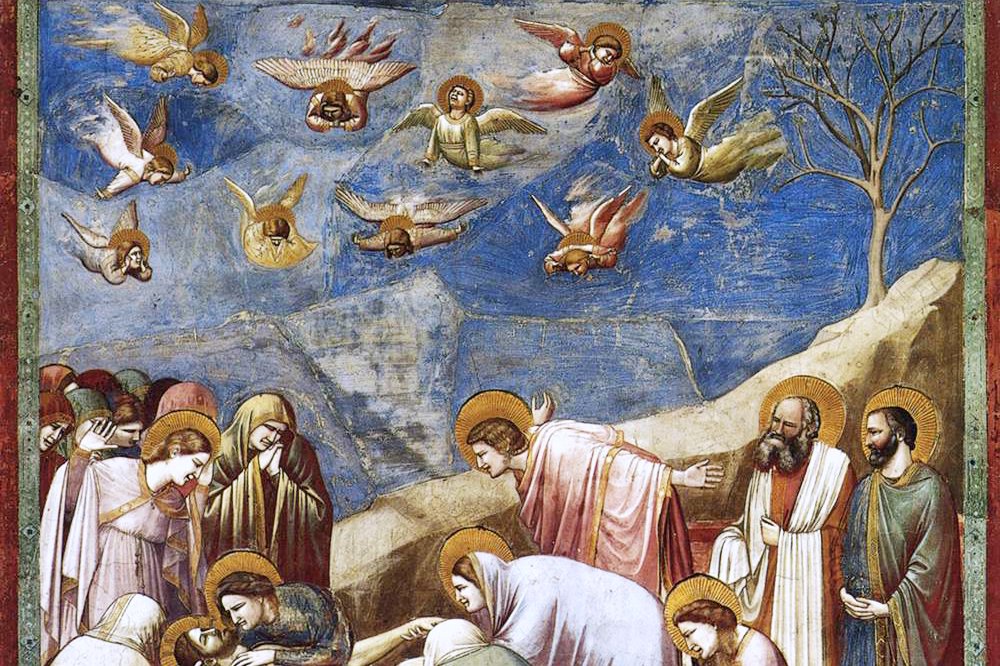
Giotto di Bondone, "Lamentation (The Mourning of Christ)," Scrovegni Chapel, Padua, c. 1304-1306 — public domain.
Giotto's version: grief made physical
No single treatment of the Lamentation shaped later art quite like Giotto di Bondone's, painted around 1304-1306 as part of his fresco cycle in the Scrovegni Chapel in Padua. Earlier medieval depictions of mourning tended toward stylized, symbolic gestures — figures with raised hands or bowed heads that signaled grief as a category rather than depicting it as a felt, physical state. Giotto broke from that convention decisively. His Mary presses her face directly against Christ's, cradling his head with an intimacy that reads as startlingly real for its era; John the Evangelist throws his arms backward in visible anguish; a swirl of small angels overhead twist and contort in the sky, each one registering sorrow through an individualized posture rather than a repeated, generic gesture. Contemporary viewers, accustomed to flatter Byzantine-influenced painting, would have found this rendering of grief unusually direct — bodies that seem to carry actual weight, faces that seem to actually suffer.
The Lamentation versus the Pietà
The Lamentation is often discussed alongside, and sometimes confused with, the Pietà, but the two are related rather than identical subjects. Michelangelo's Pietà narrows the scene to its most intimate possible form: Mary alone, cradling her son's body across her lap, with no other figures present. The Lamentation typically widens the frame considerably, gathering a fuller cast — Mary, John, Mary Magdalene, sometimes Joseph of Arimathea and Nicodemus, occasionally other mourning women — around the body, often set outdoors near the tomb rather than in an ambiguous, timeless space. Where the Pietà isolates a single, almost sculptural relationship between mother and son, the Lamentation stages a whole community's grief, which gave artists considerably more compositional freedom to stage complex arrangements of mourning figures, each reacting in their own way.
Later hands, the same pause
The subject's staying power across centuries is remarkable. Rogier van der Weyden, the great fifteenth-century Netherlandish painter, treated the theme with his characteristic sharp-edged emotional intensity, his mourners' faces etched with visible tears rendered in minute, almost sculptural detail — a technique that became something of a signature across his religious altarpieces generally. Sandro Botticelli painted at least two distinct Lamentation compositions late in his career, their compressed, almost claustrophobic groupings of mourners markedly different in mood from the airy grace of his earlier mythological work. Andrea Mantegna pushed the theme into unsettling territory with his Lamentation over the Dead Christ, using dramatic foreshortening to place the viewer almost at Christ's feet, staring directly down the length of his body — a composition so technically audacious it remains one of the most discussed single paintings in the entire Renaissance canon.
Why this scene, specifically, kept getting painted
Part of the Lamentation's enduring appeal to artists and patrons alike was practical: unlike the Crucifixion's violent action or the Resurrection's triumphant motion, the Lamentation is fundamentally still. Nothing is happening except grief itself, which made it ideally suited to small devotional panels meant for private prayer, altarpiece predella scenes, and meditative Good Friday imagery — a moment built for the viewer to pause alongside the mourners rather than simply observe a narrative event passing by. Theologically, it also gave artists a natural stage for exploring Mary's sorrow specifically, a theme the Church would eventually formalize into its own devotion, Our Lady of Sorrows, built around seven traditional moments of Mary's grief, several of which overlap directly with Lamentation imagery.
A theme without a single ending
Unlike a scene with one fixed, canonical composition, the Lamentation never settled into a standard formula the way, say, the Last Supper largely did after Leonardo. Each era, and often each individual artist, reinvented the grouping, the setting, and the emotional register — Giotto's raw physical anguish, Van der Weyden's controlled precision, Mantegna's unsettling intimacy, Botticelli's compressed sorrow. What stayed constant across seven centuries of reinvention was the underlying instinct that made the subject worth returning to again and again: that grief, held still for a moment before the story moves on, deserves to be looked at directly.
Trivia
Is the Lamentation of Christ a specific scene described in the Gospels?
What is the difference between the Lamentation and the Pietà?
Why is Giotto's Lamentation in the Scrovegni Chapel considered so influential?
Which other major artists painted the Lamentation of Christ?
Why did artists favor the Lamentation as a devotional subject?
Related Reading