Giotto's Scrovegni Chapel Frescoes

A penitent's chapel
The Scrovegni Chapel exists because of a family reputation problem. Enrico Scrovegni, a wealthy nobleman in Padua, built the small chapel around 1300 on land adjoining his family's palace, constructed atop the ruins of an ancient Roman arena, which is why the building is sometimes called the Arena Chapel. A long tradition, echoed by Dante Alighieri, who placed Enrico's father Reginaldo among the usurers in the seventh circle of the Inferno, holds that Enrico commissioned the chapel at least partly to atone for wealth his family had accumulated through lending money at interest — a practice the medieval Church treated as a serious sin. Whatever mix of piety, penance, and prestige motivated the commission, Enrico hired one of the most sought-after painters of his generation to fill every available surface with a single, continuous visual sermon.
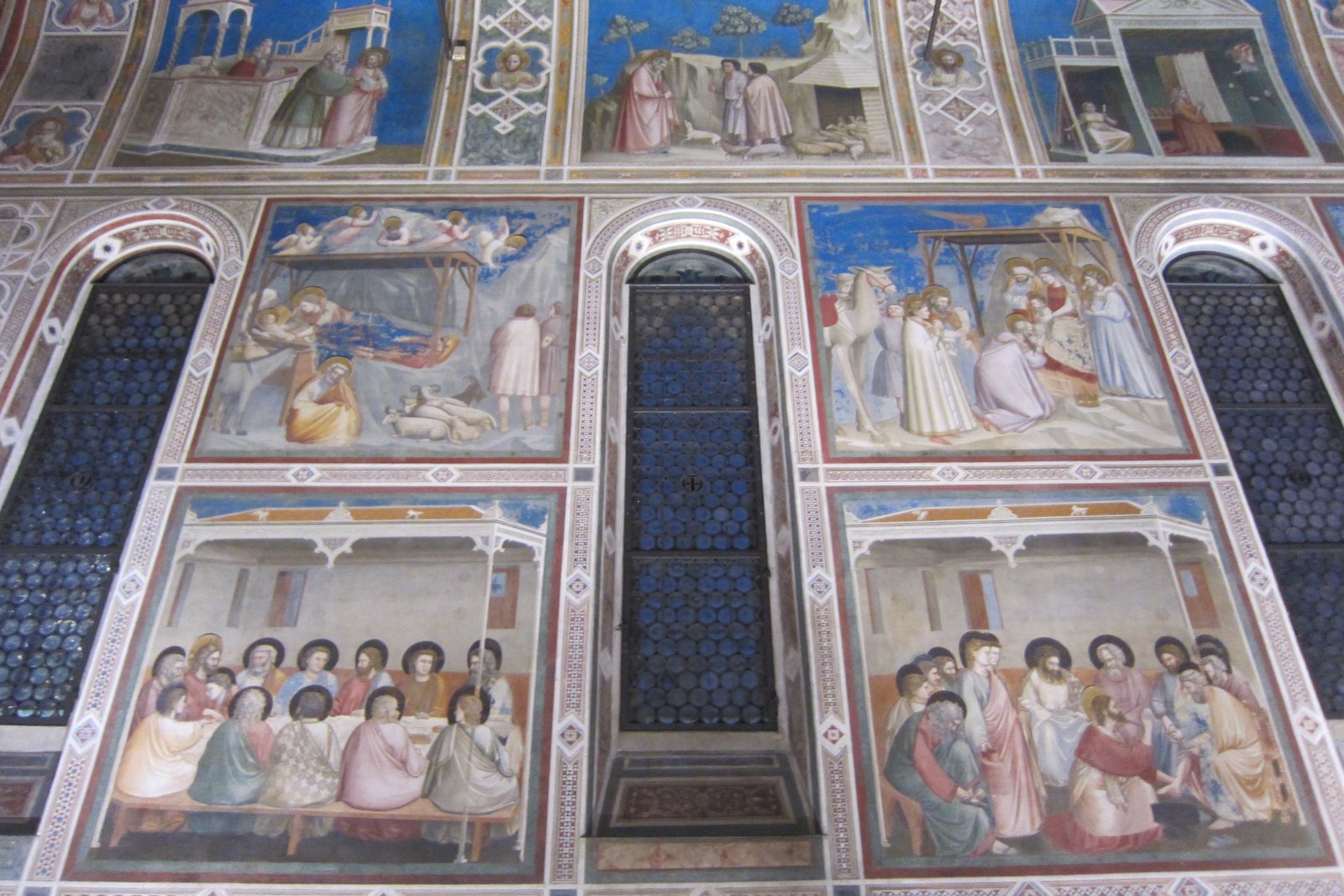
Interior of the Cappella degli Scrovegni, Padua, frescoed by Giotto di Bondone, 1303-1305. Photo by Derbrauni, CC BY-SA 4.0, via Wikimedia Commons.
The painter behind it
By around 1300, Giotto di Bondone was already an established name, though the Scrovegni Chapel would cement his reputation as the artist who changed the direction of Western painting. According to Giorgio Vasari's later, partly legendary account in Lives of the Artists, Giotto had trained under Cimabue, the leading Florentine painter of the previous generation, and gradually moved away from the flatter, more formal Byzantine-influenced style that had dominated Italian painting for centuries. What set Giotto apart, and what the Scrovegni frescoes demonstrate at full scale, was his instinct for weight, gesture, and physical presence — figures that occupy space convincingly, faces that register real emotional states, rather than symbolic, stylized expressions repeated across a composition.
Walking through the cycle
The chapel's interior is organized with remarkable clarity, unfolding almost like a filmstrip across three horizontal bands running around the side walls. The uppermost register tells the story of Joachim and Anne, Mary's parents according to apocryphal tradition rather than the canonical Gospels, followed by scenes from the life of the Virgin Mary herself, including her birth, presentation in the Temple, and betrothal to Joseph. The middle and lower bands shift to the life of Christ — the Annunciation, Nativity, Baptism, ministry, Passion, and Resurrection — arranged to be read left to right, top to bottom, much like a page of text. The entire western entrance wall is given over to a single monumental Last Judgment, positioned so that anyone leaving the chapel walks out beneath Christ enthroned in glory, flanked by scenes of the saved and the damned — a deliberate, sobering final image for a penitent patron's private chapel.
The Lamentation: grief made physical
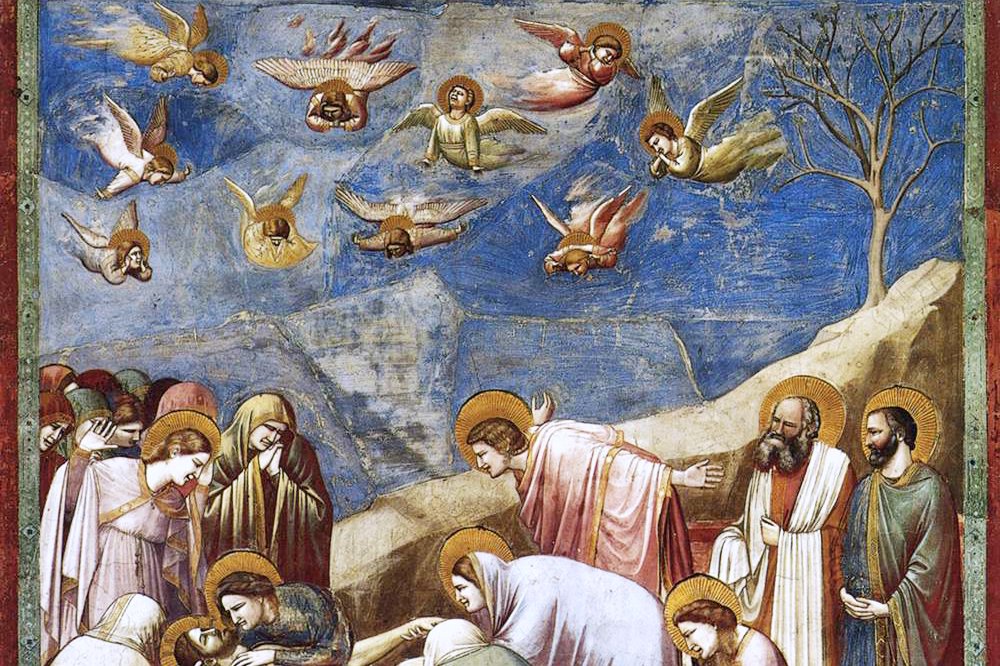
Among the individual scenes, art historians most consistently single out the Lamentation, sometimes called the Mourning of Christ, showing the dead body of Jesus surrounded by mourners after the Deposition from the cross. What makes the scene remarkable isn't dramatic invention — the subject was common in medieval art — but how Giotto handles grief itself. Mary cradles Christ's head with an intensity that reads as genuinely physical rather than ceremonial; John the Evangelist throws his arms back in visible anguish; overhead, a swirl of small angels twist and contort in the sky, each expressing sorrow through a distinct, individualized posture rather than repeated, generic gesture. This treatment of grief through bodies in space, rather than symbolic poses, became one of the most influential single images in the broader tradition of the Lamentation of Christ in art, a motif later artists across Europe would return to again and again, each finding their own way to capture what Giotto had already made unmistakably human.
Fresco technique and an astonishing pace
Painting the entire chapel in true fresco — pigment applied directly to wet plaster so it bonds permanently as the wall dries — imposed a demanding rhythm on Giotto and his workshop. Each section of plaster, called a giornata (Italian for "day's work"), had to be painted before it dried, meaning the whole cycle was built up literally day by day, patch by patch, with no possibility of significant revision once a section had set. Modern technical analysis of the chapel has identified several hundred individual giornate across its walls, and scholars estimate Giotto completed the entire commission in roughly two years — an extraordinarily fast pace given the sheer scale of the undertaking and the technical precision fresco demands.
Why art historians treat this chapel as a turning point
The Scrovegni Chapel is frequently cited as marking the beginning of a shift that would eventually lead into the Renaissance proper: painting that treats space as something bodies genuinely occupy, and emotion as something conveyed through physical gesture and facial expression rather than symbolic convention alone. Giotto's figures have volume; they cast implied weight; their grief, anger, tenderness, and wonder read as recognizably human states rather than iconographic labels. Later painters, from Masaccio to Michelangelo, would openly acknowledge Giotto's example as foundational to their own work.
Still standing, still fragile
More than seven centuries after Giotto finished, the Scrovegni Chapel remains in Padua, its frescoes remarkably intact given their age, though visits are now tightly regulated — visitors typically pass through a climate-controlled anteroom before a strictly timed entry, a precaution meant to protect plaster and pigment from humidity fluctuations that could undo what has survived seven hundred years largely untouched. For a chapel built, by tradition, out of one man's guilt over his family's wealth, it has become instead one of the most visited and studied monuments in the entire history of Western painting.
Trivia
Who commissioned the Scrovegni Chapel, and why?
What scenes does Giotto's fresco cycle depict?
Why is Giotto's Lamentation scene in the chapel considered especially important?
How long did it take Giotto to complete the Scrovegni Chapel frescoes?
Can visitors still see the Scrovegni Chapel frescoes today?
Related Reading