Our Lady of Częstochowa: The Black Madonna's Story

An icon older than the nation that claims it
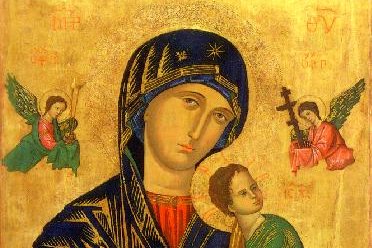
Long before Poland existed in anything like its modern form, an icon of Mary holding the Christ Child was already being venerated somewhere in the Byzantine world. Painted in the formal, symbolic style typical of Eastern icons — flat gold background, elongated features, mother and child gazing outward rather than at each other — the panel eventually made its way west, and by the late 14th century it had come into the hands of a Polish nobleman, Władysław, Duke of Opole. In 1382, he installed it at a newly founded monastery on a hill outside the city of Częstochowa, in what is now southern Poland, entrusting its care to Pauline monks brought over from Hungary. That monastery, Jasna Góra ("Bright Hill"), has held the icon ever since, and the title Our Lady of Częstochowa has grown up entirely around this single, much-traveled painting.
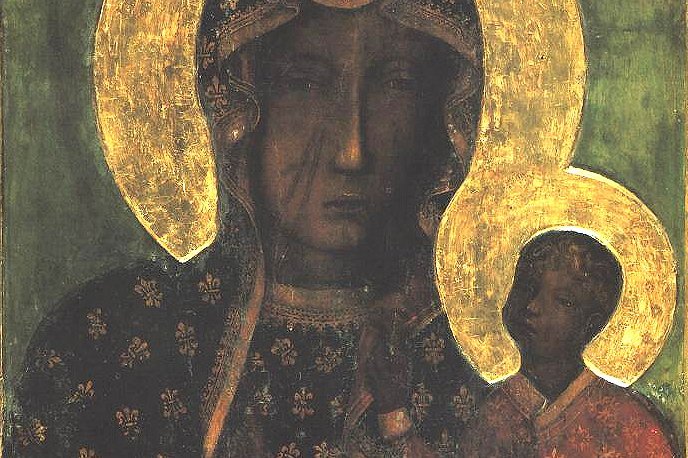
Icon of Our Lady of Częstochowa, Byzantine tradition, Jasna Góra Monastery — public domain.
Popular devotion has long credited Saint Luke the Evangelist as the original painter, with a legend holding that he worked on a tabletop salvaged from the Holy Family's own house in Nazareth. It is a beautiful story, and one repeated for generations by pilgrims — but the Church has never asserted it as historical fact, and art historians who have examined the surviving panel generally place its origin centuries after Luke's lifetime, likely somewhere in the Byzantine Empire between the 6th and 9th centuries. What is certain is that the painting has been restored and repainted multiple times across its long life, meaning the image venerated today is a layered, much-handled object rather than a single untouched original.
Why "Black Madonna"
The nickname "Black Madonna" describes the icon's most immediately striking feature: the dark, almost bronze tone of Mary's face and the Christ Child's, set against a rich red robe and a background of gold. Several explanations have been offered for the coloring. Centuries of exposure to smoke from votive candles and oil lamps in the shrine would have gradually darkened the varnish and pigment layer by layer, a physical process documented in other old devotional paintings kept in similarly smoke-filled chapels. Some art historians add that certain schools of Byzantine icon painting favored darker, more somber flesh tones to begin with, meaning the effect may be partly original rather than entirely the result of aging. Either way, the name has stuck for centuries, and "Black Madonna" now functions as shorthand recognized by Catholics well beyond Poland — Częstochowa is one of several dark-toned Marian icons venerated across Europe, alongside images like the Black Madonna of Montserrat in Spain, though each has its own distinct history and legend.
The wounds that were never erased
The icon's most debated detail is a pair of parallel slashes cut into Mary's right cheek, alongside a scatter of smaller marks elsewhere on the panel. Tradition most commonly attributes these to a violent raid on Jasna Góra in 1430, when the monastery was looted — accounts differ on the precise identity of the raiders, sometimes described as Hussite-associated fighters, sometimes simply as bandits taking advantage of a lightly defended target. According to the story passed down at the shrine, one of the attackers struck the painting with a sword before being thrown from his horse in what the faithful read as a sign of divine displeasure — a detail that belongs to pious legend rather than documented history.
What can be said with more confidence is that royal court painters were brought in afterward to restore the damaged image, and that, according to tradition repeated at the shrine, the slash marks reappeared through the layers of new paint no matter how many times restorers tried to cover them. Whether that detail is literal or a devotional way of explaining a restoration choice, the marks remain visible on the icon to this day, and Jasna Góra has never attempted to erase them fully. For pilgrims, the scars have become part of the image's meaning rather than a flaw to be hidden — a visible record, as the tradition frames it, of both violence endured and endurance itself.
Devotion that outgrew a single hilltop
Devotion to Our Lady of Częstochowa spread well beyond the monastery walls over the centuries, particularly after 1655, when a small garrison at Jasna Góra held off a much larger Swedish invading force during a war Poles still call "the Deluge." The successful defense, credited by tradition to Mary's protection, led King Jan II Kazimierz to formally dedicate the entire Polish nation to her care the following year, under the title "Queen of the Crown of Poland." From that point on, the icon stopped being simply a monastery's treasured painting and became something closer to a national emblem — one that survived partitions, foreign occupations, and decades of an officially atheist Communist government that never managed to sever the devotion attached to it.
Pope Saint John Paul II, raised in the same Polish Catholic culture that had long venerated the image, spoke often of his personal devotion to Our Lady of Częstochowa throughout his papacy, and copies of the icon have since traveled to Polish communities and parishes across the world, carrying the title — and the story of the scarred, dark-faced Madonna — far beyond the hill where the original has stood since the 14th century. For a fuller account of the monastery itself, its 1655 siege, and its role as a Polish national symbol, see the companion article on Jasna Góra Monastery.
A title among many
Częstochowa is one of dozens of titles under which Mary is venerated worldwide, each tied to a particular image, apparition, or place — from Our Lady of Guadalupe in Mexico to Our Lady of Fátima in Portugal. What distinguishes Częstochowa within that broader tradition is the sheer physical age and visible history carried by the icon itself: a painting scarred by real violence, credited across six centuries with real historical deliverance, still watched over today by the same order of monks who first received it in 1382.
Trivia
What does the title 'Our Lady of Częstochowa' actually refer to?
Why is the icon called the Black Madonna?
Who is traditionally credited with painting the icon?
What caused the scars on the icon's face?
Is Our Lady of Częstochowa an official Marian dogma or a devotional title?
You May Also Like
Related Reading