Adam and Eve: The Fall of Man in Genesis 3

One rule in a garden of plenty
Genesis 2 describes the Garden of Eden as a place of extraordinary abundance — every tree pleasing to the eye, every fruit good for food, a landscape God places the first man in specifically "to cultivate and care for it." Against that backdrop of near-total freedom, the one restriction God gives stands out precisely because it is so limited: "The Lord God gave the man this order: You are free to eat from any of the trees of the garden except the tree of knowledge of good and evil. From that tree you shall not eat; when you eat from it you shall die" (Genesis 2:16-17, NABRE). It is worth noticing how narrow the prohibition actually is — one tree, named specifically, out of an entire garden otherwise open to them.
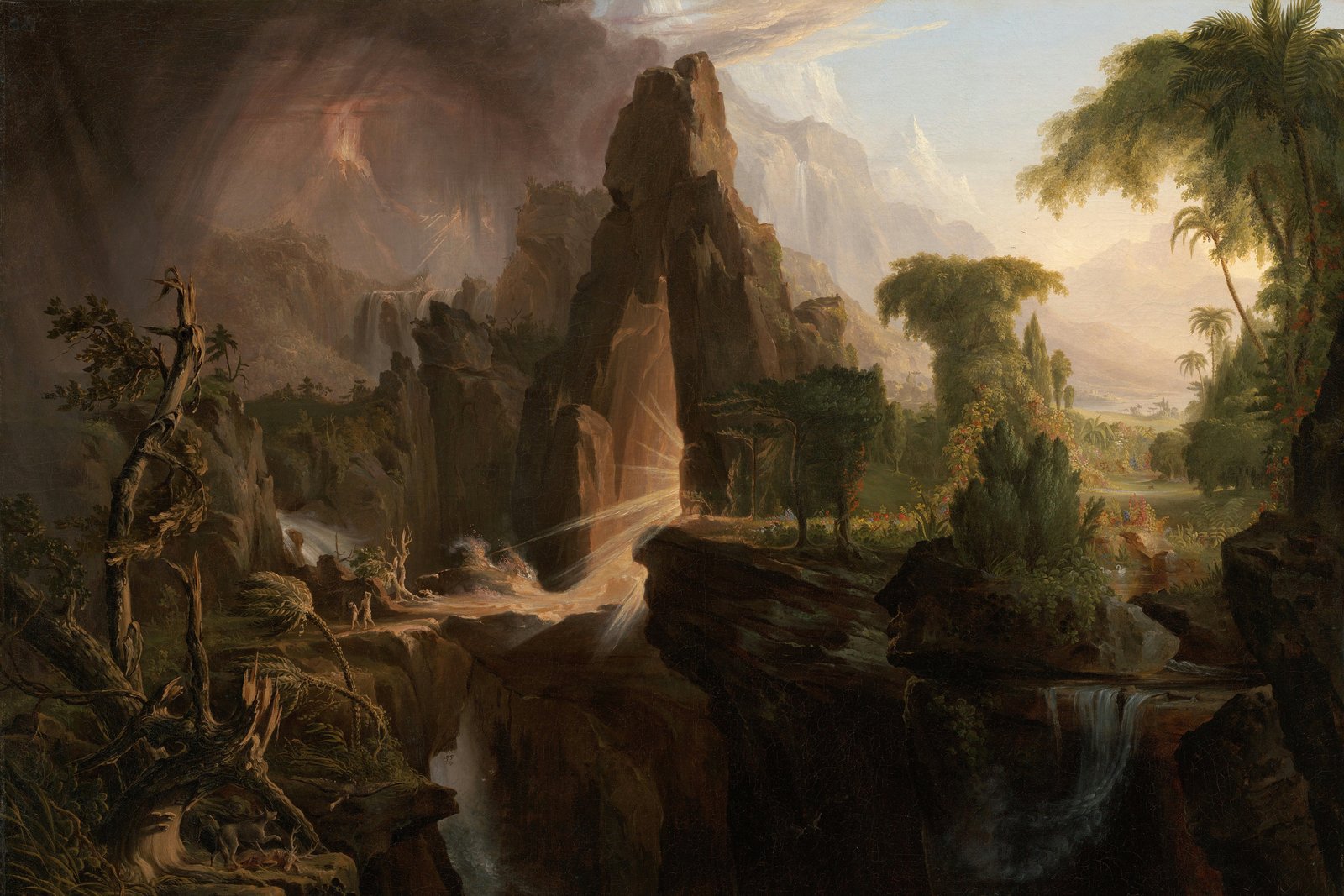
Thomas Cole, Expulsion from the Garden of Eden, 1828, Museum of Fine Arts, Boston — public domain.
Genesis 3 opens by introducing the figure who will unravel that single rule: "the most cunning of all the wild animals that the Lord God had made," described in the text simply as a serpent, without the later theological identification as Satan that Christian tradition would attach to the scene over subsequent centuries. The serpent's first move is not a direct lie but a subtle distortion, a question designed to make Eve restate — and, in restating, second-guess — the command she had been given: "Did God really say, 'You shall not eat from any of the trees in the garden'?"
The conversation that changes everything
Eve's response corrects the serpent's exaggeration, but she introduces a small addition of her own, saying they must not even touch the tree's fruit, a detail not present in God's original instruction to Adam. The serpent then moves from questioning to outright contradiction, directly denying the consequence God had named: rather than death, the serpent promises that eating will open their eyes, making them "like gods who know what is good and what is bad." The offer is not simple gluttony — it is the promise of a kind of god-like autonomy, moral knowledge and judgment untethered from trust in what God has said.
What follows happens quickly. Genesis 3:6 describes Eve's decision in three linked observations — the tree was good for food, pleasing to the eyes, and desirable for gaining wisdom — before recording the act itself: "So she took some of its fruit and ate it; and she also gave some to her husband, who was with her, and he ate it" (NABRE). The text is notably direct about Adam's presence: he is described as being with her throughout, not absent or deceived from a distance, which has shaped centuries of theological reflection on shared human responsibility for the Fall rather than placing blame on one party alone.
Shame, hiding, and the first blame-shifting
The immediate result is not the god-like clarity the serpent promised but its opposite: "Then the eyes of both of them were opened, and they realized that they were naked." Where the couple had previously lived in the garden without shame, they now sew fig leaves together and, when they hear God walking in the garden, hide among the trees — the Bible's first recorded instance of humans avoiding God rather than seeking him out. When confronted, the blame moves in a chain: Adam points to Eve, Eve points to the serpent, and nobody, in the moment, takes direct responsibility for the choice actually made.
God's response follows the same order the accusations came in, addressing the serpent first, then Eve, then Adam, with each receiving a distinct consequence rather than a single blanket punishment. To the serpent: "cursed are you among all the animals... On your belly you shall crawl, and dust you shall eat all the days of your life. I will put enmity between you and the woman, and between your offspring and hers; They will strike at your head, while you strike at their heel" (Genesis 3:14-15, NABRE) — a passage later Christian tradition has read as an early foreshadowing of ultimate victory over evil, sometimes called the protoevangelium, or "first gospel," though Genesis itself does not use that later theological language. To Adam: "By the sweat of your brow you shall eat bread, Until you return to the ground, from which you were taken; For you are dust, and to dust you shall return" (Genesis 3:19, NABRE) — mortality, previously only threatened, now becomes an explicit part of the human condition.
Exile from the garden
The chapter closes with expulsion, not merely as punishment but, the text suggests, as a kind of protective measure: God says, "Now, what if he also reaches out his hand to take fruit from the tree of life, and eats of it and lives forever?" (Genesis 3:22, NABRE), and so Adam is banished "to till the ground from which he had been taken," with cherubim and a fiery revolving sword stationed to guard the way back to the tree of life (Genesis 3:23-24). Human beings are left outside the garden, no longer able to return to the unbroken relationship with God, each other, and creation that Genesis 2 describes.
Catholic teaching, developed and formally articulated across centuries after the composition of Genesis itself, calls this event the Fall and locates in it the origin of what the Church terms original sin — not merely one bad choice by two individuals, but the beginning of a fallen condition the Catechism describes as affecting the whole of humanity thereafter, a doctrine distinct from, though rooted directly in, the narrative Genesis 3 itself tells. Readers interested in the wider Genesis narrative can find the days leading up to this moment covered in The Creation of Light and The Creation of the Sea and Sky, and the story's echo across the rest of Scripture is part of why Genesis 3, though barely two dozen verses long, remains one of the most theologically consequential chapters in the entire Bible.
Trivia
What exactly did God forbid Adam and Eve from doing?
What did the serpent actually say to Eve?
Did Adam and Eve eat the fruit together, or was Eve alone?
What punishment did God give to the serpent, Eve, and Adam?
What does 'original sin' mean, and is it the same thing as the Fall?
Related Reading