Duccio's Maestà: Siena's Greatest Altarpiece

A city that shut down for a painting
The account of the Maestà's 1311 procession to Siena Cathedral, recorded by an anonymous contemporary chronicler, describes something closer to a religious festival than an art installation: bells ringing across the city, shops closing for the day, and a procession of the bishop, city magistrates, clergy from every parish, and crowds of ordinary Sienese citizens carrying candles as they escorted the massive painted panel from Duccio's workshop to its place on the cathedral's high altar. Whether every detail of the chronicle is precisely accurate, the broader picture it paints is well supported by other evidence: Siena, in the early fourteenth century, regarded this altarpiece not merely as church furnishing but as a civic treasure with real spiritual stakes attached to it.
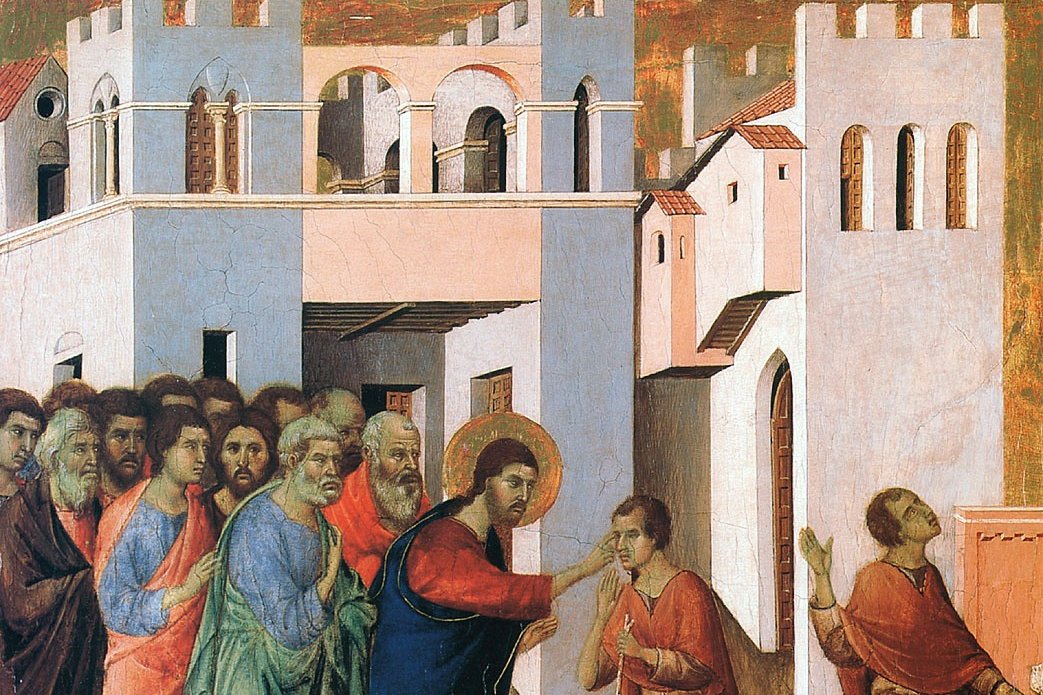
Duccio di Buoninsegna, "Maestà" (front panel), 1308-1311, Museo dell'Opera del Duomo, Siena — public domain.
Why Siena cared this much about one painting
That civic investment traces back decades earlier, to 1260, when Siena faced a numerically superior Florentine army at the Battle of Montaperti. According to Sienese tradition, the city's leaders formally dedicated Siena to the protection of the Virgin Mary before the battle, and when Siena won — a victory later Sienese chroniclers treated as nothing short of miraculous — the city's devotion to Mary as its specific protector deepened into something close to civic identity. By the time Duccio received the Maestà commission in 1308, Siena Cathedral was already understood as Mary's own house within the city, and the enthroned Virgin at its high altar carried weight well beyond ordinary devotional art: an inscription at the base of Duccio's composition reads, in Latin, "Holy Mother of God, be thou the cause of peace to Siena, and life to Duccio because he painted thee thus" — a rare instance of an artist inserting a personal petition directly into the work's own inscription.
The composition itself
The Maestà's front panel shows the Virgin Mary enthroned as Queen of Heaven, the Christ Child seated on her lap, surrounded by a dense, symmetrical gathering of saints, angels, and the four patron saints of Siena kneeling closest to the throne. Duccio worked within the established Byzantine-derived tradition of icon painting — gold backgrounds, formal frontal poses, a hierarchical scale where more important figures appear larger — but combined it with a new attentiveness to individual faces, delicately rendered drapery, and subtle variations in expression among the many attending figures that distinguish his work from the flatter, more uniformly stylized icons common a generation earlier. Where Byzantine icon painting traditionally worked within strict, largely unvarying formal rules, Duccio's Maestà shows an artist working at the edge of that tradition, pushing gently toward greater naturalism without abandoning its underlying visual grammar.
A double-sided achievement
What made the Maestà genuinely unusual for its time wasn't only its front panel — it was painted on both sides, an enormous undertaking that in effect produced two major religious paintings in a single object. The front, visible to the congregation, showed the enthroned Madonna described above. The reverse, which originally faced the choir where clergy would view it during the liturgy, depicted an extensive cycle of 26 small scenes narrating Christ's Passion, along with episodes from his public ministry and post-Resurrection appearances, rendered with a narrative density and psychological nuance — anguished faces, carefully staged crowds, architectural settings that create real spatial depth — that later art historians have credited with substantially advancing narrative painting in Italy.
Taken apart, scattered, and still studied
The altarpiece's later history is considerably less triumphant than its 1311 procession. In 1771, church officials had the Maestà sawn apart, separating the front and back panels and, in the process, breaking up what had been a unified object for over four and a half centuries. Some of the smaller narrative panels were subsequently sold off over the following century and now reside in museum collections outside Italy, including the National Gallery in London and the Frick Collection in New York, while the majority of the surviving panels remain together at the Museo dell'Opera del Duomo in Siena, reassembled as closely as scholars can manage to their original arrangement. Detailed payment records from the cathedral's own archives, documenting Duccio's daily wages across roughly three years of work, have allowed historians to date the commission with unusual precision for a medieval artwork — a rare case where the paper trail survives nearly as richly as the painting itself.
Duccio's lasting influence on Sienese painting
The Maestà effectively founded what art historians call the Sienese school of painting, a distinct tradition running parallel to, and in productive tension with, the Florentine innovations of Duccio's younger contemporary Giotto. Duccio's pupils and followers, including Simone Martini and the Lorenzetti brothers, carried his combination of Byzantine formality and emerging naturalism forward through the fourteenth century, giving Siena its own distinctive visual identity within Italian medieval art — one that traces, in a fairly direct line, back to a single altarpiece a whole city once stopped to carry through its streets.
Trivia
What does 'Maestà' mean, and why was Duccio's painting given that title?
How large was Duccio's Maestà, and is it still in one piece today?
What did the back of the Maestà depict?
Why is Siena Cathedral's dedication to the Virgin Mary significant to the Maestà's story?
How much was Duccio paid for the Maestà?
You May Also Like
Related Reading