Our Lady Undoer of Knots: The Devotion Pope Francis Made Famous

A painting made for one family's gratitude
The image behind this devotion did not begin as a public shrine piece at all. Around the year 1700, a nobleman named Wolfgang Langenmantel commissioned the painting from Bavarian court painter Johann Georg Melchior Schmidtner as an act of thanksgiving, connected to the happy resolution of a marriage crisis in his family — a private commission for a private purpose, never intended as the seed of a devotion that would eventually reach across the globe. The finished canvas eventually made its way to the church of St. Peter am Perlach in Augsburg, southern Germany, where it remained a modestly known local devotional image for the better part of three centuries, drawing the occasional pilgrim but little attention beyond Bavaria.
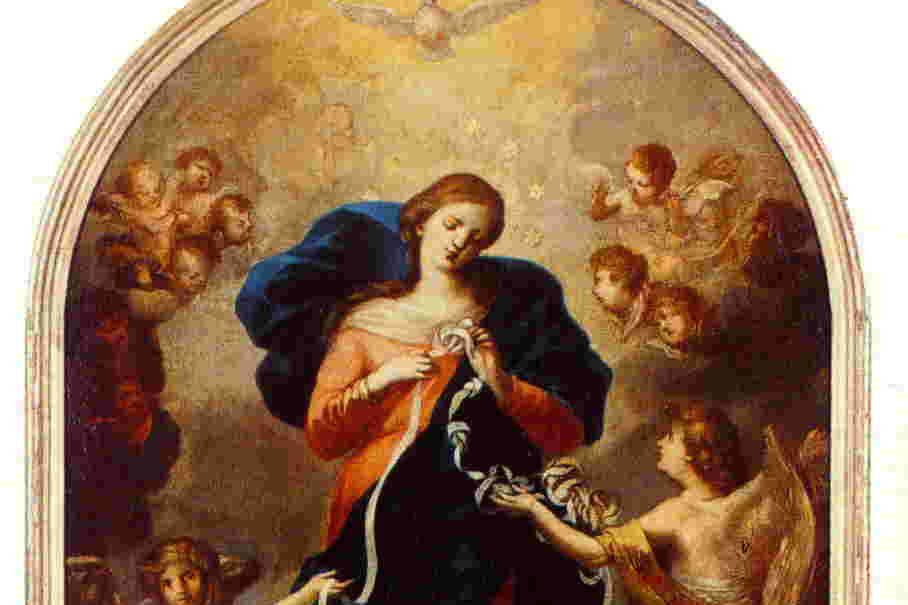
Johann Georg Melchior Schmidtner, Maria Knotenlöserin, c. 1700, St. Peter am Perlach, Augsburg — public domain.
The composition itself is unusually literal for a Marian image. Mary stands at the center in a blue mantle, calmly working a long white ribbon between her hands, undoing one knot after another. On one side, an angel hands her the tangled end of the ribbon; on the other, a second angel presents the same ribbon, now smooth and untied, toward a figure below — traditionally interpreted as a representation of the person whose prayer or difficulty Mary has resolved. Beneath her feet, in keeping with a long tradition of Marian iconography drawn from Revelation 12, she stands on a crescent moon with a serpent underfoot, and above her a dove represents the Holy Spirit.
From Augsburg to Buenos Aires
The devotion's path to worldwide recognition runs through one specific biography. In the mid-1980s, a young Argentine Jesuit named Jorge Mario Bergoglio was sent to Germany to complete doctoral studies. While there, he encountered the Schmidtner painting in Augsburg and was drawn to its imagery, reportedly obtaining a photograph or print of it to bring back home. Once in Buenos Aires, Bergoglio shared the image with a religious sister connected to Argentine parish life, and copies of the painting began appearing in churches around the city, accompanied by prayer cards asking Mary's intercession to "untie the knots" of difficult situations — troubled marriages, family estrangement, financial hardship, illness, and other tangled circumstances that felt, to those praying, beyond their own power to fix.
The devotion spread steadily through Argentina over the following decades, largely as a grassroots parish practice rather than an officially promoted one. Everything changed in March 2013, when Cardinal Bergoglio was elected Pope Francis. His personal, well-documented connection to the Augsburg painting turned what had been a regional Argentine devotion into a global phenomenon almost overnight — churches around the world began commissioning their own copies of the image, and "Mary, Undoer of Knots" novenas and prayer cards became widely available in a way that would have been unimaginable to the Bavarian church that had quietly housed the original for nearly three hundred years.
The theology behind the knots
The imagery of Mary untying knots draws on a much older thread of Christian reflection than the 1700 painting itself. Saint Irenaeus of Lyon, writing in the second century, developed a contrast between Eve and Mary that later Catholic tradition would build on extensively: where Eve's disobedience in the Garden is described as tying a knot of sin and death for humanity, Mary's obedient "yes" at the Annunciation is described as loosening that same knot through her cooperation with God's plan of salvation. This Eve–Mary parallel, sometimes called Mary as the "New Eve," had circulated in theological writing for well over a thousand years before Schmidtner ever picked up a brush — the Augsburg painting gave a striking visual form to an idea the Church had already been meditating on for centuries.
Read against that background, the "knots" in the devotion are not meant as a magical unraveling of problems but as a way of picturing Mary's intercessory role: bringing a person's tangled difficulties to God in prayer, trusting that patient, faithful cooperation — modeled on Mary's own "yes" — can loosen what force alone cannot. It is this patient, unhurried quality of the image, Mary working one knot at a time rather than yanking the ribbon free, that devotees often say resonates most, especially with those facing problems that have no quick fix.
A devotion still spreading
Today, images and statues of Our Lady Undoer of Knots can be found in parishes on nearly every continent, a remarkable spread for a devotion that, until the early 2010s, was known almost exclusively within a single German city and a handful of Argentine parishes. The original painting still hangs in St. Peter am Perlach in Augsburg, where it continues to receive pilgrims — many of them now drawn specifically by its connection to Pope Francis rather than by the local Bavarian tradition that first inspired it. For readers exploring other Marian titles and their distinct histories, see also Our Lady of Częstochowa and Our Lady of Good Counsel, each tied to its own image, place, and story of devotion spreading far beyond its origin.
Trivia
What is Our Lady Undoer of Knots a devotion to?
Where did the original painting come from?
How is Pope Francis connected to this devotion?
What does the knot in the painting symbolize?
Is Our Lady Undoer of Knots an officially defined Marian title, like the Immaculate Conception?
You May Also Like
Related Reading