Our Lady Star of the Sea: The Ancient Title Stella Maris

A title born from a copying mistake
Few Marian titles have a more unusual origin story than Star of the Sea. In the late 4th or early 5th century, Saint Jerome — the scholar responsible for translating the Bible into Latin as the Vulgate — was working through the etymology of Hebrew names, including Mary's, in one of his scriptural commentaries. Most textual scholars now believe Jerome's intended Latin rendering was something close to stilla maris, meaning "drop of the sea," a phrase evoking smallness and hidden origin. Somewhere in the process of copying and recopying his work by hand across the following centuries, a scribe wrote stella maris — "star of the sea" — instead, whether through simple error or, as some historians suggest, because the poetic image was simply too appealing to correct once it had taken hold.
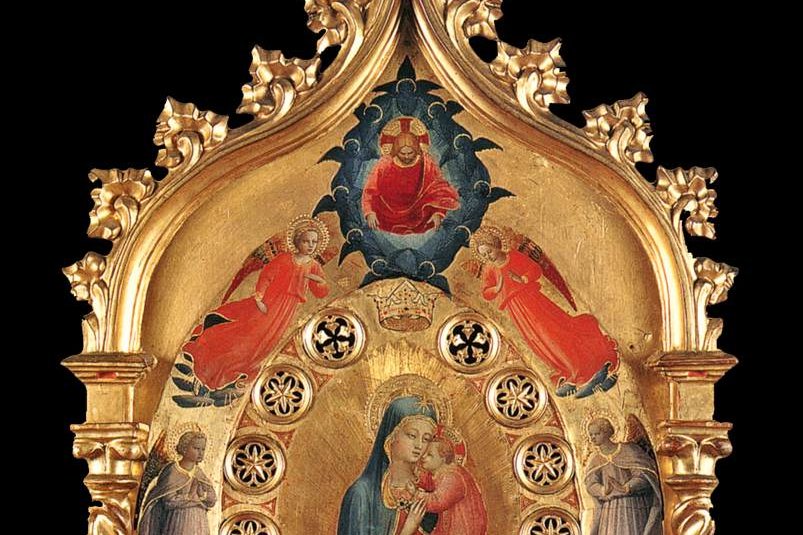
Fra Angelico, Madonna della Stella, c. 1433–34, Museo di San Marco, Florence — public domain.
Whatever its precise origin, the mistranslation never got fixed. Instead, medieval writers and preachers embraced it, and by the early Middle Ages "Star of the Sea" had become an established, beloved way of referring to Mary throughout Western Christendom — a case, unusual in the history of Christian language, where an accident of transmission produced an image so evocative that the Church simply kept it rather than correcting the record.
Why the image took hold
The reason the mistranslation stuck likely has less to do with etymology than with how naturally the image fit the world medieval Christians actually lived in. Long before satellite navigation, sailors crossing open water depended on fixed points in the night sky — above all the North Star, or Polaris — to hold a steady course and find their way home. A star that does not move, that stays reliable when everything else, wind and current and visibility, keeps shifting, was already a deeply familiar symbol of guidance to anyone who had ever put to sea. Applying that same image to Mary, picturing her as a fixed point of guidance toward Christ amid the storms and uncertainties of life, gave the title an emotional resonance that went well beyond a scholar's footnote.
Coastal and maritime communities across Europe embraced the title with particular devotion. Chapels and shrines dedicated to "Notre-Dame de la Mer," "Stella Maris," or their equivalents in dozens of languages sprang up in port towns and fishing villages from the Mediterranean to the North Sea, often built by or for sailors giving thanks for a safe voyage or praying for one still ahead. The title crossed easily into art as well, with medieval and Renaissance painters occasionally depicting Mary crowned with a star, or with a star placed above her head or on her mantle — an image the Florentine painter Fra Angelico captured in his early 15th-century Madonna della Stella, now in the monastery of San Marco in Florence, where Mary appears enthroned beneath a single star set against a gold background.
A hymn that outlasted empires
The title's staying power owes a great deal to liturgy as well as folk devotion. "Ave Maris Stella" ("Hail, Star of the Sea"), an anonymous Latin hymn likely composed by the 8th or 9th century, became one of the most widely sung Marian hymns in the Western Church, used for centuries in vespers and other liturgical settings across Europe. Its opening line alone did more to fix "Star of the Sea" in ordinary Catholic devotional memory than any theological treatise could have — generations of monks, clergy, and laypeople who never studied Jerome's Hebrew etymology nonetheless grew up singing the title in Latin, week after week, and it simply became part of how Mary was addressed in prayer.
The hymn has survived remarkably intact into the modern Church, still appearing in current liturgical books and Marian devotions, and composers from the medieval period through the present day — including chant settings still used in monasteries — have continued to set its verses to music, a rare case of an early medieval Latin hymn remaining in active, ordinary use rather than being confined to historical archives.
A living title today
Star of the Sea remains far from a historical curiosity. The Catholic Church's official worldwide ministry to seafarers, fishers, and maritime workers operates under the name Stella Maris, taking the ancient title directly as its own, and continues work today supporting sailors — including migrant fishing crews facing exploitation, port chaplaincy, and pastoral care for people who spend months at a time away from home on the water. Parishes in port cities across the world still bear the name Stella Maris or its local-language equivalents, and the title continues to be invoked in personal prayer by anyone drawn to its central image: a steady point of light to steer toward when the way forward is unclear.
Star of the Sea sits among many ancient and modern titles under which Mary has been venerated across the centuries, from Our Lady of Częstochowa to Our Lady of Good Counsel — each shaped by a different place, image, or moment in history, yet each expressing the same underlying Catholic conviction that Mary's role is to point the way toward her son.
Trivia
What does 'Star of the Sea' or 'Stella Maris' mean?
Where did the title come from?
Why is Mary associated with the sea and with sailors specifically?
Is there a well-known hymn connected to this title?
Is Stella Maris connected to any modern Catholic organizations?
You May Also Like
Related Reading