The Raising of Jairus's Daughter: Jesus Wakes a Child

A father's desperate request
Mark's Gospel introduces Jairus with his title first: "one of the synagogue officials," a position of real standing in his local community, someone who would ordinarily have had little reason to publicly grovel before an itinerant preacher. Yet that is exactly what he does: "Seeing him he fell at his feet and pleaded earnestly with him, saying, 'My daughter is at the point of death. Please, come lay your hands on her that she may get well and live'" (Mark 5:22-23, NABRE). The urgency in his words — "at the point of death," a plea for Jesus to come immediately — sets the pace for everything that follows: Jesus agrees at once, and "a large crowd followed him and pressed upon him" as they set out together (Mark 5:24).
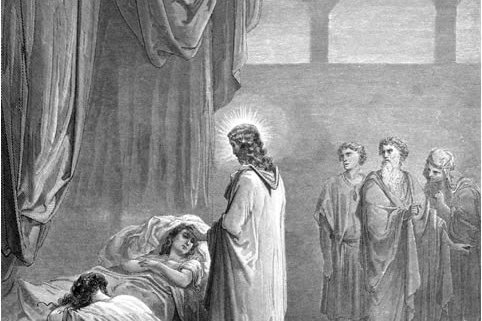
Gustave Doré, Jesus Raises the Daughter of Jairus from the Dead, 1866 — public domain.
A delay that must have felt unbearable
For a father racing against his daughter's failing life, what happens next would have been agonizing. In the crush of the crowd, a woman who had suffered from chronic bleeding for twelve years touches Jesus' cloak seeking healing, and rather than continuing on, Jesus stops entirely, asking who touched him and waiting until the woman comes forward, explains herself, and receives his blessing in full. However brief this pause may have felt to Jesus and the woman, Luke's account specifies the length of her suffering matched, almost eerily, the exact age of the girl Jairus was racing to save — twelve years, a detail the Gospel writers seem to have placed deliberately side by side.
The delay has real consequences. "While he was still speaking, people from the synagogue official's house arrived and said, 'Your daughter has died; why trouble the teacher any longer?'" (Mark 5:35, NABRE). It is difficult to imagine a more devastating message for Jairus to receive at that exact moment — confirmation that the detour for the other woman's healing had cost him precisely the time he did not have.
"Do not be afraid; just have faith"
Jesus' response to the news is immediate and direct: "Disregarding the message that was reported, Jesus said to the synagogue official, 'Do not be afraid; just have faith'" (Mark 5:36, NABRE). He continues on to the house, this time allowing only Peter, James, and John to accompany him inside, along with the girl's parents — a smaller, more private group than the large crowd that had followed him through the streets.
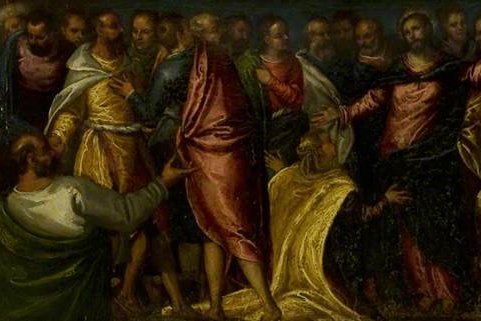
At the house, Jesus encounters a scene of open mourning: "people weeping and wailing loudly." His response to the assembled mourners is startling: "Why this commotion and weeping? The child is not dead but asleep" (Mark 5:39). The reaction is immediate and mocking — "they ridiculed him" — a detail the Gospel includes without softening; the mourners, who had presumably confirmed the girl's death themselves, treat Jesus' statement as either naive or absurd. Undeterred, "he put them all out," clearing the room of everyone except the small group he had brought and the girl's own parents.
"Talitha koum"
What happens next is recorded with unusual intimacy and detail for a Gospel miracle account. "He took the child by the hand and said to her, 'Talitha koum,' which means, 'Little girl, I say to you, arise!'" (Mark 5:41, NABRE). Mark preserves the original Aramaic words Jesus actually spoke — the everyday spoken language of Jesus and his followers in first-century Galilee, distinct from the Hebrew of the Scriptures or the Greek in which the Gospel itself was written — before translating them into Greek for his readers, a detail that has struck many readers across the centuries as an unusually vivid, almost eyewitness touch preserved intact within the text.
The result is immediate: "The girl, a child of twelve, arose immediately and walked around. [At that] they were utterly astounded" (Mark 5:42). Mark closes the episode with two instructions from Jesus that sit side by side in striking contrast — first, "strict orders that no one should know this," part of a broader pattern in Mark's Gospel where Jesus repeatedly asks witnesses of his miracles to keep them quiet, and second, an entirely practical, almost domestic follow-up: "that she should be given something to eat" (Mark 5:43). The girl who moments earlier had been mourned as dead is treated, in the story's final line, simply as a hungry child who needs a meal.
This episode is interwoven throughout with the healing of the woman whose delay complicated Jairus's journey; her own story is told fully in the companion article, The Woman with the Issue of Blood, which picks up the same crowd, the same walk to Jairus's house, and the same afternoon from her side of events.
Read together, the two miracles form a single carefully constructed episode rather than two unrelated events loosely placed side by side. Both center on women — one a grown woman worn down by twelve years of illness, the other a girl of twelve reaching the very age the first woman had spent suffering — and both hinge on faith met with immediate, tangible restoration. Mark's decision to interlace the stories, delaying the resolution of one to tell the other, has long struck readers and commentators as deliberate, inviting a reading in which the two accounts illuminate each other rather than standing simply as separate wonders performed on the same afternoon.
Trivia
Who was Jairus, and what did he ask Jesus to do?
What happened on the way to Jairus's house?
What did Jesus say when he was told the girl had died?
What exactly did Jesus say and do to raise the girl?
Why did Jesus tell witnesses to keep the miracle secret, and did he give any other instructions?
Related Reading