Our Lady of Good Counsel: The Genazzano Fresco Mystery

A wall that had nothing, and then had everything
Genazzano is a small hill town in the Lazio region of Italy, roughly thirty miles southeast of Rome, and in the 15th century it was home to an Augustinian church dedicated to Saint Mary of Good Counsel that had stood unfinished for years, its congregation too poor to complete the building. According to the tradition still told at the shrine, on April 25, 1467, the town's church bells began ringing with no one pulling the ropes, drawing residents outdoors to investigate. What they reportedly found, on a section of the church's incomplete wall that moments earlier had been bare plaster, was a small image of Mary and the Christ Child, rendered in delicate detail — an image, the tradition insists, that had not been there before and that no one in the town had commissioned, painted, or seen arrive.
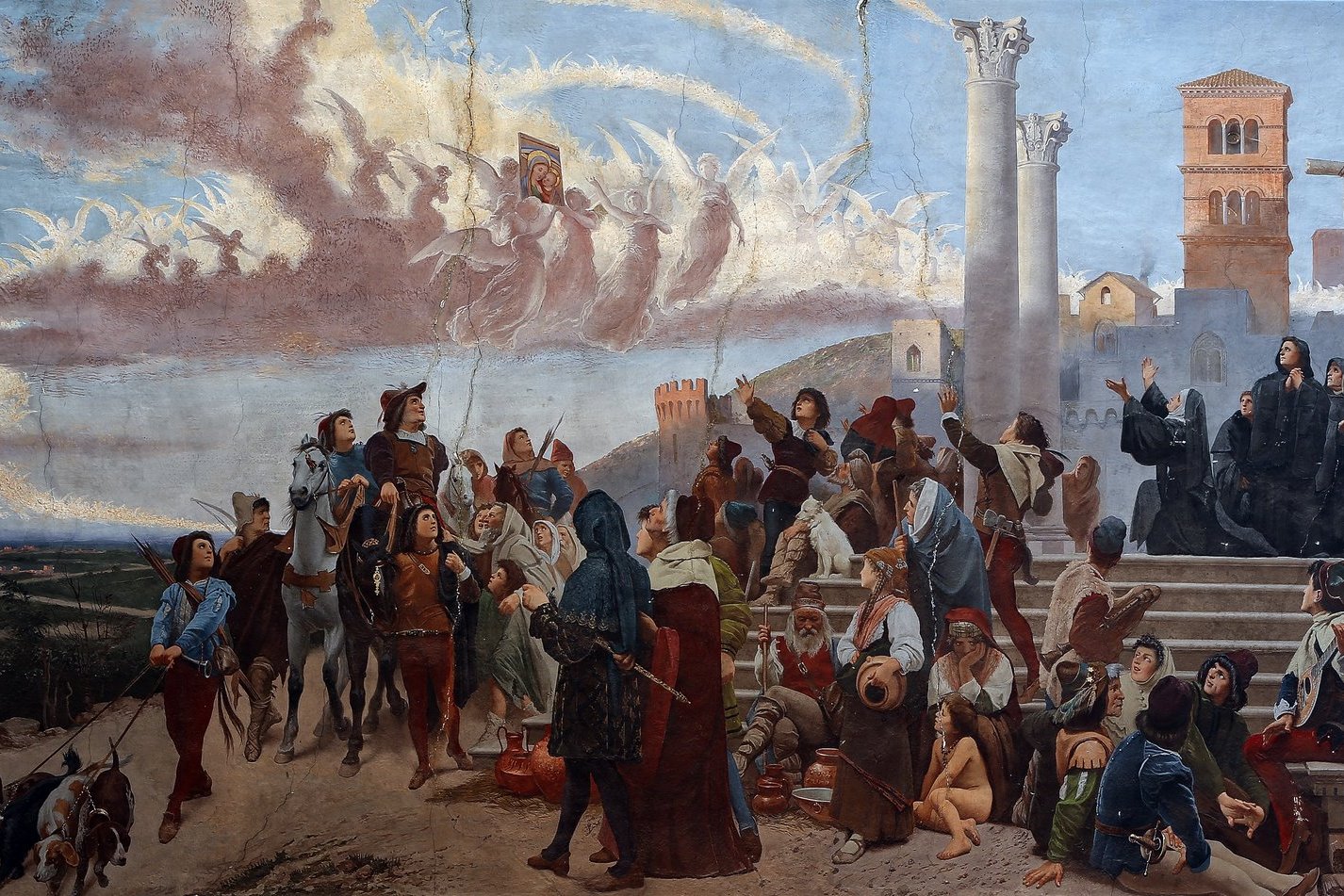
Prospero Piatti, Apparition of Our Lady of Good Counsel at Genazzano, 19th century — public domain.
The fresco itself is modest in size, roughly seventeen by twelve inches, showing Mary in three-quarter profile with the Christ Child's cheek pressed close against hers, an intimate, tender composition distinct from the more formal, frontal poses common in earlier Marian icons. From that day forward, the image became the focus of intense local veneration, and the unfinished church quickly found the resources — largely through donations tied to the growing devotion — to complete construction around its unexpected treasure.
What historians can and cannot say
The precise physical origin of the fresco remains genuinely unresolved. No contemporary documentation survives naming an artist, and no record has ever been found explaining how, or from where, the image reached that particular wall. A once-popular local legend held that the image had originally been venerated in Scutari, in present-day Albania, and was carried across the Adriatic by angels or by pious refugees fleeing Ottoman expansion in the region — a dramatic account that later historical study has treated with considerable skepticism, since it rests on later retellings rather than contemporary 15th-century sources.
What can be said with more confidence is simply that a genuinely mysterious event, by all surviving contemporary accounts, took place at Genazzano in April 1467, that it was taken seriously enough by local authorities and Church officials of the time to draw significant attention, and that the devotion it sparked has never meaningfully faded across the more than five and a half centuries since. As with other unexplained devotional images in Catholic history, the Church has neither dogmatically affirmed a miraculous origin nor dismissed the tradition — it has instead permitted and, at various points, actively encouraged the devotion that grew up around the image, while leaving the precise historical question open.
A shrine cared for across centuries
Care of the Genazzano shrine passed to the Augustinian order, whose members had staffed the church from its founding, and the order has maintained custody of the site and its devotion ever since — a continuity of nearly six hundred years that is itself unusual among Marian shrines, many of which have changed hands or custodianship repeatedly across the centuries. The Augustinians actively promoted the title and image well beyond Genazzano itself, and Our Lady of Good Counsel devotion spread through Augustinian networks into parishes, schools, and religious houses across Europe and eventually worldwide, particularly following a formal papal coronation of the image in the 17th century, an honor traditionally reserved for images already receiving substantial and sustained veneration.
Several popes have shown particular attachment to the devotion. Pope Leo XIII, in the late 19th century, added the invocation "Mother of Good Counsel, pray for us" to the Litany of Loreto, a widely used Marian prayer, cementing the title's place in the Church's broader devotional vocabulary well beyond the town where it originated. The feast associated with the image is celebrated on April 26, marking the day after the fresco's traditional appearance.
A title carried into daily decision-making
What distinguishes Our Lady of Good Counsel from Marian titles tied to protection, healing, or national identity is its specific, practical focus: the devotion asks for Mary's intercession precisely in moments of decision, when the right path forward is unclear and the stakes of choosing wrong feel real. That focus has made the title a natural fit for institutions built around forming judgment and character — countless Catholic schools and colleges worldwide bear the name Our Lady of Good Counsel or Notre Dame du Bon Conseil, invoking the same devotion for students facing their own formative choices.
The image remains at Genazzano today, still cared for by the Augustinians, still drawing pilgrims seeking clarity for decisions large and small. Like Our Lady of Częstochowa and other Marian titles tied to a single enduring image, Good Counsel demonstrates how a small, physically modest painting — its true origin still genuinely unresolved after nearly six hundred years — can become the anchor of a devotion that long outgrew the town where it first appeared.
Trivia
What is Our Lady of Good Counsel?
How did the image reportedly arrive at Genazzano?
Is the miraculous origin story an official Church teaching?
Why is the title 'Good Counsel' specifically?
Is Our Lady of Good Counsel connected to any well-known religious institutions?
You May Also Like
Related Reading