Saint Marie of the Incarnation, Mystic of New France

A businesswoman before she was a nun
Marie Guyart was born in Tours, France, in 1599, and married at seventeen to a silk manufacturer, Claude Martin, who died just two years later, leaving her a widow with an infant son and no independent income. Rather than remarrying, which would have been the conventional path for a young widow of her class, she moved into her brother-in-law's household and took over management of his transport and freight business — work that put her in charge of contracts, accounts, and logistics at a scale unusual for a woman in early seventeenth-century France.
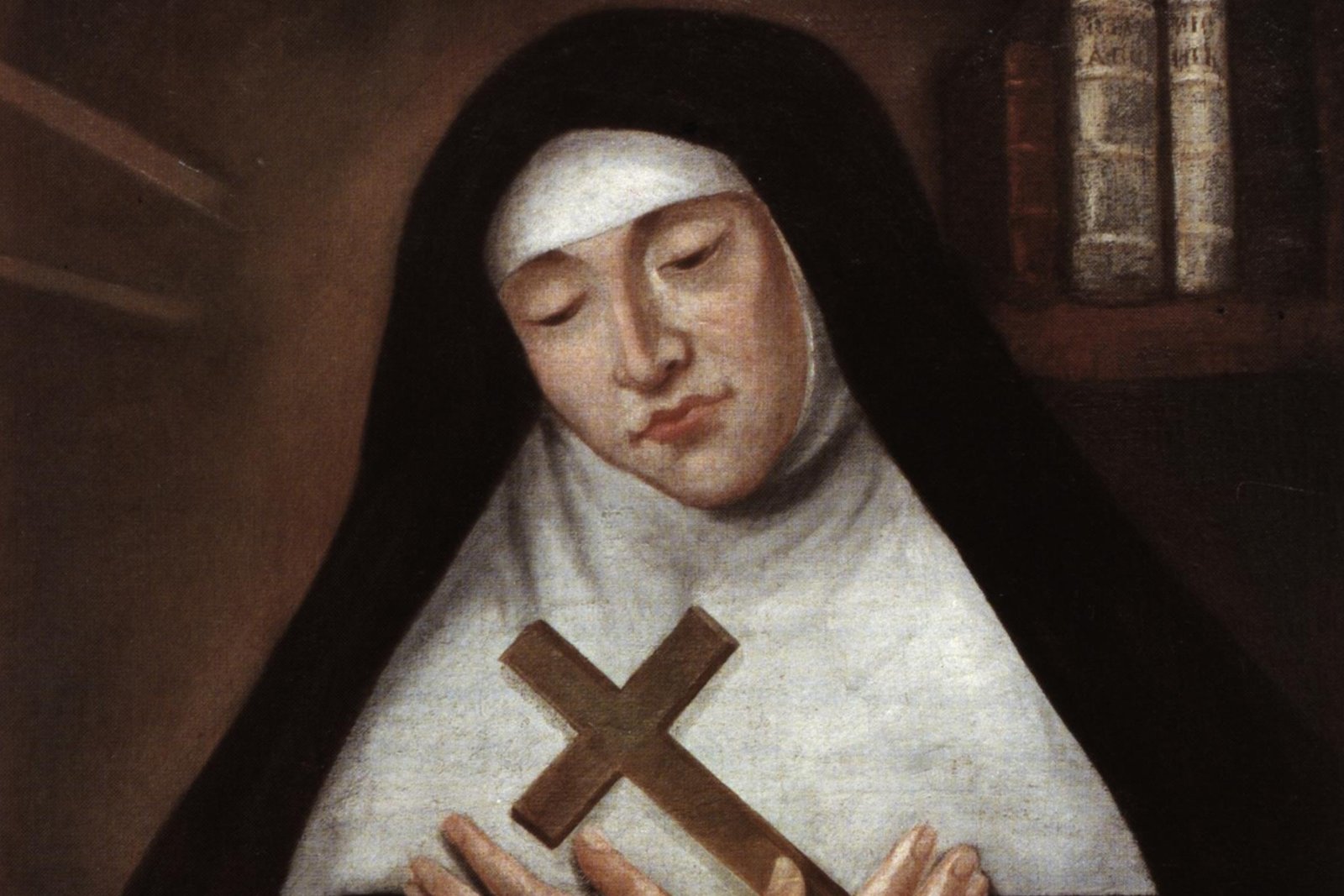
Hugues Pommier, posthumous portrait of Marie of the Incarnation, 1672, Ursulines of Quebec — public domain (Wikimedia Commons)
That practical experience would matter later in ways she could not have anticipated. But first came a decision that has struck readers of her story for four centuries as almost unbearably difficult: convinced of a religious calling that had been building in her through years of private mystical experience, she left her business and, in 1631, entered the Ursuline convent at Tours — leaving her eleven-year-old son, Claude, in the care of her sister. Her own later letters describe the anguish of that separation directly and without the polish that hagiography sometimes applies to hard choices; she did not pretend it had been easy. Claude, for his part, eventually became a Benedictine monk and, after his mother's death, dedicated years to compiling, editing, and publishing her spiritual writings and correspondence — the very source material historians still use to reconstruct her interior life today.
A calling toward Canada
Within the convent, Marie experienced what she and her spiritual directors understood as an increasingly specific mystical call toward a distant, unnamed land — a vision she later connected, once the opportunity arose, to the struggling French colony of New France, centered on the small fortified settlement of Quebec. In 1639, backed by a wealthy French widow named Madeleine de la Peltrie who financed the venture, Marie of the Incarnation and a small group of companion Ursulines crossed the Atlantic, a journey that in this period carried real risk of shipwreck, disease, and, once they arrived, an uncertain colonial settlement still only three decades old and perennially short on food, security, and basic infrastructure.
What she built there, given those conditions, was remarkable by any measure. She established the Ursuline monastery and school in Quebec, the first school for girls anywhere in North America, teaching both French colonial girls and Indigenous girls from allied nations, at a time when formal education for girls of any background was far from guaranteed even in Europe. Her approach to the Indigenous communities she worked among went well beyond conventional missionary practice for her era: she invested years in learning multiple Indigenous languages, becoming proficient enough in Algonquin, Montagnais, and Iroquois to compile dictionaries, catechisms, and other instructional texts in each — a body of linguistic work that later scholars of Indigenous languages have recognized as historically significant in its own right, independent of its religious purpose.
Letters that built a colony's first written record
Marie of the Incarnation was also an extraordinarily prolific letter writer — an estimated 13,000 to 20,000 letters over her lifetime, of which around 280 survive, most addressed to her son Claude back in France. Those surviving letters have become one of the most valuable primary sources historians have for understanding daily life in seventeenth-century New France: colonial politics, relations with Indigenous nations, the practical hardships of the settlement, and her own unusually candid inner spiritual struggles, all recorded by someone writing without any expectation that her private correspondence would eventually be studied as a historical archive.
Her theological and mystical writings, later compiled by her son into a substantial body of published work, led to comparisons — made by later scholars rather than by Marie herself, who was notably humble about her own gifts — to Teresa of Avila, another woman mystic whose interior spiritual writing combined visionary depth with remarkably clear-eyed practical judgment.
Canada's founding religious figure
Marie of the Incarnation died in Quebec in 1672, having spent thirty-three years in the colony without ever returning to France or seeing her son again in person. Pope John Paul II beatified her in 1980, and Pope Francis formally canonized her in 2014 through an equivalent canonization — a process the Church uses to recognize saints whose holiness and veneration are already longstanding and well established, without requiring a new miracle-based process. She is remembered today, alongside figures like Samuel de Champlain, as one of the founding figures of French Canada, and the Ursuline monastery she established in Quebec remained an active school for centuries afterward, one of the oldest continuously operating educational institutions in North America.
Her life offers an unusual answer to a question many people ask about religious vocation: whether it requires leaving behind competence, responsibility, and hard-won practical skill for something purer and more otherworldly. Marie of the Incarnation's story suggests the opposite — that the very skills she built running a shipping business in Tours were precisely what let her build, essentially from nothing, one of the first lasting educational institutions on a new continent.
Trivia
Who was Saint Marie of the Incarnation?
What was her life like before she became a nun?
Why did she leave her son behind to go to Canada?
What did Marie of the Incarnation accomplish in Quebec?
When was she canonized and recognized officially?
You May Also Like
Related Reading