Saint Mary of Egypt

Seventeen years in Alexandria
The traditional account of Mary's early life, preserved chiefly through a Greek biography attributed to Saint Sophronius of Jerusalem, describes her leaving her family home in Egypt at the age of twelve and making her way to Alexandria, where she spent the following seventeen years supporting herself through prostitution. The narrative does not soften or moralize over these years in the way later, more sanitized hagiography sometimes treats a saint's pre-conversion life — it presents them plainly as a period of genuine, sustained dissipation, which is precisely what gives the second half of her story its force. Nothing about Mary's early life suggested she was searching for anything resembling holiness; by her own account, recorded by Sophronius, she pursued that life because she wanted to, not out of desperation or coercion.
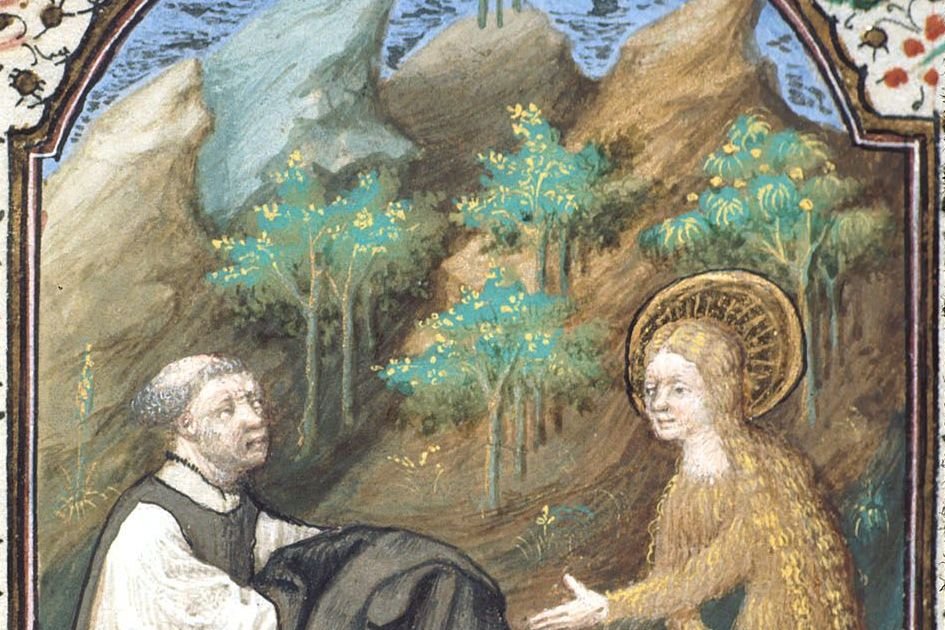
Anonymous French manuscript illumination of Mary of Egypt, 15th century, held by the British Library — public domain.
What changed her direction was, on the surface, almost an accident. Around the age of twenty-nine, she noticed a crowd of pilgrims heading toward the harbor to sail for Jerusalem, bound for the feast of the Exaltation of the Holy Cross, and decided to join them — not out of any religious motive, but because a ship full of travelers represented, to her, simply a larger and more varied set of opportunities than Alexandria could offer. She paid her way onto the voyage in the same coin she'd used to support herself for nearly two decades, and arrived in Jerusalem still entirely uninterested in the religious purpose of the pilgrimage around her.
The threshold she could not cross
The turning point, as Sophronius records it, came when Mary joined the crowds moving toward the Church of the Holy Sepulchre to venerate a relic of the True Cross displayed for the feast. Others around her passed through the church doors without difficulty; Mary found herself physically pushed back by some invisible resistance each time she tried to enter, while everyone else continued past her as though nothing were happening. After several failed attempts, she stepped aside and, for what the account suggests was the first time in her adult life, genuinely reckoned with what she had become — recognizing the barrier not as bad luck but as a direct consequence of the life she was living.
Standing in the church courtyard, she is said to have prayed before an icon of the Virgin Mary, promising to abandon her old life entirely if she were allowed to enter and venerate the Cross. She then attempted the doorway a final time and passed through without resistance. Whatever one makes of the supernatural framing, the psychological structure of the story is deliberate and clear: conversion, in Mary's account, isn't gradual moral improvement but a single, total break, marked by a literal threshold she could not cross until she meant what she said on the other side of it.
Forty years alone in the desert
After venerating the Cross, Mary crossed the Jordan River and walked into the desert beyond it, and by her own account to Zosimas decades later, she remained there — alone, without any human contact — for roughly forty-seven years. The first seventeen of those years, she reportedly told him, were the hardest, spent fighting recurring, overwhelming temptations to return to her old life and old appetites; only gradually, through prayer and sheer endurance, did that struggle ease into the settled solitude that defined the rest of her time in the wilderness.
By the time a monk named Zosimas encountered her — himself on a Lenten retreat into the desert from his monastery near the Jordan, following a local custom of monks dispersing into the wilderness for the whole of Lent — Mary had been transformed by decades of exposure and near-total fasting into a figure Zosimas at first mistook for something other than human: gaunt, sun-blackened, and dressed only in rags that had long since disintegrated. She reportedly knew his name and details of his life without having been told, and asked him to return the following year with the Eucharist, which she then received on the bank of the Jordan — an episode later Christian art returned to repeatedly, depicting Mary reportedly walking across the river's surface to reach him.
A death recorded by a lion
Zosimas returned again a year later, at Mary's earlier instruction, and found her dead, her body already showing signs of having lain undisturbed for some time, with a message traced in the sand beside her identifying herself and asking for burial. Unable to dig a grave alone in the hard desert ground, Zosimas is said to have been aided, according to the traditional account, by a lion that appeared and helped scrape out the grave with its claws before departing peacefully — a detail firmly in the territory of pious legend rather than verified history, but one that fit a recurring theme in desert hagiography of wild animals recognizing and honoring a hermit's sanctity.
Why her story endures
Mary of Egypt's legend has had an unusually long and active liturgical life, particularly in Eastern Christianity, where her full biography is read aloud each year during Great Lent as part of the Canon of St. Andrew of Crete — meaning that unlike most saints, whose stories are marked briefly on a single feast day, Mary's life is retold in full, at length, as an annual act of communal reflection on repentance. The Church has always been explicit that the narrative's more dramatic elements — the invisible barrier at the church door, the lion, the walking across water — belong to the register of hagiographic legend rather than documented biography. What the tradition insists is real, regardless of the specific details, is the underlying claim at the heart of the story: that no life, however far gone, is considered beyond the reach of a conversion total enough to remake it completely.
Trivia
Who was Saint Mary of Egypt?
What happened at the church door in Jerusalem?
Who was Saint Zosimas, and what was his role in her story?
How is Saint Mary of Egypt remembered in Eastern Christianity today?
When is Saint Mary of Egypt's feast day?
You May Also Like
Related Reading