Saint Camillus de Lellis, Priest

A soldier's life, and a ruinous gambling habit
Camillus de Lellis was born in 1550 in Bucchianico, in the Abruzzo region of Italy, to a mother in her sixties and a father who served as an officer in the army of the Kingdom of Naples. His mother died when he was young, and Camillus grew up largely under his father's influence, following him eventually into military life as a teenager. He served for years as a mercenary soldier in campaigns fought by Venice and Naples against the Ottoman Empire, a rough, violent existence that shaped him into a tall, physically imposing man known for a volatile temper and, above all, for a gambling addiction so severe that by his mid-twenties he had lost virtually everything he owned to cards and dice, at one point reportedly gambling away even his coat and shirt in a single sitting.
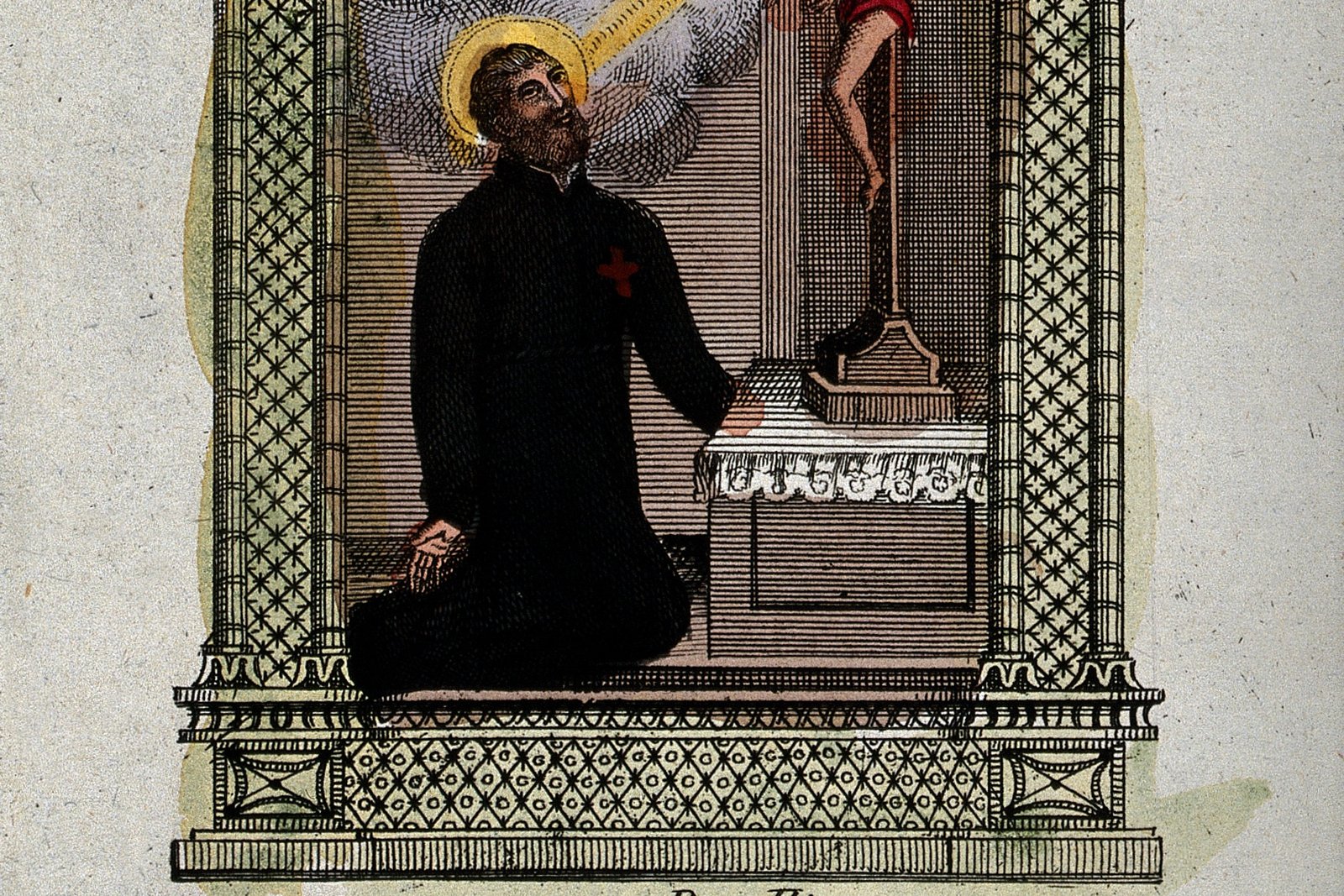
S. Camillo de Lellis, coloured engraving, 19th century — Wellcome Collection, CC BY 4.0.
He also developed a chronic, painful wound in his leg during his military service — an injury that never fully healed and troubled him for the rest of his life — and it was this injury, ironically, that first brought him into contact with the world he would eventually spend his life serving. Unable to continue as a soldier, and with no other trade, Camillus took work at San Giacomo Hospital in Rome, a major hospital for incurables, first as a patient and then as a laborer. He did not last long there: his temper and continued gambling got him dismissed, and for a time he drifted back into destitution, working as a laborer on the construction of a Capuchin friary in Manfredonia.
A sudden, deep conversion
It was during this period of drifting, sometime in his mid-twenties, that Camillus experienced what he would later describe as a profound conversion — traditional accounts place a decisive turning point around 1575, tied to a period of reflection prompted by the preaching of a Capuchin friar during his work on the friary building. Camillus abandoned gambling for good, sought reconciliation with the Church, and resolved to devote his life to God, eventually returning to San Giacomo Hospital in Rome — this time not as a troublesome laborer, but determined to reform how the sick were cared for there.
What he found appalled him. Hospital care in sixteenth-century Rome, as in most of Europe at the time, was often provided by poorly trained, poorly supervised staff with little genuine compassion for the patients in their charge — a stark, systemic problem rather than the fault of any one institution. Camillus began organizing better, more attentive care among the hospital staff, and around 1584, having studied for the priesthood in his thirties despite his old leg wound and limited education, he was ordained. He did not stop at reforming a single hospital; he set out to build something that would outlast him.
Founding an order built around a fourth vow
In 1582, Camillus and a small group of companions began what would become the Order of Clerics Regular, Ministers of the Sick — known popularly as the Camillians — formally approved by Pope Sixtus V in 1586 and raised to the status of a religious order by Pope Gregory XIV in 1591. What set the Camillians apart from other religious communities of the time was a distinctive fourth vow, added to the traditional vows of poverty, chastity, and obedience: a specific commitment to serve the sick, even those suffering from contagious and life-threatening diseases, at risk to the members' own lives if necessary.
This was not a symbolic gesture. Camillus and his religious brothers personally nursed victims of plague outbreaks in Rome and Naples, cared for wounded soldiers on actual battlefields — reportedly the first organized group to establish something resembling a mobile field-medical service, a precursor by centuries to later organizations like the Red Cross — and tended survivors pulled from shipwrecks. Members of the order died from diseases they contracted while nursing patients, a toll Camillus regarded not as a tragedy to be avoided but as the expected cost of the vow they had taken.
Reforming how hospitals actually functioned
Beyond direct nursing, Camillus pushed for concrete institutional reforms that were unusual for his era: he insisted on separating patients with contagious diseases from other patients, promoted better ventilation and cleanliness in hospital wards, opposed the common practice of declaring patients dead prematurely — a genuine hazard in an age before reliable methods of confirming death — and trained his religious brothers in what amounted to a systematic, disciplined approach to bedside nursing care rather than treating hospital work as unskilled labor fit only for the desperate. Historians of nursing and hospital administration have credited these reforms with meaningfully improving hospital practice in Italy during his lifetime and after, well before Florence Nightingale's better-known reforms of nursing in the nineteenth century.
Camillus continued this work despite his own chronic ill health — the old leg wound from his soldiering days never healed, and he developed additional ailments later in life — reportedly saying that he wished to die "with at least one foot in the grave and one hand still serving the sick." He died in Rome on July 14, 1614, having spent nearly forty years transforming the worst period of his own life into the foundation for an order still active today.
A patron shaped by his own failures
Pope Benedict XIV canonized Camillus de Lellis in 1746, and Pope Leo XIII later named him, alongside Saint John of God, co-patron of hospitals and the sick — a fitting pairing, since both men came to hospital ministry only after difficult, unsettled early lives far removed from conventional sanctity. Pope Pius XI later extended his patronage specifically to nurses and nursing associations. His feast, kept on July 14, remains especially meaningful to healthcare workers and hospital chaplains, who often point to Camillus not as a distant, idealized figure but as proof that a genuinely wasted, self-destructive youth is no barrier to a life spent, later, in complete service to others.
Trivia
What did Camillus de Lellis do before becoming a priest?
Why is Camillus de Lellis the patron saint of hospitals and nurses?
What religious order did Saint Camillus found?
What is Camillus de Lellis's feast day?
Was Camillus de Lellis canonized, and who declared him a patron of healthcare?
You May Also Like
Related Reading