Saint Dismas — The Good Thief Promised Paradise

Two thieves, two responses
Luke's Gospel records that Jesus was crucified alongside "two others, both criminals," one on each side of him (Luke 23:32-33). As the three men hung dying, one of the criminals turned his suffering into mockery: "Are you not the Messiah? Save yourself and us" (NABRE, Luke 23:39). The other criminal — the man Christian tradition would come to call Dismas — rebuked him instead: "Have you no fear of God, for you are subject to the same condemnation? And indeed, we have been condemned justly, for the sentence we received corresponds to our crimes, but this man has done nothing criminal" (NABRE, Luke 23:40-41).
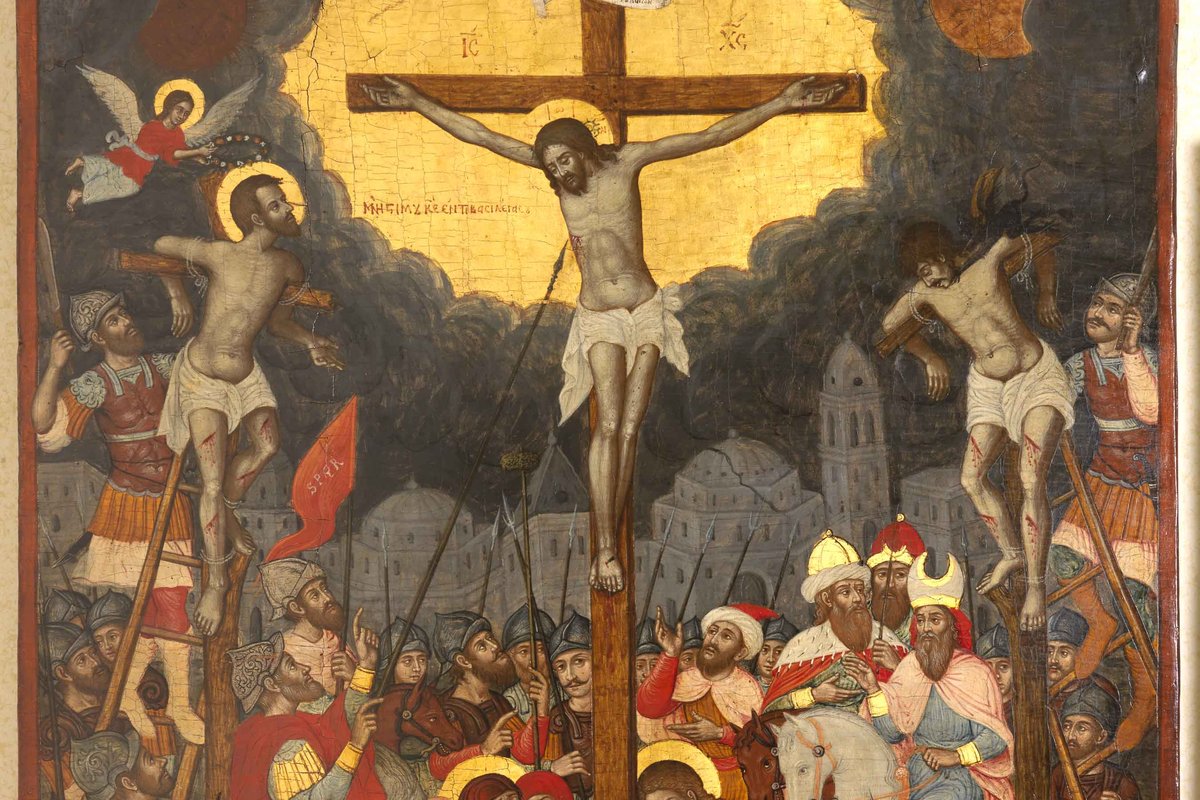
Ioannis Moskos, 'Crucifixion (Between the Two Thieves),' 1711, Hellenic Institute of Venice — public domain.
It's worth being precise about what the Gospel actually tells us and what it doesn't. Luke never names either criminal. The name "Dismas" comes from later Christian tradition — most notably the apocryphal Gospel of Nicodemus, a text not included in the biblical canon — and has simply become the name Catholic devotion has used for this figure for many centuries. What Scripture gives us is not a biography, but a single scene: a man, condemned and dying, who in his final hour tells the truth about himself and about the innocent man beside him.
Roman crucifixion reserved this particular punishment mainly for slaves, rebels, and violent criminals, and the charge against both men executed alongside Jesus was likely connected to banditry or insurrection against Roman authority rather than petty theft in the modern sense — "criminals" in Luke's account almost certainly implies something closer to armed robbery or rebellion, the kind of offense Rome punished with maximum public brutality specifically to deter others. That context sharpens the scene rather than softening it: the man traditionally called Dismas wasn't a minor offender receiving disproportionate punishment, but someone who, by his own admission a moment later, considered his sentence just.
Tradition gave the unrepentant thief a name too — Gestas, again drawn from apocryphal sources rather than Scripture itself — and some of the same non-canonical stories that name Dismas go further, claiming the two men had crossed paths with the Holy Family years earlier, during the flight into Egypt, with Dismas even shown mercy to the infant Jesus at that time. None of this appears anywhere in the Gospels, and it should be read strictly as legend layered onto the story long after the fact, the kind of imaginative elaboration common in apocryphal literature that tried to fill gaps the canonical Gospels left open. What Luke actually gives us is far sparser, and far more powerful for its sparseness: two criminals, two responses to the same suffering, and nothing about their earlier lives at all.
"Today you will be with me in Paradise"
Having acknowledged his own guilt, the man turns directly to Jesus with a request that asks for nothing but mercy: "Then he said, 'Jesus, remember me when you come into your kingdom'" (NABRE, Luke 23:42). He doesn't ask to be spared execution. He doesn't claim any good deeds or plead a case for himself. He simply asks to be remembered.
Jesus's answer is immediate and unqualified: "He replied to him, 'Amen, I say to you, today you will be with me in Paradise'" (NABRE, Luke 23:43). It's one of the most striking promises in the entire New Testament — granted not to a disciple who had followed Jesus for years, not to someone who had performed any recorded act of charity or faith beforehand, but to a condemned man in his final hours, on the strength of a single turn of the heart.
A theology of last-minute mercy
Catholic tradition has long treated this exchange as the clearest possible biblical statement that salvation depends on God's mercy rather than a lifetime's accumulation of good works. Dismas becomes, in effect, proof by example: whatever he had done to earn a death sentence under Roman law, his final words undo none of it, yet Christ's promise remains total and immediate — "today," not eventually, not after further trial.
This is also why Dismas holds a distinctive place among the saints. The Church doesn't venerate him for any documented virtue, teaching, or ministry — there simply isn't one recorded. What's venerated is the conversion itself: the recognition of guilt, the defense of an innocent man's dignity even while both of them were dying, and the simple request for remembrance that was met with more than either thief could have expected to ask for.
What "Paradise" meant to a dying man
The word Jesus uses, "Paradise," comes from a Persian term originally describing a walled garden or royal park, adopted into Greek and then into Jewish and early Christian usage as a way of describing the dwelling place of the righteous dead — a meaning already familiar to Jewish listeners of Jesus's time from other religious writings of the period. By promising Dismas Paradise "today," Jesus wasn't offering a vague, distant hope but an immediate one: no purification process, no waiting period, no additional trial to pass. That immediacy is part of why theologians have long treated this exchange carefully alongside the Church's teaching on judgment and purification after death — not as a contradiction, but as a reminder that a heart's genuine turn toward God, even in a single dying breath, is sufficient for Christ to answer completely.
A patron for those who feel it's too late
Because his story is entirely about a conversion made at the very last possible moment, Dismas has become a natural patron for the dying, for condemned prisoners, and for anyone who fears that too much time has passed or too much wrong has been done for God's mercy to still apply. The Catholic Church keeps his feast on March 25, and while relatively few churches or shrines carry his name compared to saints with centuries of recorded ministry, his story remains one of the most frequently retold in Christian preaching about mercy — precisely because it asks so little of the reader beyond honesty, and promises so much in return.
Some Catholic prison and hospital chaplaincy programs have taken his name directly, calling themselves Dismas Ministries or similar, a fitting choice given that his entire recorded story takes place inside the two settings his patronage now covers most directly: a place of condemnation, and a deathbed. Readers interested in the broader crucifixion narrative this scene belongs to may also want to read about the Stations of the Cross, the devotional walk through Christ's Passion that this exchange with Dismas falls within.
Trivia
Who was Saint Dismas in the Bible?
What did the Good Thief actually say to Jesus on the cross?
What did Jesus promise the Good Thief?
Why is Saint Dismas important in Catholic tradition?
When is Saint Dismas's feast day?
You May Also Like

Related Reading