Saint Moses the Black, Desert Father

From feared outlaw to fugitive monk
The Sayings of the Desert Fathers — a collection of terse, often startling anecdotes gathered from the monks who settled Egypt's western desert in the fourth century — do not soften Moses's past to make him easier to admire. He is remembered plainly as a man who, before his conversion, had led a band of some seventy armed robbers who terrorized the countryside around him. Ancient sources, including the historian Palladius writing within living memory of Moses's life, describe him as an enslaved man of Ethiopian or Nubian origin, dismissed from his master's household for theft and for violent, even murderous behavior, who then turned that same capacity for violence into a career as an outlaw leader.
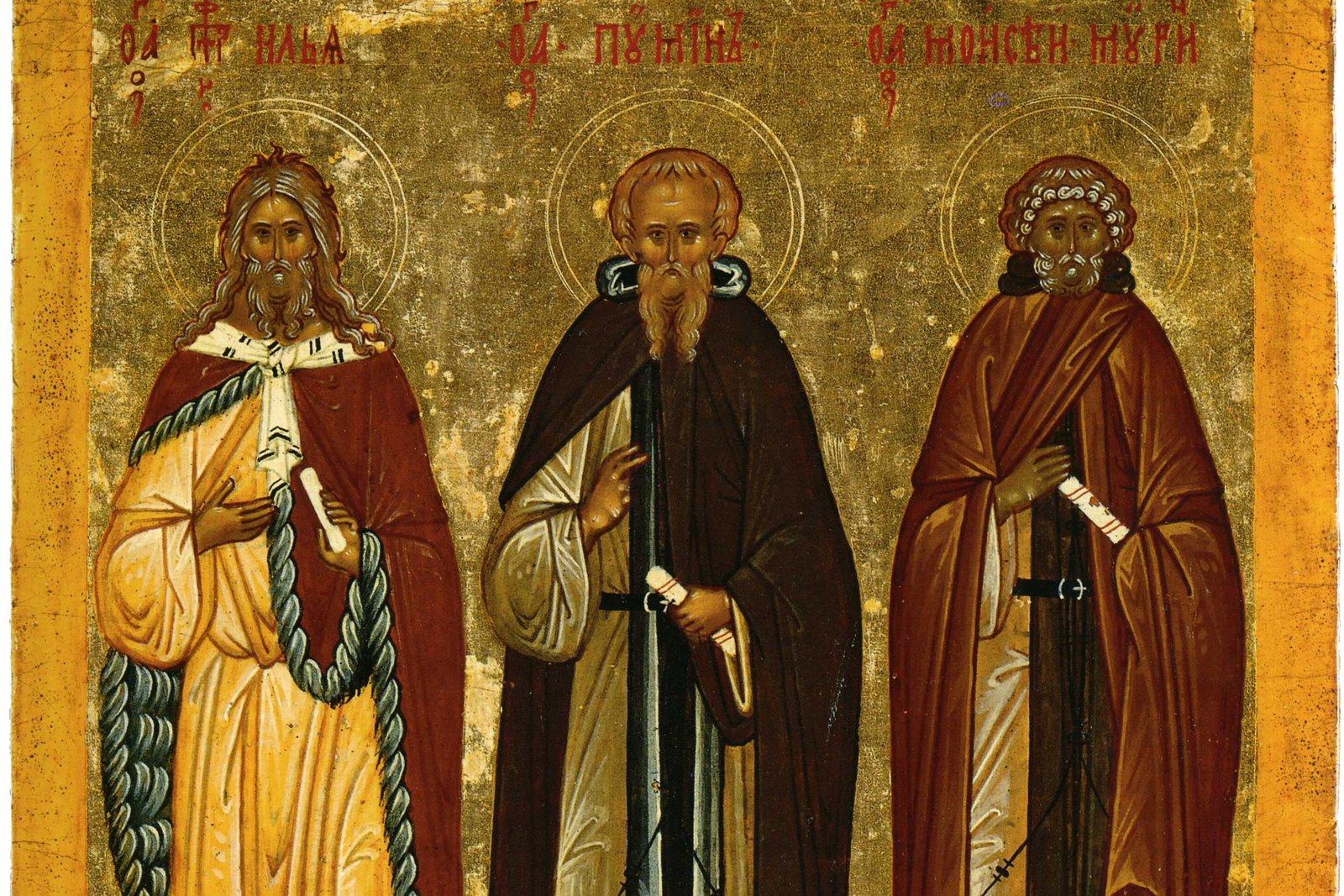
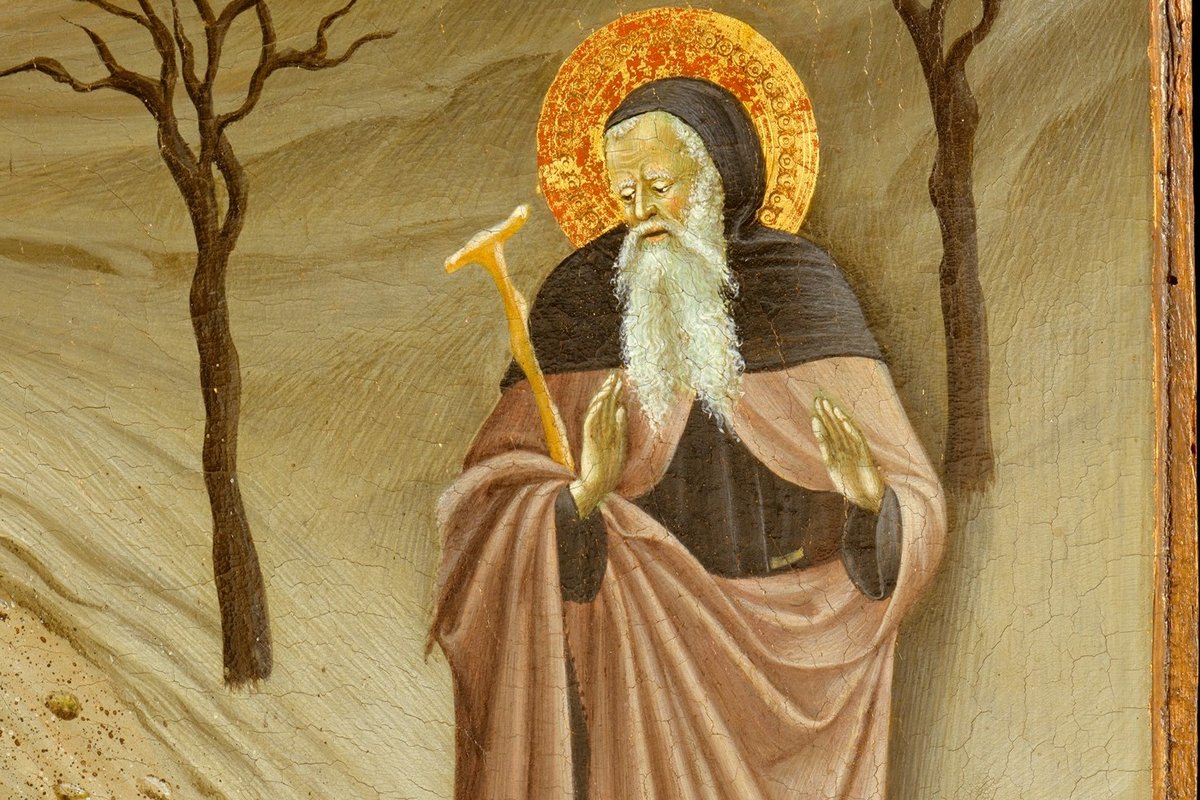
Unknown icon painter, Saints Poemen, Elijah, and Moses the Black, 15th century — public domain (Wikimedia Commons)
What brought Moses into the desert was not a spiritual awakening but flight — tradition holds that, pursued by authorities after a run of crimes, he sought a place to disappear and found it among a scattered community of Christian ascetics living in the region of Scetis, in the desert west of the Nile Delta. What he found there was not what he expected. The monks' discipline — voluntary poverty, extreme self-denial, hours of prayer in physical conditions that would break most people within days — struck him as something closer to real courage than anything his old life had demanded. He asked to stay, and he did.
A convert who out-disciplined the disciplined
What distinguishes Moses among the desert fathers, whose stories are already full of extraordinary asceticism, is the degree to which he seems to have driven himself harder than his teachers expected, as if determined to answer for his past through sheer intensity of practice. Multiple accounts describe him undertaking punishing vigils and fasts well beyond what his monastic superiors initially assigned him, and struggling, by his own account, with the same violent temperament he had brought with him from his old life — the Sayings describe him wrestling literally and repeatedly with anger and lust long after his conversion, not achieving instant serenity the moment he took up monastic life.
The story that has done more than any other to fix Moses's reputation involves a moment when a fellow monk was brought before a council of elders to be judged for a sin. Moses was asked to attend and give his opinion. He arrived carrying a basket with a hole in it, filled with sand, letting it trickle out behind him as he walked. When the others asked what he was doing, he answered that his own sins were running out behind him where he could not see them, and that he had come, despite that, to sit in judgment on someone else's. The council reportedly dropped the matter entirely. The story is preserved, in slightly varying wordings, across multiple ancient collections of the Sayings, and it remains one of the most frequently retold anecdotes from the entire desert monastic tradition — not because it flatters Moses, but because it doesn't.
Ordination, leadership, and a refusal to stop growing
As his reputation for wisdom and humility spread, Moses was eventually ordained a priest — tradition preserves an account of the ordaining bishop deliberately testing him first, publicly rebuking him and having him thrown out of the sanctuary to see how he would react, and Moses's calm response to the humiliation reportedly convinced the bishop he was ready. He went on to gather a community of disciples of his own, becoming a respected spiritual father within the wider network of monks scattered across Scetis, a region that by the later fourth century had become one of the most important centers of Christian monastic life anywhere in the world, predating and directly influencing the monastic rules that would later shape Western Christianity through figures like Saint Benedict.
Moses's teaching, as recorded in the Sayings, returns again and again to two themes drawn directly from his own history: relentless self-examination rather than judgment of others, and the conviction that no past, however violent, placed a person permanently beyond the reach of transformation. Given who was saying it, the message carried a weight that abstract preaching about mercy could never have matched.
A death that matched his life's turn away from violence
Around the year 405, a raiding party — the sources describe Berber or Bedouin raiders who periodically threatened the loosely defended desert monasteries — attacked the community where Moses lived. Warned in advance, according to tradition, Moses refused to flee and refused to allow his monks to take up weapons to defend themselves, insisting that a life built on turning away from violence could not end by taking it back up, even in self-defense. He and several companions were killed in the attack. The Church has remembered his death since as a form of martyrdom, one that completes rather than interrupts the arc of his story: a man who had once led armed men in taking what wasn't his, dying instead in deliberate, chosen nonviolence.
Moses the Black is venerated today across multiple Christian traditions — Eastern Orthodox, Oriental Orthodox including the Ethiopian and Coptic churches that claim him with particular pride as one of their own, and the Catholic Church, which keeps his memory among the honored Desert Fathers whose sayings shaped centuries of Christian monastic life. In recent decades he has also become an especially meaningful figure for Christian communities of African descent specifically looking for early, well-documented Black saints within the ancient Church — a search his story answers about as directly and dramatically as any figure from the entire patristic era.
Trivia
Who was Saint Moses the Black and when did he live?
Why is he called 'the Black' or 'the Ethiopian'?
How did a violent criminal become a monk?
What is Moses the Black known for as a monk?
How did Saint Moses the Black die?
You May Also Like
Related Reading