Jacob Serves Laban for Rachel

A man with nothing to offer but his own labor
By the time Jacob arrives at his uncle Laban's household in Haran, he's a man on the run — having fled his home after tricking his brother Esau out of their father's blessing, he arrives at Laban's with nothing to offer as a bride price for the woman he wants to marry. Genesis is direct about his feelings: Jacob loves Rachel, Laban's younger daughter, and proposes the only currency he has — his own labor. "I will serve you seven years for your younger daughter Rachel," he tells Laban, who agrees readily: "It is better to give her to you than to another man. Stay with me" (Genesis 29:18-19, NABRE).
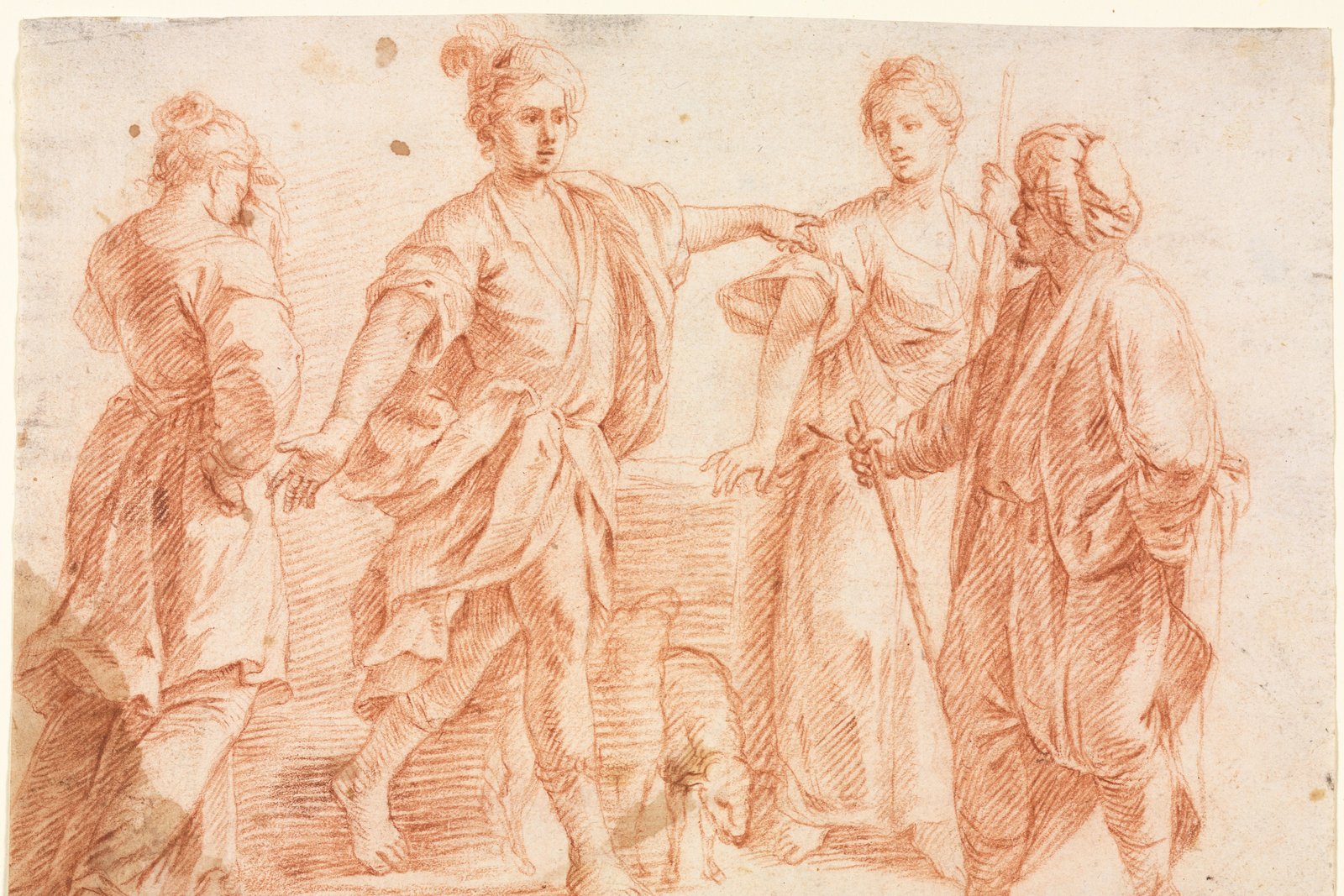
17th-century Bolognese school, Jacob and Laban with Rachel and Leah, Cleveland Museum of Art, public domain (CC0) via Wikimedia Commons
Seven years that felt like a few days
What follows is one of Genesis's more quietly affecting lines. Rather than describing seven years of labor as a grinding sentence, the text says the opposite: "So Jacob served seven years for Rachel, yet they seemed to him like a few days because of his love for her" (Genesis 29:20, NABRE). It's a small detail, easy to skim past, but it does real work — establishing that whatever else happens in the chapters that follow, Jacob's feeling for Rachel wasn't calculated or transactional on his side. He's not enduring the arrangement; the years pass lightly for him because of how much he wants what's waiting at the end of them.
A wedding, a veil, and a terrible morning
When the seven years finally end, Laban holds a wedding feast — and then, under cover of night or a bridal veil, substitutes his older daughter Leah in Rachel's place. Jacob doesn't discover the switch until the next morning: "In the morning, there was Leah!" (Genesis 29:25, NABRE). His reaction is immediate and furious — he confronts Laban directly: "How could you do this to me! Was it not for Rachel that I served you? Why did you deceive me?" (Genesis 29:25, NABRE). It's worth noting how closely the scene mirrors deception Jacob himself once carried out: years earlier, he had disguised himself to be mistaken for someone he wasn't, in order to receive a blessing meant for an older sibling. Now he's the one deceived, in a scene built around exactly that same substitution.
Laban's excuse, and a second seven years
Laban's justification is calm and, on its face, unanswerable: "It is not the custom in our country to give the younger daughter before the firstborn" (Genesis 29:26, NABRE) — a supposed local rule Jacob had no way to have known in advance, and no real power to dispute after the fact, given how thoroughly he depended on Laban's household. Rather than simply losing Rachel, though, Jacob is offered a second arrangement immediately: finish the customary bridal week with Leah, and Rachel will be given to him too, in exchange for another seven years of labor (Genesis 29:27, NABRE). Jacob accepts, and Genesis records him marrying Rachel as well shortly after — though the additional seven years of service technically came after the marriage this time, not before it.
A household built on unequal love
The consequences of this arrangement ripple through the rest of Genesis. Jacob ends up married to two sisters simultaneously, a household dynamic Genesis doesn't shy away from describing as difficult — the text is explicit that Jacob loved Rachel more than Leah, a favoritism Leah clearly feels and that shapes much of the family tension in the chapters that follow, including the birth-order and naming of Jacob's many children by both wives and their respective servants. What began as a straightforward love story — seven years passing like a few days — becomes the foundation of one of the more complicated households in all of Genesis, with consequences that extend all the way to the origins of the twelve tribes of Israel.
A name that carries Leah's own grief
Scripture doesn't leave Leah as simply the unwanted substitute in this story — it follows her directly into motherhood and lets her own words reveal how she experienced the marriage. "When the Lord saw that Leah was unloved, he made her fruitful, while Rachel was barren" (Genesis 29:31, NABRE), and when her first son is born, the name she gives him carries her pain openly: she named him Reuben, "for she said, 'It means, "The Lord saw my misery; surely now my husband will love me"'" (Genesis 29:32, NABRE). It's a rare moment in Genesis where a mother's naming of a child doubles as a direct statement of her own unmet hope — Leah isn't simply fulfilling a household role; she's hoping, out loud, that bearing children might finally earn her the love the marriage itself never gave her.
A blessing that remembers both sisters together
Centuries later, in the Book of Ruth, the elders of Bethlehem bless Boaz's marriage to Ruth by invoking this very pair of sisters: "May the Lord make this woman come into your house like Rachel and Leah, who between them built up the house of Israel" (Ruth 4:11, NABRE). It's a striking detail — rather than treating Rachel and Leah's story as a cautionary tale about deception and rivalry, later Scripture remembers them jointly, as the shared founding mothers of the nation itself, their children together forming the twelve tribes regardless of the unequal love and painful competition that marked their actual marriage. Whatever the story's difficulties, its outcome is remembered less for its wounds than for what it ultimately built.
A deceiver caught in his own pattern
What gives this episode its lasting narrative weight isn't just the romance or the betrayal individually, but the way the story quietly completes a circle. Jacob, the man who once wore his brother's clothes and lied to his own father's face to receive a blessing meant for someone else, finds himself on the receiving end of an almost identical substitution — the wrong sibling presented in place of the right one, in circumstances he can't undo once he discovers the truth. Genesis never states this parallel outright, but it hardly needs to; the echo is close enough that readers across centuries have consistently noticed it, reading Jacob's fourteen years of labor as more than a hard bargain — a long, costly encounter with the very kind of deception he had once practiced himself.
Trivia
Why did Jacob agree to work seven years for Rachel?
How did Laban trick Jacob on the wedding night?
What excuse did Laban give for the substitution?
Did Jacob still get to marry Rachel?
Is there irony in Jacob being deceived this way?
Related Reading