The Knights of Columbus: History and Mission Explained

A parish priest solves a practical problem
Father Michael McGivney didn't set out to build an international organization. He was a parish priest in a city full of Catholic immigrants — mostly Irish, Italian, and French-Canadian families working in New Haven's factories and shipyards — and he kept running into the same tragedy: a husband and father would die, often young, often suddenly, and leave a widow and children with no income and no safety net. Government social programs as we understand them today didn't exist yet. And the private, voluntary associations that filled that gap for other Americans — fraternal lodges, mutual aid societies, labor unions — routinely excluded Catholics, a reflection of the religious and ethnic discrimination Catholic immigrants faced throughout the late 19th century in the United States. (Read more about McGivney's own life and his path toward beatification — this article focuses on the organization he started.)
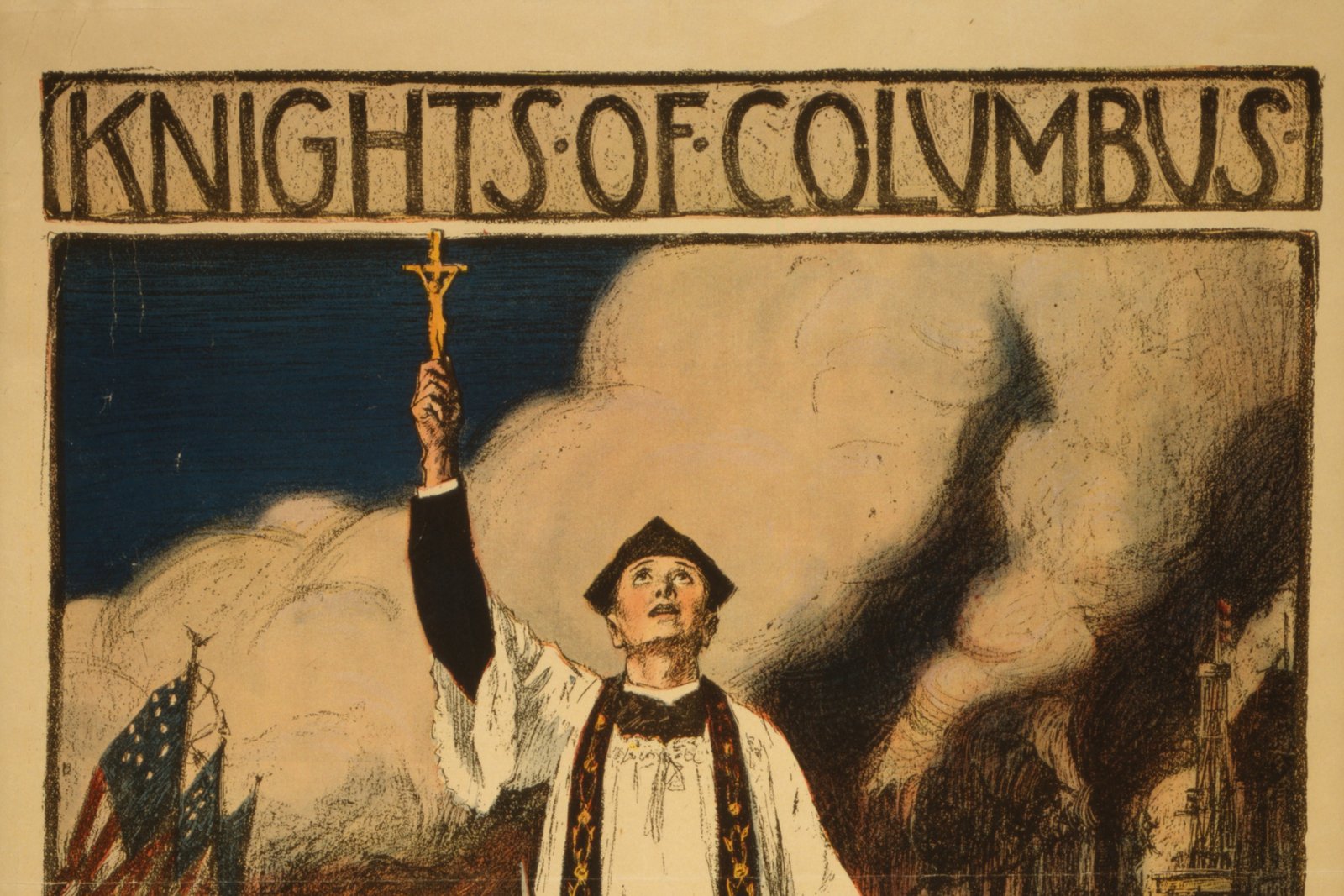
William Balfour Ker, Knights of Columbus, 1917 — public domain, Library of Congress.
McGivney's answer was practical rather than ideological. On March 29, 1882, he and a small group of men from St. Mary's Church in New Haven formally organized the Knights of Columbus as a mutual benefit society: members paid dues, and the organization provided life insurance so that a family wouldn't be left destitute when its breadwinner died. They named the new order after Christopher Columbus deliberately — in a cultural moment when Catholic immigrants were often painted as foreign and un-American, claiming a Catholic explorer credited with discovering the New World was itself a quiet rebuttal.
The insurance side of that founding idea never went away — it grew into one of the largest life insurance operations in North America, and it's worth understanding why that matters, because it's the financial engine that funds much of the charity the order is known for today.
From one New Haven council to a global order
The order's first councils were entirely within Connecticut, but growth outward was fast. By the late 1880s and 1890s, the Knights had restructured into a federal system — local councils, then state-level jurisdictions, then a national governing body — which let it coordinate across state lines and, eventually, across borders into Canada, Mexico, the Philippines, Poland, and other countries with significant Catholic populations.
Structurally, the order organizes its members through four progressive "degrees," each built around one of its core principles — charity, unity, fraternity, and (for men who choose to continue to the optional fourth degree) patriotism. A member who reaches the Fourth Degree is addressed as "Sir Knight" and typically joins a Fourth Degree assembly, the most visibly public arm of the organization — the Knights in ceremonial capes and plumed hats you've likely seen leading a parish procession, standing honor guard at a bishop's installation, or presenting the colors at a parade. There are more than 3,600 Fourth Degree assemblies worldwide today.
By the numbers, the order reports more than 2.2 million members and over 17,000 local councils as of 2025 — a scale that makes it, by a wide margin, the largest Catholic fraternal service organization in the world. Its wholly owned insurance company underwrites more than two million individual contracts, with over $123 billion of life insurance in force as of 2025.
A history of showing up in hard moments
The pattern McGivney started — organize locally, respond practically to a real need — repeated itself throughout the order's history, often during the country's worst moments. During World War I, the Knights ran welfare centers for American troops both at home and in France, and after the war they funded education, job training, and employment programs for returning veterans. In the 1920s, when Oregon passed a law that would have effectively outlawed Catholic parochial schools, the Knights helped fund the legal challenge that became Pierce v. Society of Sisters — the 1925 Supreme Court case that struck the law down and established a lasting precedent protecting parents' right to choose religious schooling for their children.
During the Cristero War in Mexico in the 1920s, when the Mexican government violently suppressed the Catholic Church, the Knights supported persecuted Catholics there; nine Knights killed in that conflict were later beatified or canonized as martyrs. And notably, historians have pointed out that the Knights of Columbus was the only major American fraternal society of its era whose constitution did not bar Black membership — a detail that mattered again during World War I, when the order's troop-support facilities were, according to contemporary accounts, the only racially integrated welfare facilities available to American soldiers.
Where the charity goes today
Today's Knights of Columbus describes charity as its foremost principle, and the figures back that framing: Supreme Knight Patrick Kelly's 2025 annual report cited roughly $197 million donated and 48 million volunteer-hours given to charitable projects in 2024 alone. That money and labor moves in several recognizable directions.
Disaster and refugee relief. The order has funded emergency aid since at least 1903, when it responded to a Kansas flood, and that pattern of showing up after disasters has continued ever since — including hundreds of thousands of dollars given to typhoon victims in 2015. More recently, following Russia's 2022 invasion of Ukraine, the roughly 2,000 Knights already active in Ukraine organized food, clothing, and transportation for refugees fleeing toward the Polish border; in the first three months of the war alone, Knights in Poland reportedly assisted more than 300,000 of the people who crossed. Since the invasion began, the order has delivered more than 8.5 million pounds of relief supplies and over $17 million in humanitarian aid tied to the conflict.
Support for persecuted Christians abroad. Between 2014 and 2018, the Knights gave more than $2 million toward food, shelter, and medical care for persecuted Christians and other religious minorities in the Middle East, part of a broader, ongoing commitment to Christian communities under threat overseas.
The Ultrasound Initiative and pro-life work. Since 2009, the order has funded and placed ultrasound machines in crisis pregnancy centers across the country — a program it has called one of its most significant humanitarian achievements — reaching its 2,000th machine installed in August 2025. After the 2022 Dobbs v. Jackson Women's Health Organization Supreme Court decision, the order expanded its Aid and Support After Pregnancy (ASAP) initiative to give more direct support to women facing unplanned pregnancies.
People with disabilities. The Knights have partnered with Special Olympics since its very first games in 1968, and have given more than $600 million in total support to people with intellectual and physical disabilities — one of the largest sustained charitable commitments in the order's history.
Much of this is only possible because of that original 1882 insurance idea: the order's insurance and investment arms generate the revenue base that funds a large share of its charitable giving, a structure that still traces directly back to McGivney's original purpose of protecting families financially.
A visible, parish-level presence
For most American Catholics, the Knights of Columbus isn't an abstraction — it's the men running the parish fish fry every Lenten Friday, the council selling raffle tickets after Mass to fund a seminarian's tuition, the Fourth Degree honor guard at a diocesan Confirmation Mass, or the volunteers quietly restocking a parish food pantry. That hyper-local, council-by-council structure is exactly what McGivney intended from the beginning — fraternity and charity organized around one's own parish, not a distant headquarters.
The order's connection to its founder has only deepened in recent years. Father Michael McGivney was beatified on October 31, 2020, after the Vatican approved a miracle attributed to his intercession — the formal step just short of canonization as a saint. The Knights continue to promote his cause and his memory, a reminder that the organization's entire charitable infrastructure, insurance business, and parish presence still trace back to one priest's concern for a handful of widows and orphans in 19th-century New Haven.
If you're exploring how practical Catholic charity has looked across different eras, our Catholic social teaching explained article covers the broader tradition the Knights' work fits into, and how to get involved at your parish is a natural next read if a local council has caught your interest.
Trivia
Who founded the Knights of Columbus, and why?
Why is it called the Knights of Columbus?
How many members does the Knights of Columbus have today?
What charitable work is the Knights of Columbus best known for?
Is the Knights of Columbus connected to its founder's sainthood cause?
Related Reading