Venerable Michael McGivney, Founder of the Knights of Columbus

The eldest son of a brass-mill molder
Michael Joseph McGivney was born on August 12, 1852, in Waterbury, Connecticut, the eldest of thirteen children born to Patrick and Mary McGivney, Irish immigrants who had come to Connecticut amid the great wave of Irish Catholic migration following the famine years. Patrick worked as a molder in one of Waterbury's brass mills — hard, dangerous factory labor typical of the jobs available to Irish Catholic immigrants in mid-nineteenth-century New England, where Catholics faced real, everyday discrimination from an overwhelmingly Protestant establishment. Six of Michael's twelve younger siblings died in infancy or childhood, an ordinary tragedy of the era that gave the family a close, firsthand sense of how thin the margin was between a working family's stability and its ruin.
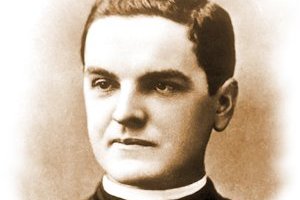
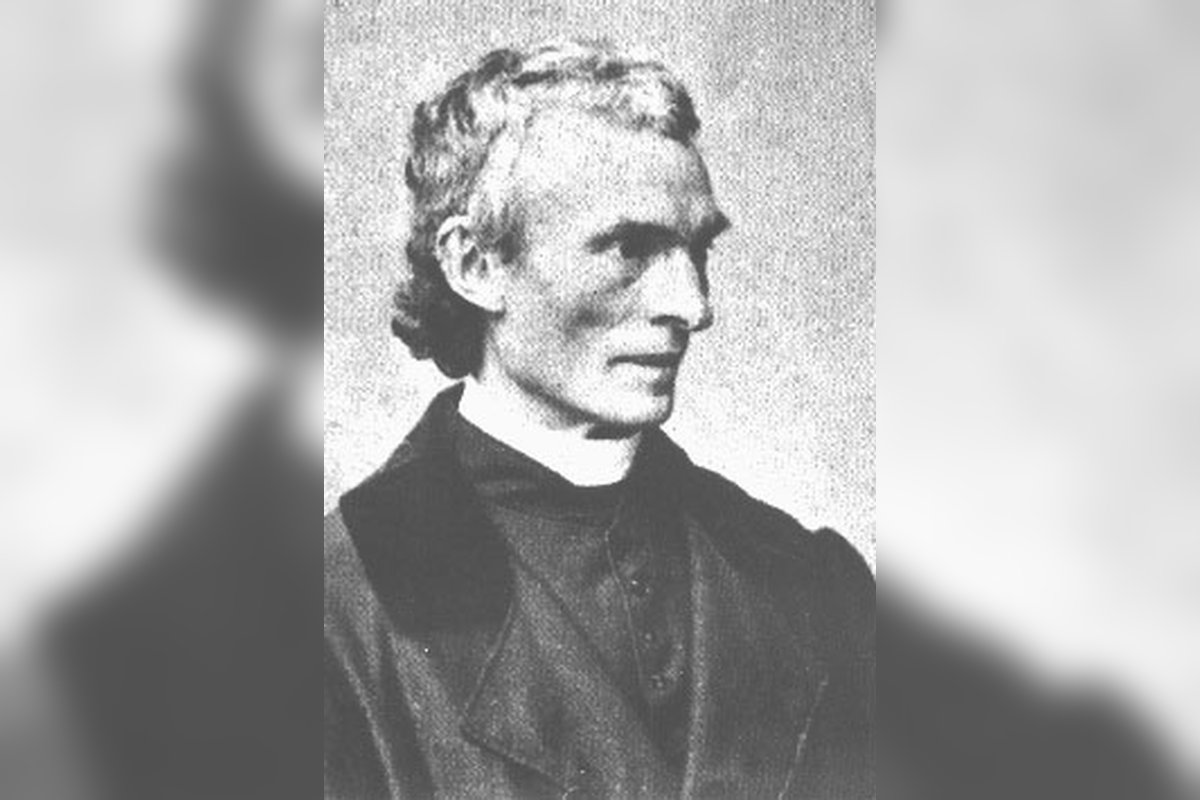
Photograph of Father Michael J. McGivney, before 1890, photographer unknown — public domain.
McGivney left school early to work in the same brass mills, but by his teenage years he had decided he wanted to become a priest, and in 1868, at sixteen, he entered seminary — first in Quebec, then in Niagara Falls, New York, and then in Montreal. His studies were interrupted in 1873 when his father died, leaving the family without income and forcing Michael, briefly, to come home and work to support his mother and siblings. The bishop of Hartford, recognizing the young man's promise, stepped in to pay for the rest of his seminary training at St. Mary's Seminary in Baltimore. McGivney was ordained a priest for the Diocese of Hartford on December 22, 1877, and was assigned as an assistant pastor at St. Mary's Parish in New Haven — the first Catholic parish established in that city.
A parish priest who paid a bond he couldn't afford
At St. Mary's, McGivney built a reputation less for scholarship than for a particular, practical kind of devotion to his working-class parishioners. He organized plays, fairs, and outings, believing that wholesome entertainment did real good for a community's morale, and he revived a local temperance society. When a widowed parishioner, Mary Downes, was left with children the state threatened to take into custody unless someone posted a bond the family couldn't afford, McGivney told the court he would personally guarantee it — despite not having the money himself, relying on a local grocer to lend it to him so the family could stay together. The same instinct showed up again in 1881 and 1882, when he spent months visiting a condemned young parishioner, James "Chip" Smith, in prison in the weeks before his execution for murder, praying with him and, by contemporary newspaper accounts, leaving him visibly steadied in his final days.
Both episodes point to the same quality that would define McGivney's whole short ministry: he treated the practical, material vulnerability of his immigrant parishioners — debt, imprisonment, a dead breadwinner — as a priest's direct business, not a separate concern from their spiritual care.
Founding a fraternal insurance society for Catholic immigrant families
That instinct found its lasting form on March 29, 1882, when McGivney organized a small group of men from St. Mary's into what he named the Knights of Columbus. The need was concrete and widely shared in his own pews: when a Catholic immigrant father died, as so many did young in an era before modern medicine or workplace safety, his widow and children were frequently left destitute, with no income and no social safety net to fall back on. Protestant-run fraternal and mutual-aid societies — the standard way working-class American families insured against exactly this risk in the late nineteenth century — often excluded Catholics outright or required members to take oaths the Church forbade them from swearing. The American Catholic hierarchy, meanwhile, was separately worried that Irish Catholic men, denied these mainstream fraternal options, were drifting toward radical secret societies instead.
McGivney's answer addressed both problems with one simple mechanism: members paid into a shared fund, and when a member died, the society paid a death benefit directly to his widow and children. He deliberately named the organization after Christopher Columbus — not for any special Marian or saintly patronage, but to make a pointed historical argument that Catholics had been present in, and had helped discover, the Americas long before the Protestant establishment that now treated them as outsiders. The new Knights elected McGivney as their first leader, but he declined, insisting a layman should hold that role instead, and by 1884 he had stepped back to serve only as the group's chaplain — a decision that let the organization grow as something lay Catholics ran for themselves, rather than a priest's personal project.
Transferred, sick, and dead at thirty-eight
In 1884 the Diocese of Hartford transferred McGivney to St. Thomas Church in Thomaston, Connecticut, where he continued parish work and helped establish a local Knights of Columbus council. He fell ill during the severe 1889–1890 "Russian flu" pandemic that swept through much of the world, and the illness developed into tuberculosis and, by January 1890, pneumonia. Confined to the St. Thomas rectory for his final months, he died there on August 14, 1890, at thirty-eight — just thirteen years into his priesthood. More than seventy priests and delegations from all fifty-seven existing Knights of Columbus chapters attended his funeral, a scale of turnout that suggests how widely his work was already recognized within Connecticut Catholic circles, even if his name meant little beyond them.
He was buried at St. Mary's Church in New Haven, the parish where he had started the Knights eight years earlier — now his cause's major shrine, and the site of the Blessed Michael McGivney Pilgrimage Center that opened there in 2020.
From a one-parish insurance fund to a global fraternal order
The organization McGivney founded in a single New Haven parish basement grew, over the following century, into the world's largest Catholic fraternal service organization, with millions of members in thousands of councils across multiple countries by the early twenty-first century. Its founder, meanwhile, remained largely forgotten outside Connecticut Catholic memory until the Archdiocese of Hartford opened his canonization cause in 1996. The archdiocese closed its local investigation in 2000 and forwarded the case to the Vatican's Congregation for the Causes of Saints; in March 2008, Pope Benedict XVI formally recognized McGivney's "heroic virtue" and declared him Venerable — the step in the canonization process that confirms a candidate lived a life of exemplary Christian virtue, short of the formal miracle required for beatification.
That miracle, according to the Vatican's own account, came through a family far from Connecticut. In February 2015, doctors at Vanderbilt University Medical Center told Dan and Michelle Schachle, a Catholic couple from Dickson, Tennessee, that the son Michelle was carrying had fetal hydrops, a condition involving abnormal fluid buildup that typically proves fatal within days of birth. Dan worked for the Knights of Columbus's own insurance arm, and the family and their parish community prayed for McGivney's intercession specifically. Days after a previously scheduled pilgrimage to Fátima, Portugal, a follow-up ultrasound back in Tennessee found no trace of the condition doctors had diagnosed weeks earlier — a reversal doctors involved could not explain medically. The boy, named Michael McGivney Schachle, was born that May. A diocesan tribunal in Nashville investigated the case, and the Vatican's own medical and theological review concluded the cure had no natural explanation; Pope Francis approved it on May 27, 2020, clearing the way for McGivney's beatification that October 31 at the Cathedral of Saint Joseph in Hartford.
Venerable, Blessed — and what still lies ahead
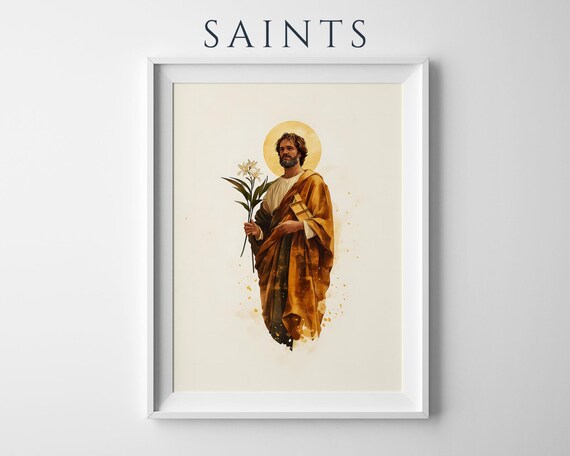
McGivney now holds the title Blessed, the stage directly before canonization, which the Church would grant only after a second verified miracle attributed to his intercession. His cause's postulator and the Father McGivney Guild, which supports it, continue gathering and forwarding reports of favors attributed to his prayers for that purpose. Whatever the eventual outcome, his own life left behind almost no personal writing — no sermons, letters, or journals survive, by his biographers' account — which means what the Church is actually weighing is not a body of spiritual teaching but a pattern of ordinary pastoral action: a bond posted for a widow's children, a condemned man visited daily, and a fraternal insurance fund built, quietly and without personal ambition, to keep Catholic immigrant families from falling through the cracks of a country that didn't yet fully welcome them. Those who want a model of the kind of steady, unglamorous care for one's own household that McGivney spent his ministry defending might also look to Saint Joseph, the patron the Knights of Columbus themselves have long honored as a model of fatherhood and quiet providence.
Trivia
Who was Michael McGivney?
Why did McGivney found the Knights of Columbus?
How did Michael McGivney die?
What miracle led to McGivney's beatification?
Is Michael McGivney a canonized saint?
Related Reading