The Litany of Loreto Explained

A prayer named after a shrine
Most litanies take their name from their content or purpose — the Litany of the Saints is named for what it does. The Litany of Loreto is named instead for a place: the Shrine of Our Lady of Loreto, on Italy's Adriatic coast, where its use in this particular form is documented as early as 1558. That doesn't necessarily mean the prayer was composed there from nothing — Marian litanies with a similar structure were already circulating in the century or more before Loreto's version is first recorded — but Loreto is the specific place history most directly connects to the text now prayed under its name across the whole Catholic world.
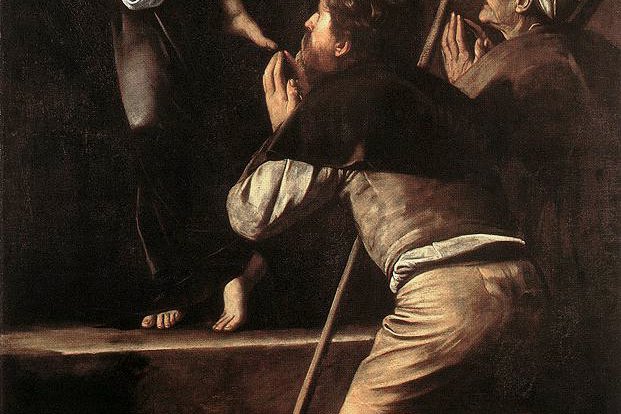
Caravaggio, Madonna di Loreto (1604-1606), public domain via Wikimedia Commons
Built on an older tradition
The Litany of Loreto didn't appear in isolation. Litanies invoking Mary under a series of titles have a longer pedigree, with examples appearing as early as the twelfth century and multiplying through the thirteenth and fourteenth centuries across Western Christendom. Devotion in the Christian East also contributed to this broader current — lists of titles honoring Mary were a familiar feature of Eastern liturgical and devotional tradition as well, and that influence shaped the kind of language later Western Marian litanies, Loreto's included, would use. What eventually distinguished the Loreto litany from its many predecessors and contemporaries was less its originality than its staying power: it's the version that survived, spread, and eventually received formal Church approval, while many of the earlier regional variants faded from common use.
Approved by a pope, expanded by his successors
Pope Sixtus V formally approved the Litany of Loreto in 1587, giving it an official standing among Marian devotions rather than leaving it as simply one popular custom among many regional variants. That approval also set a rule that has governed the litany's text ever since: only a pope has the authority to add a new title to it. Several have exercised that authority over the centuries that followed. Pope Pius VII, for instance, added the title "Queen of all saints" in 1814, specifically in gratitude for his own return to Rome after being held captive during the Napoleonic wars — a reminder that even a centuries-old fixed prayer text has, at points, absorbed a very particular moment of one pope's personal history into its permanent wording.
Titles that build a portrait, one phrase at a time
Reading through the litany's full list of titles — among them "Seat of Wisdom," "Mystical Rose," "Tower of David," "House of Gold," "Morning Star," "Health of the Sick," "Refuge of Sinners," and "Queen of Peace" — gives a sense of how the prayer works as a whole. No single title is meant to carry the entire weight of Marian devotion; instead, the litany accumulates images and roles across many short phrases, each drawn from Scripture, tradition, or centuries of devotional reflection on Mary's place in salvation history. Praying the full litany means moving through dozens of these titles in sequence, each met with the same brief response — a structure that, much like the Litany of the Saints, relies on repetition and accumulation rather than a single developed argument to make its point.
How the prayer is structured
The Litany of Loreto doesn't open directly with Mary's titles. Like most Catholic litanies, it begins with a short series of invocations to the Trinity — "Lord, have mercy," "Christ, have mercy," then addresses to God the Father, Son, and Holy Spirit in turn — before moving into the long central section of Marian titles that gives the prayer its popular name. After the final title, "Queen of Peace," the litany closes with the Agnus Dei ("Lamb of God, who takes away the sins of the world...") and a concluding prayer, traditionally the collect asking for health of body and soul through Mary's intercession. That three-part shape — Trinitarian opening, accumulated titles, Agnus Dei and closing prayer — is the same basic skeleton shared by the Litany of the Saints and most other approved Catholic litanies; Loreto's distinctive middle section is simply longer and more image-rich than most.
What some of the titles actually mean
Many of the titles can sound puzzling to a modern ear until their source is explained. "Tower of David" and "House of Gold" come from the Song of Songs and from Old Testament imagery of strength and preciousness, applied to Mary as a reflection of her unique dignity. "Ark of the Covenant" draws a direct parallel between the Old Testament vessel that carried God's presence among his people and Mary, who carried Christ himself in her womb. "Morning Star" echoes the way the planet Venus precedes and announces the sunrise, read as a symbol of Mary going before and pointing toward her son. "Health of the Sick," "Help of Christians," and "Refuge of Sinners" are more straightforward — titles describing roles the faithful have historically turned to Mary for in prayer, particularly during plagues, wars, and periods of persecution when several of these specific titles are believed to have entered common use. None of the titles claim anything for Mary that competes with Christ's own unique role as savior; Catholic teaching has always held that any power attributed to Mary's intercession is received from God, not possessed independently.
Related Marian prayers
The Litany of Loreto is one of several approved litanies in the Church's official liturgical books, but it sits within a much larger family of Marian devotions. The Rosary itself is built from repeated Hail Marys grouped around meditations on Christ's life, and the Litany of Loreto is traditionally prayed immediately after finishing a full Rosary, extending its meditative rhythm a little further. The Angelus, prayed by tradition at morning, noon, and evening, is shorter and built around the Annunciation rather than a list of titles. The Memorare, by contrast, is a single continuous prayer rather than a litany, appealing to Mary's intercession through a single sustained argument instead of an accumulated list. Together, these prayers represent different shapes the Church's Marian devotion has taken over the centuries — litany, rosary, antiphon, and single petition — each suited to a different kind of prayer occasion.
Still prayed today, especially in May and October
The Litany of Loreto remains one of the most commonly prayed Marian litanies in the Church today, often recited at the end of the Rosary or as a standalone devotion, particularly common during May and October, months with strong traditional associations with Marian devotion. For a prayer whose exact origins reach back more than four and a half centuries, and whose roots draw on litany traditions older still, it remains in active, ordinary use — not a historical artifact recited out of obligation, but a working prayer that continues, occasionally, to grow.
Trivia
What is the Litany of Loreto?
Why is it called the Litany of Loreto?
When was the Litany of Loreto officially approved by the Church?
Has the list of titles changed since it was first approved?
Did the Litany of Loreto develop out of nothing, or did earlier Marian litanies exist?
Related Reading