The Litany of the Saints Explained

A prayer built from a single, repeated request
The structure of the Litany of the Saints is almost deceptively simple. It opens with brief invocations of God — Father, Son, and Holy Spirit — then moves to Mary, and from there into a long, ordered sequence of named saints: apostles, martyrs, bishops, virgins, and others drawn from across the Church's history. After each name, the congregation responds with the same short phrase, "pray for us." Only after this long roll call does the litany shift into a different register, moving into a series of specific petitions — for the Church, for those in need, for the particular occasion the litany is being prayed for — each answered instead with "we beg you, hear us" or a similar refrain. The repetition isn't padding; it's the prayer's whole method, a sustained act of asking one intercessor after another to join in a single request.
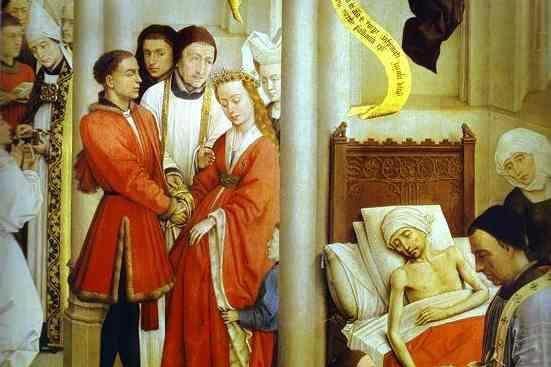
Rogier van der Weyden, Seven Sacraments Altarpiece, detail (15th century), public domain via Wikimedia Commons
Roots reaching back to the fifth century
Few prayers still used regularly in the Catholic liturgy can claim roots as old as this one. Documented forms of litanies invoking the saints in procession go back at least to the fifth century, associated with a procession connected to Saint Mamertus, bishop of Vienne in Gaul. Later, Pope Saint Gregory the Great is credited with organizing a sevenfold litany procession, known as the Litania Septiformis, around the year 590, during a time of plague in Rome. The specific text and structure used today developed and standardized over the many centuries between then and now, but the basic form — name a saint, ask for intercession, move to the next — has proven remarkably durable across an enormous span of Church history.
Sung at the Easter Vigil
Of the litany's uses in the modern liturgy, its appearance at the Easter Vigil is among the most striking. It's sung during the procession connected to that night's baptisms and receptions into full communion with the Church — the night the liturgical year's central feast begins, and the night the Church welcomes new members into itself. Calling on the saints by name at exactly that moment frames baptism as an entry not just into a set of beliefs, but into fellowship with a specific, named communion of holy men and women who have gone before — the same connection the Catechism describes when it says that those in heaven "do not cease to intercede with the Father for us" and that "by their fraternal concern our weakness [is] greatly helped" (CCC 956).
Sung at ordinations
The litany's other major liturgical setting is the ordination of priests, deacons, and bishops. During the rite, the candidate or candidates lie prostrate before the altar while the whole assembly sings the litany over them — a striking visual and audible combination of total physical humility and the invoked support of the whole communion of saints. The gesture is meant to express something specific: that the man being ordained isn't relying on his own strength or worthiness for the ministry he's about to receive, but is asking, quite literally while lying face down, for the intercession of the entire Church, living and dead, on his behalf.
Room for local names within a universal structure
Although a standard core list of saints anchors the litany's usual form, the prayer isn't entirely fixed. Local custom permits the addition of particular names relevant to the specific celebration — the patron saint of the parish or diocese where the liturgy is happening, or the patron saints chosen by those being baptized or ordained that day. That flexibility lets what is, on paper, a very old and standardized prayer take on a specific, local shape each time it's prayed, tying a particular congregation's own saints into the same ancient structure used across the universal Church.
The order the saints are named in
The sequence of names isn't random. The litany moves through a traditional hierarchy that mirrors how the Church has long organized its calendar of saints: after Mary come the archangels and angels, then John the Baptist and the patriarchs of the Old Testament, then the apostles and evangelists, then martyrs, bishops and doctors of the Church, priests and religious, and finally holy men and women drawn from the laity. Within each group, names are usually arranged with the earliest or most prominent figures first — Peter and Paul lead the apostles, for instance — though local versions can rearrange or expand a category to make room for names with particular importance to that place or occasion. The effect of moving through the categories in order is to let the litany trace, in miniature, the whole shape of the Church's membership across time: angels, Old Testament figures, the apostolic generation, and the long unfolding history of holiness that followed.
The litany at funerals and in other rites
Beyond the Easter Vigil and ordinations, the Litany of the Saints — or a shortened form of it — appears in several other rites where the Church wants to call attention explicitly to the communion between the living and the dead. It can be sung during the Rite of Christian Burial, asking the saints' intercession for the person who has died. Shorter litanies drawing on the same structure also appear in the rite of religious profession, when a man or woman makes vows as a monk, friar, or nun, and in the dedication of a church, when the building itself is set apart for worship. In each case the underlying logic is the same: whenever the Church marks a major threshold — death, religious commitment, a building's consecration, baptism, ordination — it reaches for this same ancient form, asking the saints by name to accompany the moment.
A prayer that predates most of what surrounds it
Because the Litany of the Saints is woven into rites most Catholics encounter only occasionally — an ordination, the Easter Vigil, a religious profession — it's easy to overlook just how much older it is than nearly everything else in the modern liturgy around it. Many elements of the current Easter Vigil and ordination rites were revised in the twentieth century, some substantially; the litany's basic form — name a saint, respond "pray for us," move to the next — has survived relatively unchanged in its essential shape since long before those revisions, carried forward through a Church that has otherwise rewritten a great deal of its liturgical language over the centuries.
Why the repetition is the point
It would be easy to read a litany with dozens of names and responses as simply long, but the length is doing real theological work. The Litany of the Saints doesn't ask once and move on — it keeps asking, name after name, building a cumulative sense of a communion far larger than the people physically present in the room. By the time the litany reaches its closing petitions, the assembly has spent several minutes doing nothing but naming holy men and women and asking for their prayers — a slow, deliberate way of making the Church's teaching on the communion of saints audible, one name and one response at a time, rather than simply stated as doctrine.
Trivia
What is the Litany of the Saints?
How old is this prayer?
When is the Litany of the Saints used in the liturgy today?
Can the list of saints named in the litany change?
Why is a candidate for ordination told to lie face down during the litany?
You May Also Like
Related Reading