How to Pray the Rosary, Step by Step

The physical rosary, piece by piece
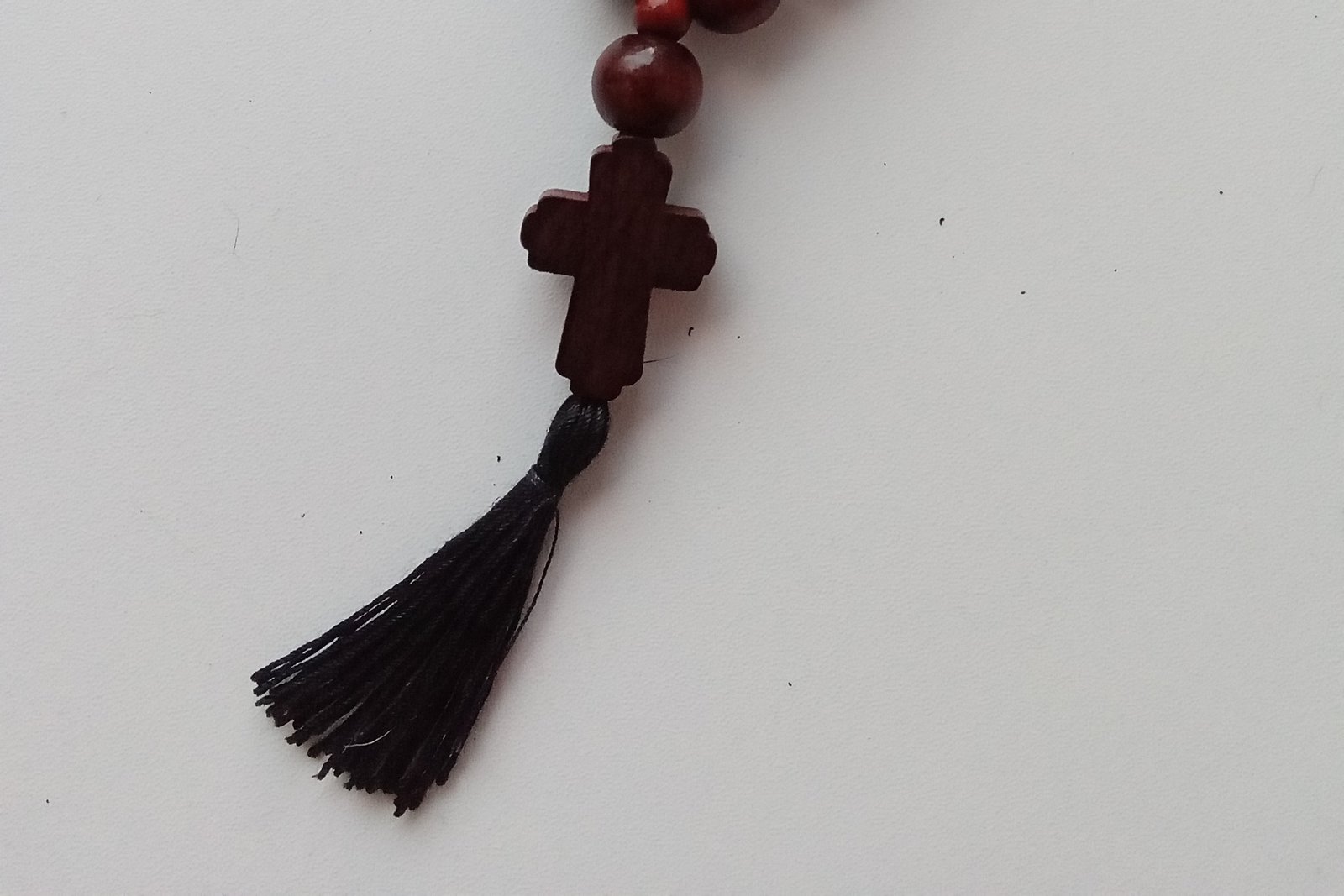
A standard five-decade rosary has a crucifix at one end, followed by a single bead, then three beads, then another single bead, before the loop opens into five groups ("decades") of ten beads each, with a single bead separating each decade. A small medal, often depicting Mary, usually sits where the tail meets the loop. Every bead corresponds to exactly one prayer, which is the whole trick to praying it: your fingers keep count so your mind doesn't have to.
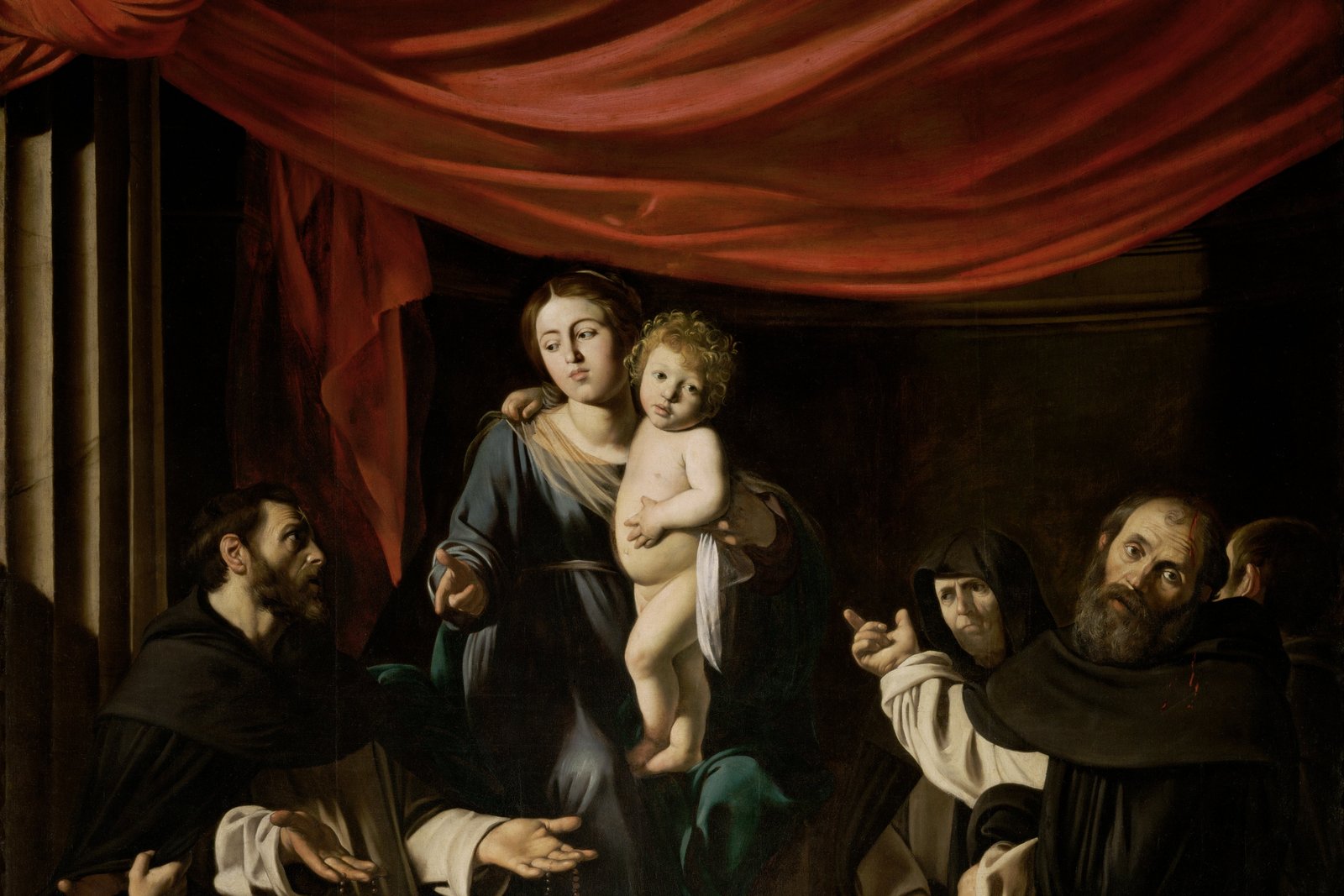
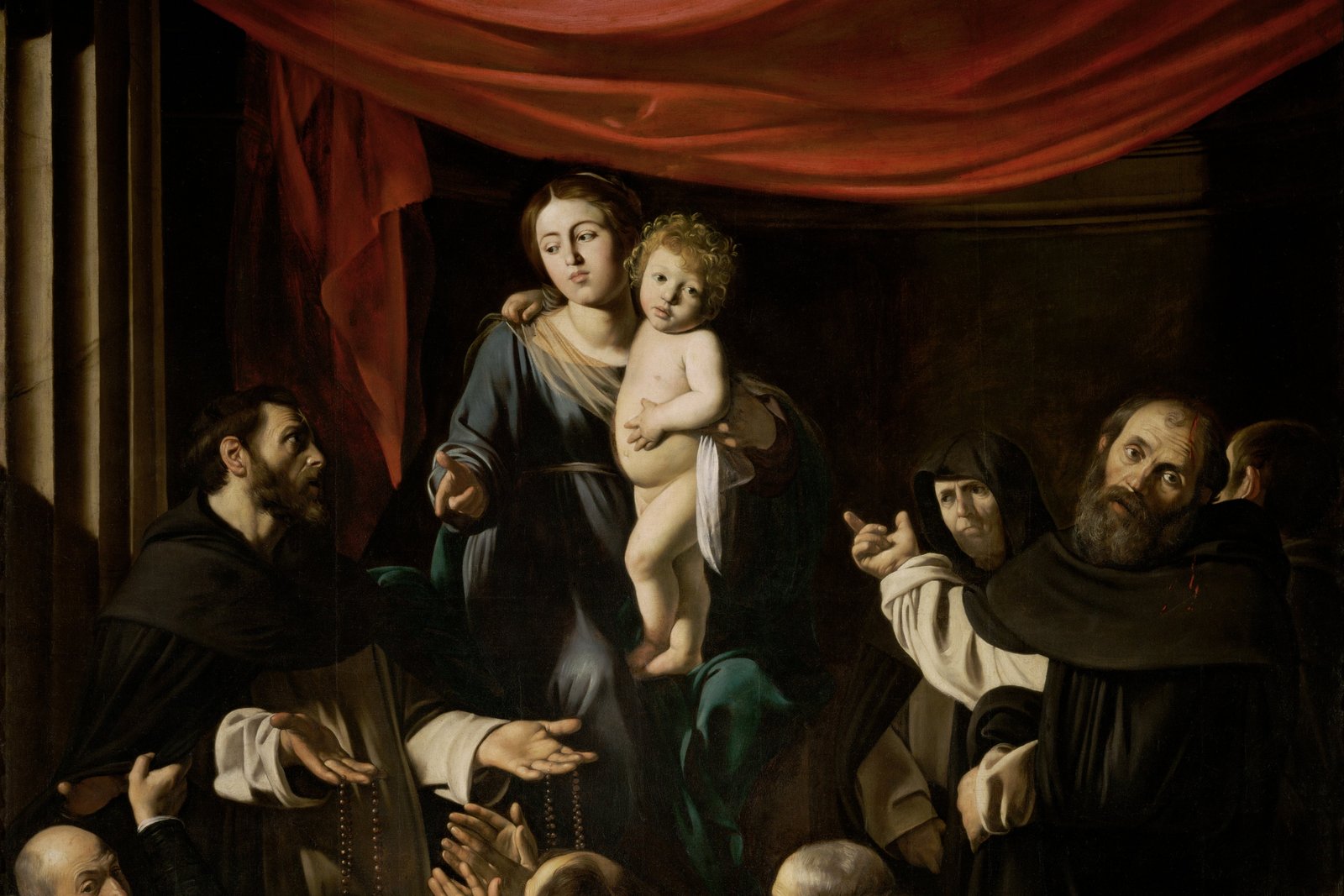
Caravaggio, Madonna of the Rosary, 1607, Kunsthistorisches Museum, Vienna — public domain.
If you don't have a rosary on hand, none of what follows requires one — the same sequence of prayers can be counted on fingers or simply prayed in order without beads at all. The beads are a memory aid, not a requirement for the prayer to "count."
The opening sequence
Starting at the crucifix and moving inward:
- On the crucifix: pray the Apostles' Creed.
- On the first single bead: pray the Our Father.
- On the next three beads: pray a Hail Mary on each, traditionally offered for an increase in faith, hope, and charity.
- On the next single bead: pray the Glory Be.
That's the entire opening. Everything from here repeats in a fixed pattern five times, once per decade.
Praying a decade
Each of the five decades follows the same shape:
- Announce the Mystery for that decade (see below) and, if you like, pause for a moment to picture the scene before praying.
- On the single bead, pray the Our Father.
- On the ten beads that follow, pray a Hail Mary on each.
- On the single bead that closes the decade, pray the Glory Be.
Many Catholics also add the Fatima Prayer after the Glory Be — "O my Jesus, forgive us our sins, save us from the fires of hell, lead all souls to Heaven, especially those most in need of your mercy" — a devotion connected to the reported Marian apparitions at Fatima in 1917. It's a widespread custom rather than a required part of the Rosary's traditional structure.
Repeat this same four-step pattern for all five decades, moving one Mystery to the next each time. After the fifth decade, many Catholics close with the Hail, Holy Queen (the Salve Regina) and a final Sign of the Cross.
The four Mysteries — and which days they belong to
The heart of the Rosary isn't the repetition itself; it's what each decade is meant to be meditated on while the Hail Marys are prayed. There are twenty of these scenes, called Mysteries, grouped into four sets of five:
- Joyful Mysteries — the Annunciation, the Visitation, the Nativity, the Presentation in the Temple, and the Finding of the Child Jesus in the Temple. Traditionally prayed Mondays and Saturdays.
- Sorrowful Mysteries — the Agony in the Garden, the Scourging at the Pillar, the Crowning with Thorns, the Carrying of the Cross, and the Crucifixion. Traditionally prayed Tuesdays and Fridays.
- Glorious Mysteries — the Resurrection, the Ascension, the Descent of the Holy Spirit at Pentecost, the Assumption of Mary, and her Coronation as Queen of Heaven. Traditionally prayed Wednesdays and Sundays.
- Luminous Mysteries — Christ's Baptism in the Jordan, the wedding at Cana, his proclamation of the Kingdom of God, the Transfiguration, and the institution of the Eucharist at the Last Supper. Traditionally prayed Thursdays.
The Luminous Mysteries are the newest addition to the Rosary by several centuries. Pope John Paul II introduced them in his 2002 apostolic letter Rosarium Virginis Mariae, explaining that he wanted to fill what he saw as a gap between the Joyful Mysteries of Christ's infancy and the Sorrowful Mysteries of his Passion — the years of Christ's public ministry had no set of Mysteries of their own before then. For a closer look at all twenty scenes, see the Mysteries of the Rosary.
The weekly assignment of Mysteries to days is a widely followed custom, not a rule — nothing prevents someone from praying the Sorrowful Mysteries on a Monday because that's the day grief is heaviest, or repeating the same set every day during Lent.
Common beginner questions in practice
Losing count mid-decade is close to universal among people learning the Rosary, and it doesn't undo anything already prayed — simply pick up where you think you left off, or restart the decade if you're unsure. There's no requirement to pray an entire five-decade Rosary in one sitting either; some people pray a single decade during a commute or a walk, which is a complete and valid form of the prayer on its own, just a shorter one.
It's also worth knowing what the Rosary is not. The Catechism draws a clear line between the veneration given to Mary and the adoration reserved for God alone (CCC 971, 2096-2097), and the Rosary itself is overwhelmingly Christ-centered in its content — of the twenty Mysteries, only one, the Coronation, focuses on Mary directly, while every other scene is drawn from Christ's own life. Praying the Rosary is not an act of worshiping Mary; it's a way of walking through the Gospel using her eyes.
Where the devotion came from
A popular legend credits Saint Dominic with receiving the Rosary directly from Our Lady in the thirteenth century, a story told in more detail in Our Lady Gives the Rosary to Saint Dominic. Historians generally describe a slower, more gradual development instead — strings of knotted cords used for repeated prayer, medieval "Marian psalters" of 150 Hail Marys echoing the 150 psalms, and a settling, by the late Middle Ages, into something close to the fifteen-decade form that held for centuries before John Paul II's 2002 addition brought it to twenty. Dominic's association with the Rosary's promotion is old and durable even where the single miraculous origin story is pious tradition rather than documented history.
None of that history is necessary to actually pray it, though. The whole devotion reduces to four familiar prayers, repeated in a fixed order, while attention rests on one Gospel scene at a time — simple enough to learn in one sitting, and, for many Catholics, never fully finished being learned at all.
Trivia
How long does it take to pray a full Rosary?
What are the four Mysteries of the Rosary and which days are they prayed?
When were the Luminous Mysteries added to the Rosary?
Do I need to say every word perfectly or use a specific rosary to pray it correctly?
Is the Rosary only for Catholics who are good at meditation?
Related Reading