The Miraculous Medal Novena: Prayer and Origins

The apparition behind the medal
On the night of November 27, 1830, a young novice named Catherine Labouré reported seeing the Virgin Mary in the chapel of the Daughters of Charity motherhouse on Rue du Bac in Paris — the second of several visions Catherine experienced that year. Mary appeared standing on a globe, her feet crushing a serpent, rays of light streaming from rings on her fingers toward the earth below. Around the image, in an oval frame, ran the words Catherine understood as a message to be inscribed exactly: O Marie, conçue sans péché, priez pour nous qui avons recours à vous — "O Mary, conceived without sin, pray for us who have recourse to thee." According to Catherine, a voice then told her: "Have a medal struck upon this model. All who wear it will receive great graces." The full story, including the image's reverse side and its symbolism, is told at greater length in The Miraculous Medal.
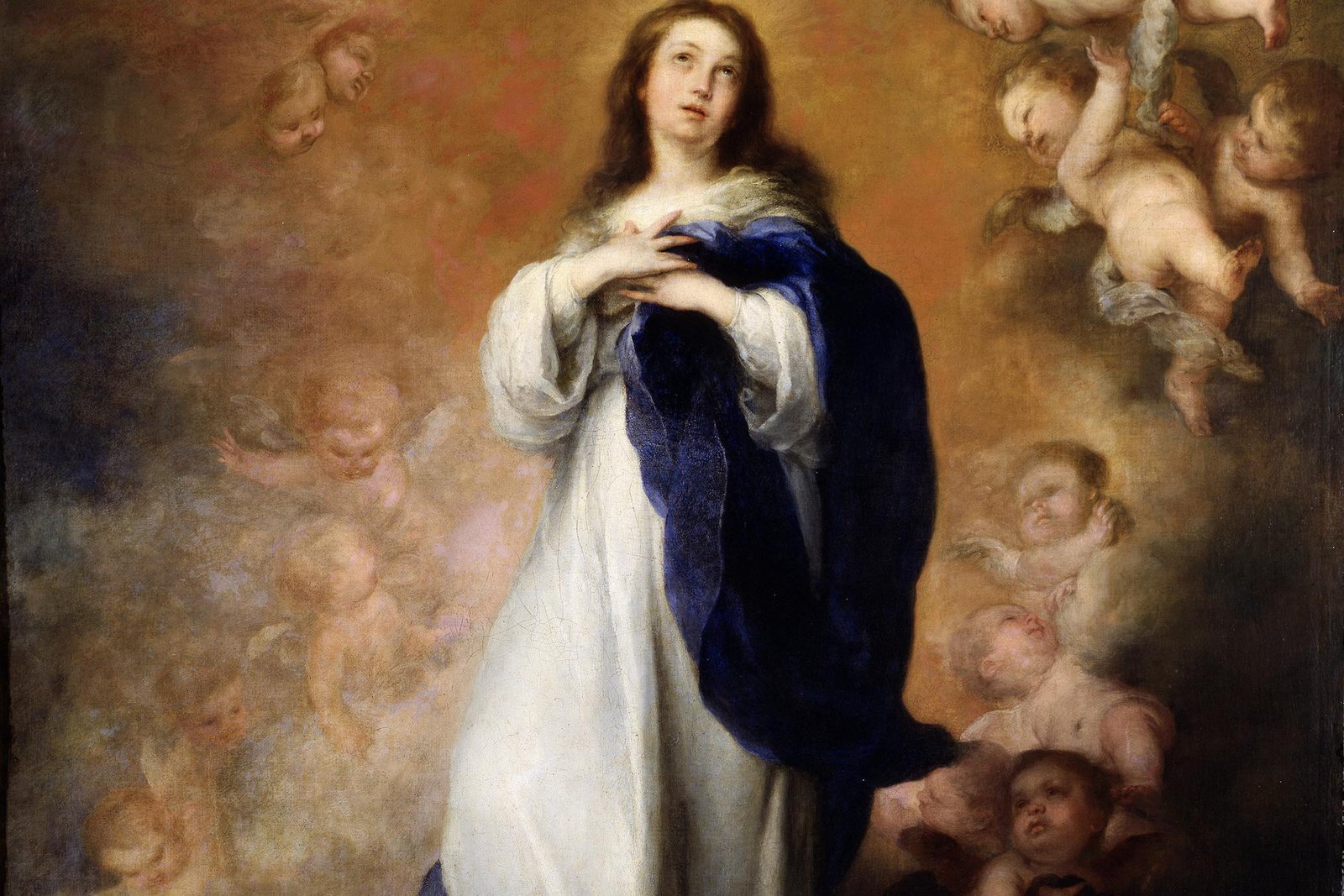
Bartolomé Esteban Murillo, Immaculate Conception of the Venerables (Soult), 1678, Museo del Prado — public domain.
It took nearly two years of Catherine relaying the request to a cautious spiritual director before the Archbishop of Paris authorized the medal's production; the first 1,500 were struck in June 1832. Within a few years, millions had spread across France and beyond, earning the popular name "Miraculous Medal" long before the Church formally examined and approved the devotion in 1836. Catherine herself lived out the rest of her life in near-total anonymity as an ordinary Sister of Charity, only revealing her role shortly before her death in 1876, and was canonized by Pope Pius XII in 1947.
Why pray a novena around it
Wearing the medal is itself the more familiar devotional practice, but a novena built around its origin story exists to draw the wearer back to what the medal actually represents: a request, not a charm. Catherine's account is explicit that the graces promised come "through" the medal, not from the metal object itself — the medal points toward Mary's intercession rather than possessing power independently of it. Praying a nine-day novena is a way of engaging that intercession directly and repeatedly, rather than treating the medal as a passive talisman worn and forgotten.
Nine days of prayer is, of course, the shape every Catholic novena takes, tracing back to the apostles' nine days of prayer between the Ascension and Pentecost. For that origin story in full, see What Is a Novena?.
The traditional novena prayer
The version below, distributed by EWTN as the traditional text, is one of the most widely used forms of the Miraculous Medal Novena, typically preceded by an invocation of the Holy Spirit and three recitations of "O Mary, conceived without sin, pray for us who have recourse to you":
O Immaculate Virgin Mary, Mother of Our Lord Jesus and our Mother, penetrated with the most lively confidence in your all-powerful and never failing intercession, manifested so often through the Miraculous Medal, we your loving and trustful children implore you to obtain for us the graces and favors we ask during this Novena, if they be beneficial to our immortal souls, and the souls for whom we pray. (Here privately form your petitions.) You know, O Mary, how often our souls have been the sanctuaries of your Son who hates iniquity. Obtain for us then a deep hatred of sin and that purity of heart which will attach us to God alone so that our every thought, word and deed may tend to His greater glory. Obtain for us also a spirit of prayer and self-denial that we may recover by penance what we have lost by sin and at length attain to that blessed abode where you are the Queen of angels and of men. Amen.
This prayer is typically prayed once each day for nine consecutive days, with the petitioner privately naming a specific request at the point indicated. Many versions of the novena also include the Memorare — a separate, older Marian prayer — as an additional daily prayer, though it isn't part of the Novena Prayer text itself.
The Immaculate Conception, explained
The medal's central phrase, "conceived without sin," refers to a specific Catholic teaching that is often confused with a different one. The Immaculate Conception is not a claim about how Jesus was conceived; it concerns Mary's own conception in her mother Anne's womb, and holds that Mary herself was preserved from original sin from that very first moment, by a grace won in advance through her son's future redemption. Pope Pius IX defined this belief as dogma in 1854, in the bull Ineffabilis Deus — remarkably, just four years before Mary reportedly identified herself using nearly identical language to a young visionary at Lourdes, Bernadette Soubirous, reinforcing for many Catholics a sense of continuity between the Rue du Bac apparitions and later Marian devotion.
Catherine's apparition, in 1830, actually preceded the formal 1854 definition of the dogma by more than two decades — meaning the medal helped popularize belief in the Immaculate Conception among ordinary Catholics well before Rome made it official teaching, a detail historians of the devotion often note as unusual.
Praying it as more than a habit
It's easy for a medal worn daily to become background noise — a piece of jewelry rather than a living request. The novena exists to interrupt that drift, asking nine consecutive days of deliberate attention to what Catherine reported hearing in that Paris chapel: an offer of grace, tied to a specific image and a specific prayer, extended to "all who have recourse" to it. Whether prayed during a season of particular need or as an annual practice around Catherine's November 28 feast day, the novena turns a small oval medal back into what it was struck to be — not a good- luck charm, but a standing invitation to ask.
Trivia
Is there a fixed time of year to pray the Miraculous Medal Novena?
What does the phrase 'conceived without sin' on the medal actually mean?
Where did the design on the Miraculous Medal come from?
Did the Church investigate Catherine Labouré's reported visions before approving the medal?
Is there an official Saints Home product tied specifically to the Miraculous Medal?
Related Reading