The Memorare Prayer Explained

A prayer built on a single argument
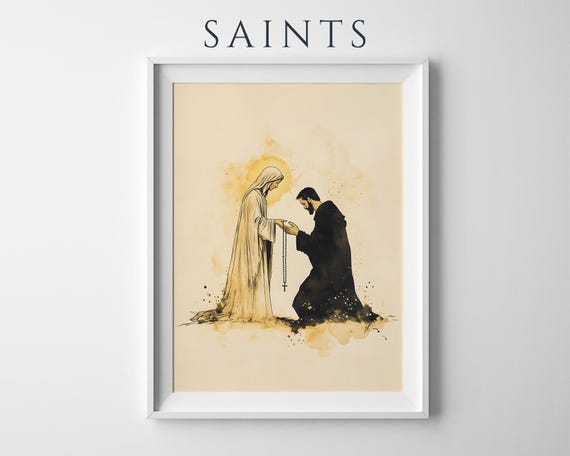
The Memorare — Latin for "remember" — is short enough to memorize in a sitting, and its entire structure rests on one central claim, stated plainly in its opening line: "Remember, O most gracious Virgin Mary, that never was it known that any one who fled to thy protection, implored thy help, or sought thy intercession was left unaided." Everything that follows builds on that claim. The person praying identifies themselves as "sinful and sorrowful," standing before Mary the way the opening line describes countless others having stood before her, and asks that their own prayer not become the first exception to an otherwise unbroken record — closing with the direct request that Mary "hear and answer me." It's an appeal built less on elaborate theological argument than on precedent: if no one else has ever been turned away, why would this prayer be the first?
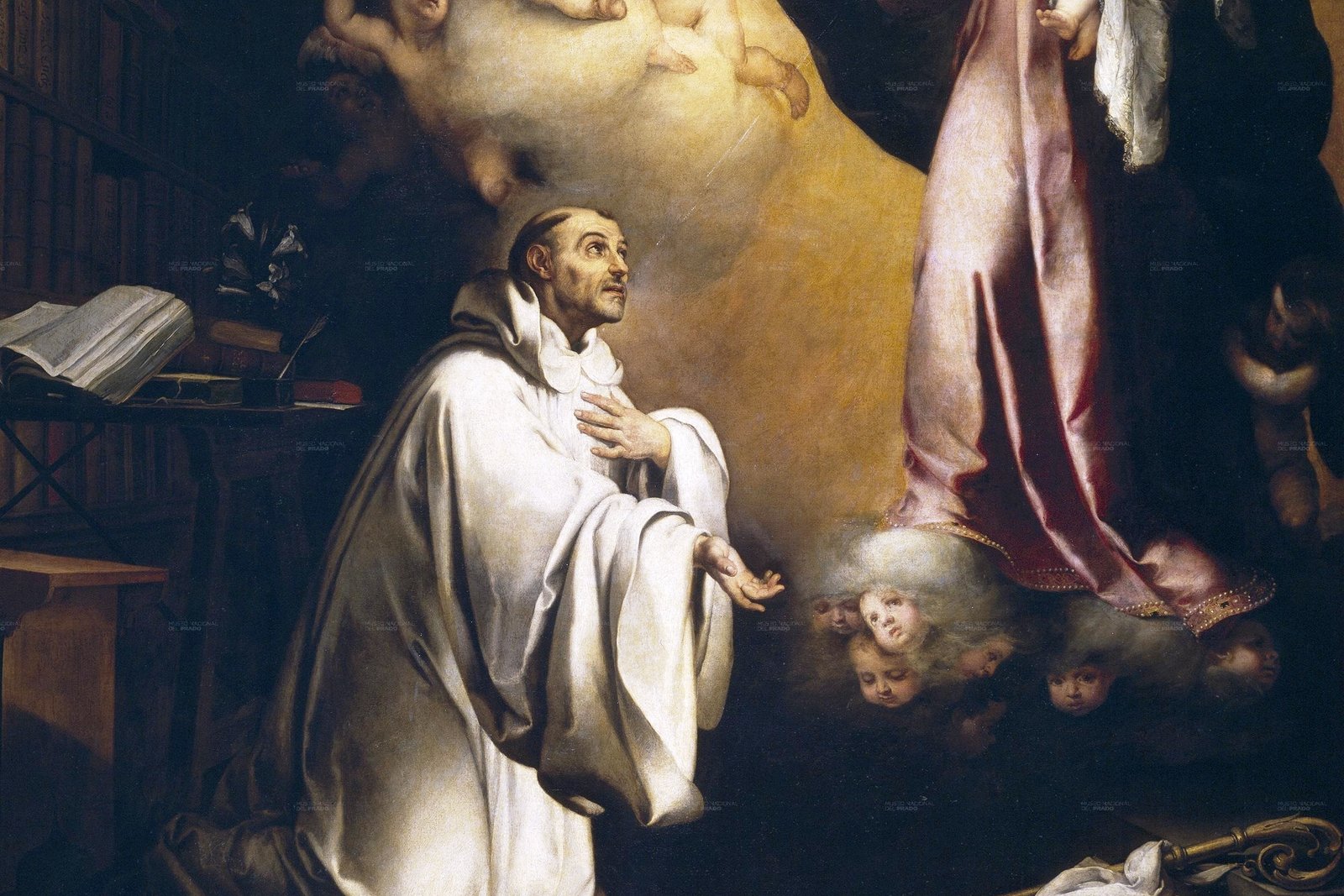
Bartolome Esteban Murillo, San Bernardo (17th century), public domain via Wikimedia Commons
The saint's name attached to someone else's words
For a very long time, popular devotion has credited the Memorare to Saint Bernard of Clairvaux, the influential twelfth-century Cistercian abbot and Doctor of the Church known for his own deep Marian devotion. It's a natural enough attribution to make — Bernard wrote extensively about Mary, and a short prayer built entirely around confident appeal to her intercession fits the reputation built around his other writings. The trouble is that it isn't accurate. The Memorare, as it's prayed today, is drawn from a longer prayer, "Ad sanctitatis tuae pedes, dulcissima Virgo Maria" ("At the feet of your holiness, sweetest Virgin Mary"), which itself doesn't appear in the historical record until the fifteenth century — roughly three hundred years after Bernard's death in 1153. The actual author of that longer, older prayer is unknown, which means the author of the Memorare drawn from it is, by extension, also unknown.
Where the mix-up likely started
If Bernard of Clairvaux didn't write it, where did his name attach to the prayer in the first place? The most plausible explanation traces to a different Bernard entirely — Father Claude Bernard, a seventeenth-century French priest who died in 1641, and who is credited with popularizing the prayer on a massive scale centuries after its actual composition. Over time, it appears "Bernard" the popularizer and Bernard of Clairvaux the much more famous medieval saint were conflated in popular memory, with the prayer's authorship sliding from the more obscure, more recent figure onto the far better-known name from centuries earlier. It's a modest, almost mundane kind of historical confusion — but one that stuck firmly enough to attach to the prayer for a very long time in popular Catholic memory.
A priest, prisoners, and two hundred thousand leaflets
Whatever confusion later arose about who wrote it, there's no dispute about who spread it. Father Claude Bernard held a particular personal devotion to Mary under the title Consolatrix Afflictorum, "Comforter of the Afflicted," and directed much of his ministry toward society's most desperate — including prisoners condemned to execution. He promoted the Memorare specifically among these populations, and accounts of his ministry describe him having roughly 200,000 leaflets of the prayer printed in multiple languages for distribution. It's largely through his deliberate, sustained effort that a short prayer drawn from a much longer, largely forgotten fifteenth-century text became one of the best-known Marian prayers in the Catholic world.
The full text, line by line
The complete prayer runs only a few sentences, but each clause does specific work. It opens, as noted, with the appeal to precedent — "never was it known that any one... was left unaided" — before moving into its second half: "Inspired by this confidence, I fly unto thee, O Virgin of virgins, my Mother; to thee do I come, before thee I stand, sinful and sorrowful." Here the one praying explicitly names their own condition, not claiming any merit of their own, before closing with the direct petition: "O Mother of the Word Incarnate, despise not my petitions, but in thy mercy hear and answer me. Amen." That final title, "Mother of the Word Incarnate," is doing real theological work in a short space — it grounds the whole appeal not in any power Mary possesses independently, but in her unique relationship to Christ, the eternal Word who "became flesh" in her womb (John 1:14), as the reason her intercession carries weight at all.
How it fits with Catholic teaching on Mary
The prayer's confidence can sound, out of context, like it places Mary above or alongside Christ as a source of help in her own right. Catholic teaching has never held that. The Church's own teaching is explicit that Mary's role is always one of intercession — asking her son on behalf of others — not an independent power of her own; whatever grace flows through her prayers for someone, Catholic doctrine holds, ultimately comes from God. The Memorare's logic fits that framework precisely: it asks Mary to carry the petition forward, not to grant it herself, trusting in a maternal relationship the Church has honored since its earliest centuries rather than claiming any rivalry with Christ's own unique role as mediator.
A prayer alongside other short Marian appeals
The Memorare belongs to a small family of short, urgent Marian prayers that work differently from longer devotions like the Litany of Loreto, which accumulates dozens of titles rather than making a single argument. The Sub Tuum Praesidium ("We fly to thy protection"), one of the oldest Marian prayers on record, makes a similar move in even fewer words, appealing directly to Mary's protection in a moment of danger. The Memorare is longer than that ancient prayer but shorter than a full litany or rosary decade, occupying a kind of middle ground — substantial enough to build a real argument, brief enough to recall from memory in a moment of real urgency, which is precisely the kind of moment it was written, and later popularized, to meet.
A short prayer for urgent moments
Today the Memorare is prayed both as a stand-alone petition in moments of particular need and as a recurring element within longer devotions, including many novenas seeking Mary's intercession. Its appeal lies largely in its brevity and its directness — where a full litany of Marian titles works by accumulation, the Memorare makes its case in a single, tightly focused argument and asks for a hearing. Its complicated authorship history doesn't seem to have dampened that appeal at all; if anything, it's a reminder that some of Catholic devotion's most enduring prayers arrived not through famous authorship but through centuries of quiet use by people who needed exactly what the prayer offers: a confident, urgent appeal to someone they believed would listen.
Trivia
What does the Memorare actually say?
Was the Memorare written by Saint Bernard of Clairvaux?
Where did the mistaken attribution to Saint Bernard come from?
How did the Memorare become so widely known?
When is the Memorare typically prayed today?
Related Reading