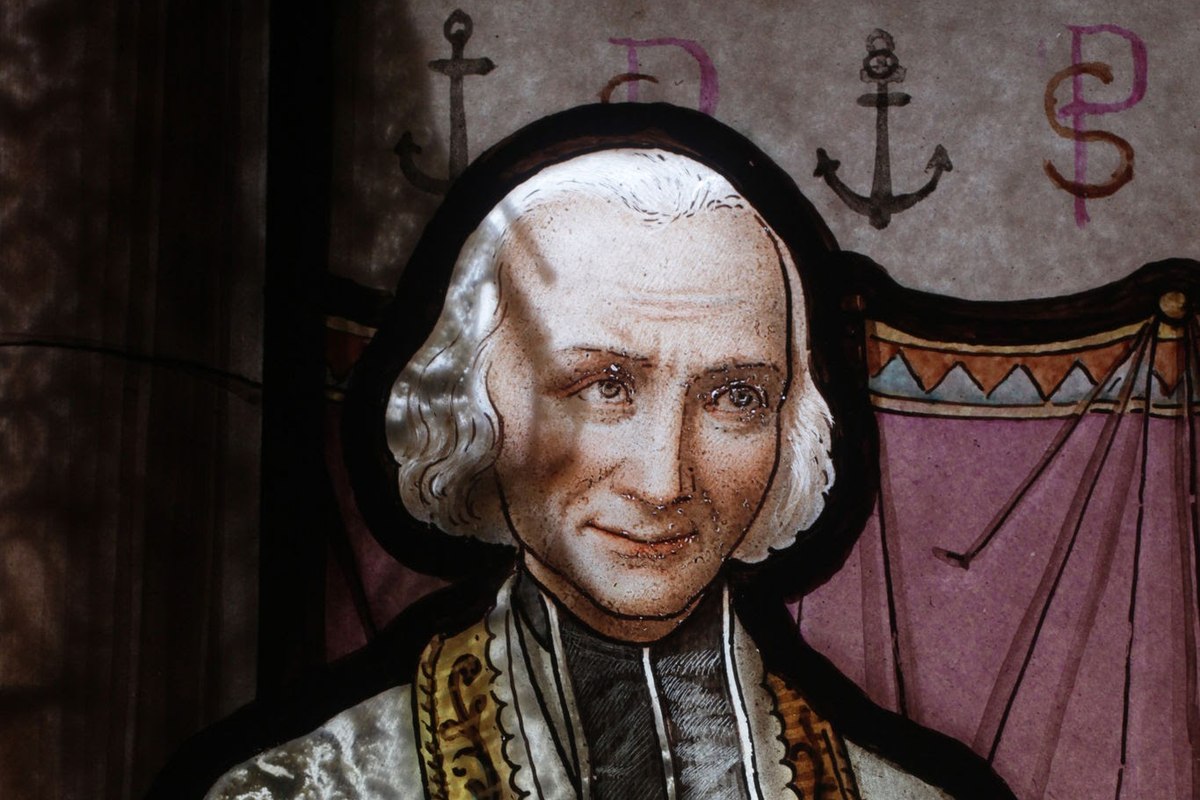
Ars-sur-Formans: The Shrine of Saint John Vianney

A priest sent to the smallest, hardest parish available
When Jean-Baptiste Vianney was ordained in 1815, his own seminary superiors had serious doubts about him — he had struggled badly with Latin and academic theology throughout his training, and was ordained largely on the strength of his evident piety rather than scholarly promise. In 1818, his bishop assigned him to Ars-sur-Formans, a scattered rural parish in eastern France so small and unremarkable that it was considered an unimportant posting, home to roughly 230 people scattered across farms and hamlets. Learn more about his remarkable life and legacy in our article on Saint John Vianney.
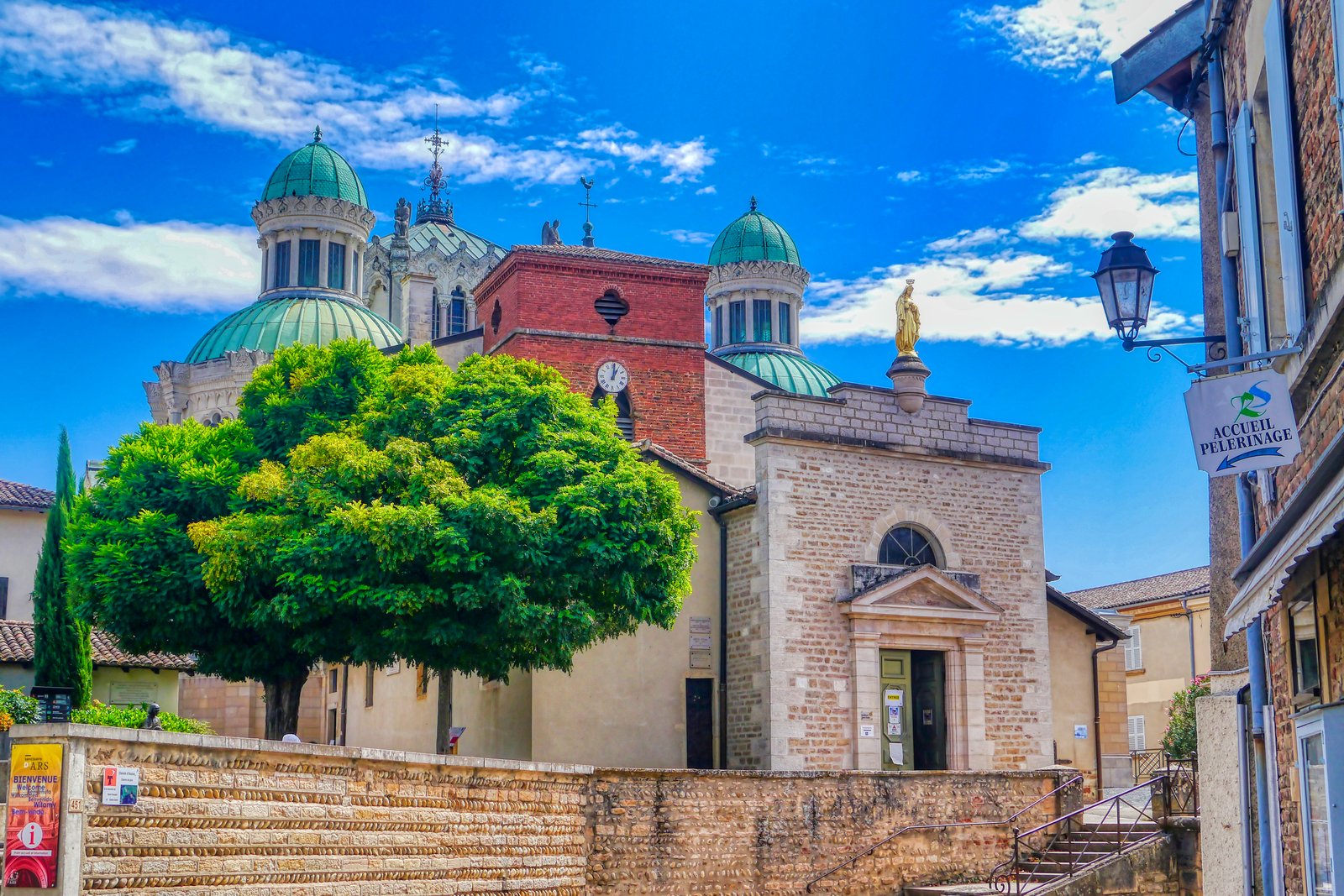
Photograph by Zairon, Ars-sur-Formans Basilique Saint-Sixte, 2020 — CC BY-SA 4.0, Wikimedia Commons.
Vianney found a community that was, by his own account and that of contemporaries, religiously indifferent at best — a common condition in rural France in the decades following the disruption of the Revolution, when parish life across the countryside had been badly weakened. He set about rebuilding it through an unglamorous combination of preaching, catechesis, personal austerity, and an increasingly demanding schedule of hearing confessions, a ministry he came to see as the center of his priestly vocation.
The confessor whose fame outgrew the village
What began as ordinary parish work gradually became something extraordinary. Word of Vianney's insight as a confessor — his apparent ability to address penitents' unspoken struggles with unusual clarity and compassion — began spreading first regionally and then nationally through the 1830s and 1840s. By the 1850s, the trickle of visitors had become a flood: pilgrims were arriving from across France and increasingly from abroad, drawn specifically to have their confession heard by this one priest, in numbers that eventually reached an estimated 20,000 people annually.
The scale of the phenomenon reshaped the tiny village. A special rail spur was constructed to bring pilgrims to Ars, hotels and hospices sprang up to house them, and Vianney himself adopted a punishing schedule, reportedly spending between eleven and sixteen hours a day in the confessional during the busiest years of his ministry, sleeping only a few hours a night and eating almost nothing. He continued this pace well into his seventies, despite chronic exhaustion and several attempts — always refused by his bishop — to resign and retreat to a monastery.
A church rebuilt around its own history
Vianney's original parish church, a modest stone building, could not remotely accommodate the crowds his reputation eventually drew, and after his death in 1859 the decision was made to preserve the historic structure rather than demolish it — instead building a much larger basilica around and alongside it, so that the original church effectively became a chapel within the larger complex. This approach, unusual among European pilgrimage sites, means visitors today can still stand inside the same modest sanctuary where Vianney celebrated Mass and heard confessions for four decades, physically enclosed within the grander basilica that grew up around his legacy.
The Basilica of Saint Sixtus, as the larger complex is known, was built in stages through the late nineteenth and early twentieth centuries, its scale and decoration reflecting the shrine's growing importance following Vianney's beatification in 1905 and canonization in 1925. In 1929, Pope Pius XI further recognized his significance by declaring him the patron saint of parish priests worldwide, cementing his legacy well beyond the boundaries of the small parish where he had spent his entire priesthood.
Incorruption and a shrine that still functions as intended
Vianney's body, preserved and displayed above the former high altar of the original church in a glass reliquary, is generally described as incorrupt — meaning it has not undergone the visible decomposition ordinarily expected after death, a phenomenon the Church has associated with a number of saints over the centuries without treating it as doctrinally required for sanctity. His preserved heart is also venerated separately as a distinct relic within the shrine complex, a tradition connected to devotional practices common in French Catholicism of the era.
What distinguishes Ars from many pilgrimage sites, though, is that its central devotional practice — confession — remains actively offered there today, not merely commemorated. Priests continue to hear confessions at the shrine for visiting pilgrims, a direct continuation of the ministry that made the village famous in the first place, rather than a museum piece describing what once happened there. The rectory where Vianney lived has also been preserved largely as it was during his lifetime, offering visitors a glimpse of the austere, sparse living conditions he maintained even as his fame — and the crowds arriving to see him — grew far beyond anything the young priest sent to a forgotten rural parish could have anticipated.
Pope John Paul II visited Ars in 1986 to mark the bicentenary of Vianney's birth, and Pope Francis later sent a personal letter to priests gathered there in 2019, underscoring how the small village has remained, across nearly two centuries, a reference point specifically for the priesthood in a way few other pilgrimage sites are — visited as much by clergy seeking renewal in their own vocation as by lay pilgrims drawn to its Marian or saintly devotions in the more typical sense.
Trivia
Why did pilgrims travel to Ars-sur-Formans in such large numbers?
How long was John Vianney the parish priest of Ars?
What can visitors see at Ars-sur-Formans today?
Is Vianney's body still preserved at the shrine?
You May Also Like

Related Reading