Sacré-Cœur Basilica, Paris

A vow made in defeat
The Basilica of the Sacred Heart of Montmartre exists because of a war France lost badly. In 1870, Napoleon III's government blundered into a conflict with Prussia and its German allies, and within months French armies were crushed, the emperor himself was captured, and Paris endured a four-month siege that starved its population into eating zoo animals to survive. When the war ended in defeat, Paris erupted again — this time in the Commune, a radical uprising crushed by the French army itself in a week of street fighting so violent that thousands of Parisians died within their own city walls.
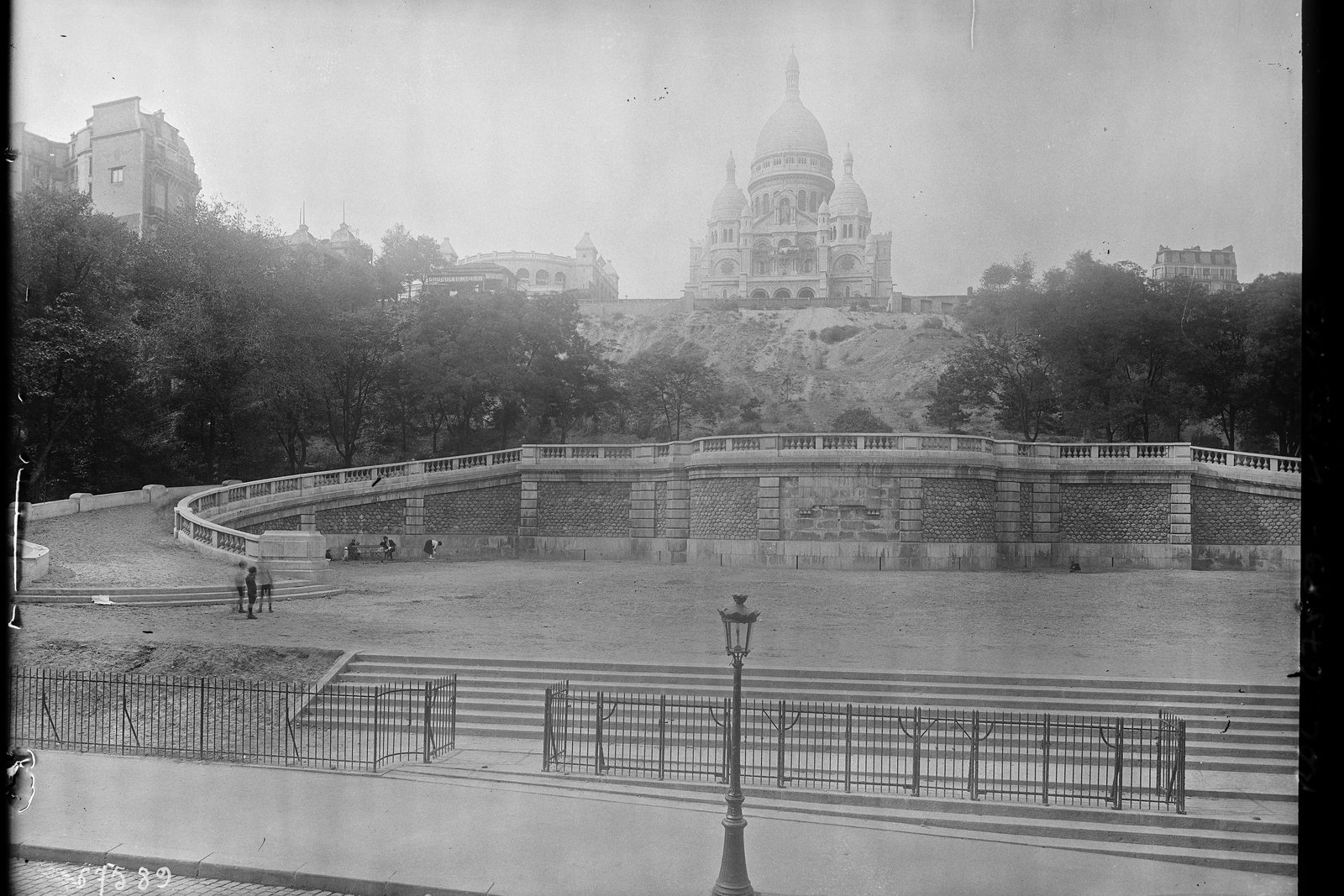
Photograph by Agence Rol, 1921 -- public domain (Bibliothèque nationale de France / Gallica), via Wikimedia Commons.
Out of that double catastrophe, two laymen — Alexandre Legentil and his brother-in-law Hubert Rohault de Fleury — made a private vow in December 1870, while the Prussian siege was still underway. If France and Paris were spared further disaster, they promised, they would build a church consecrated to the Sacred Heart of Jesus as a public act of penance and hope. The vow found rapid support among French Catholics who read the national catastrophe as a call to spiritual renewal, and by 1873 the National Assembly had formally declared the project a matter of public utility, clearing the way for construction on the highest point in Paris: the hill of Montmartre.
Building on unstable ground
The site chosen for the basilica was symbolically perfect and physically treacherous. Montmartre — the name likely derives from "mount of martyrs," tied to the tradition that Saint Denis, Paris's first bishop, was executed there in the third century — rises steeply above the rest of the city, giving any building on its summit commanding views in every direction. But centuries of gypsum quarrying beneath the hill had left the ground honeycombed and unstable, and architect Paul Abadie, who won the design competition in 1874, had to sink eighty-three concrete pillars, some more than 30 meters deep, before the foundations could bear the weight of a masonry church.
Construction dragged on for thirty-nine years, from 1875 to 1914, funded almost entirely by small donations from ordinary French Catholics rather than state money — a detail the basilica's own history still emphasizes as proof of a genuinely popular devotion rather than an imposed monument. The building was structurally finished just as the First World War broke out, which delayed its formal consecration until 1919, after the armistice. Abadie died in 1884, decades before seeing his design completed, and several other architects carried the project through its final stages.
The Romano-Byzantine style Abadie chose was itself a departure from the Gothic Revival fashionable in French church architecture at the time, drawing instead on Byzantine domes reminiscent of Hagia Sophia and the Basilica of San Vitale in Ravenna, giving Sacré-Cœur a silhouette unlike anything else in Paris — four smaller domes clustered around a central one, topped by a bronze statue of Christ, all of it rendered in brilliant white stone rather than the grey limestone of Notre-Dame de Paris across the river.
The stone that cleans itself
Part of what makes Sacré-Cœur so visually distinct from the rest of the city is a genuine chemical quirk. The basilica's exterior is faced with travertine stone quarried at Château-Landon, southeast of Paris, and that particular stone secretes calcite whenever it rains, a natural bleaching reaction that keeps the surface white rather than letting it darken with soot and grime the way most old Parisian buildings have over a century of urban pollution. The effect is almost architectural sleight of hand: a building over a hundred years old that looks freshly built.
A vigil that has never stopped
The devotion at the heart of the building's name — the Sacred Heart of Jesus, a Catholic devotion centered on Christ's literal and symbolic heart as an image of divine love and mercy — traces back to visions reported by the French nun Margaret Mary Alacoque in the 1670s at Paray-le-Monial, two centuries before Montmartre's basilica existed. What makes Sacré-Cœur's expression of that devotion unusual is its practice of perpetual adoration: since August 1, 1885, before the building itself was even finished, a continuous rotation of worshippers has kept someone praying before the exposed Eucharist inside the church twenty-four hours a day, without a single day's interruption, for more than a century. Religious communities and lay volunteers take shifts around the clock, a vigil the basilica describes as reparation and intercession offered on behalf of the whole nation — the same spirit, expanded across generations, that motivated Legentil and Rohault de Fleury's original 1870 vow.
A monument still argued over
Not everyone in Paris has always welcomed the basilica the same way. Montmartre in the 1870s was a stronghold of the radical political left, closely tied to the Commune the French army had just crushed, and some contemporaries and later historians read the decision to crown that specific hill with a monumental Catholic church as a deliberate act of political and spiritual reclamation — a conservative, Catholic answer built literally on top of a neighborhood associated with revolutionary defeat. The basilica's own official history frames the building purely as an act of national penance and hope; the more skeptical reading exists alongside it in the historical record, and both are worth knowing if you want to understand why the church still provokes strong feelings from some Parisians even today.
Whatever one makes of that argument, the numbers speak for themselves: Sacré-Cœur draws over ten million visitors a year, making it one of the most visited monuments in France, and from its steps — arguably the best free view in the entire city — pilgrims and tourists alike look out over the same Paris that Legentil and Rohault de Fleury were praying for when they first made their vow a century and a half ago.
Trivia
Why was the Sacré-Cœur Basilica built?
How long did it take to build Sacré-Cœur?
What is the significance of the perpetual adoration at Sacré-Cœur?
Why does Sacré-Cœur look so white compared to other Paris landmarks?
Who has authority over the interpretation of Sacré-Cœur's history?
Related Reading