Einsiedeln Abbey and the Black Madonna

From a hermit's cell to a monastery
The story of Einsiedeln Abbey begins not with a founding charter or a bishop's decree, but with a single monk seeking solitude. Saint Meinrad of Einsiedeln, a Benedictine monk from the island monastery of Reichenau on Lake Constance, withdrew into the dense forest of the Swiss Alps in the ninth century to live as a hermit, eventually settling in the remote spot that would give the later abbey its name — Einsiedeln, from the German for "hermitage" or "place of the hermit." Tradition holds that the abbess of the Fraumünster convent in Zurich gave Meinrad a small wooden statue of the Virgin Mary and Child, which he kept and prayed before in his simple cell for years.
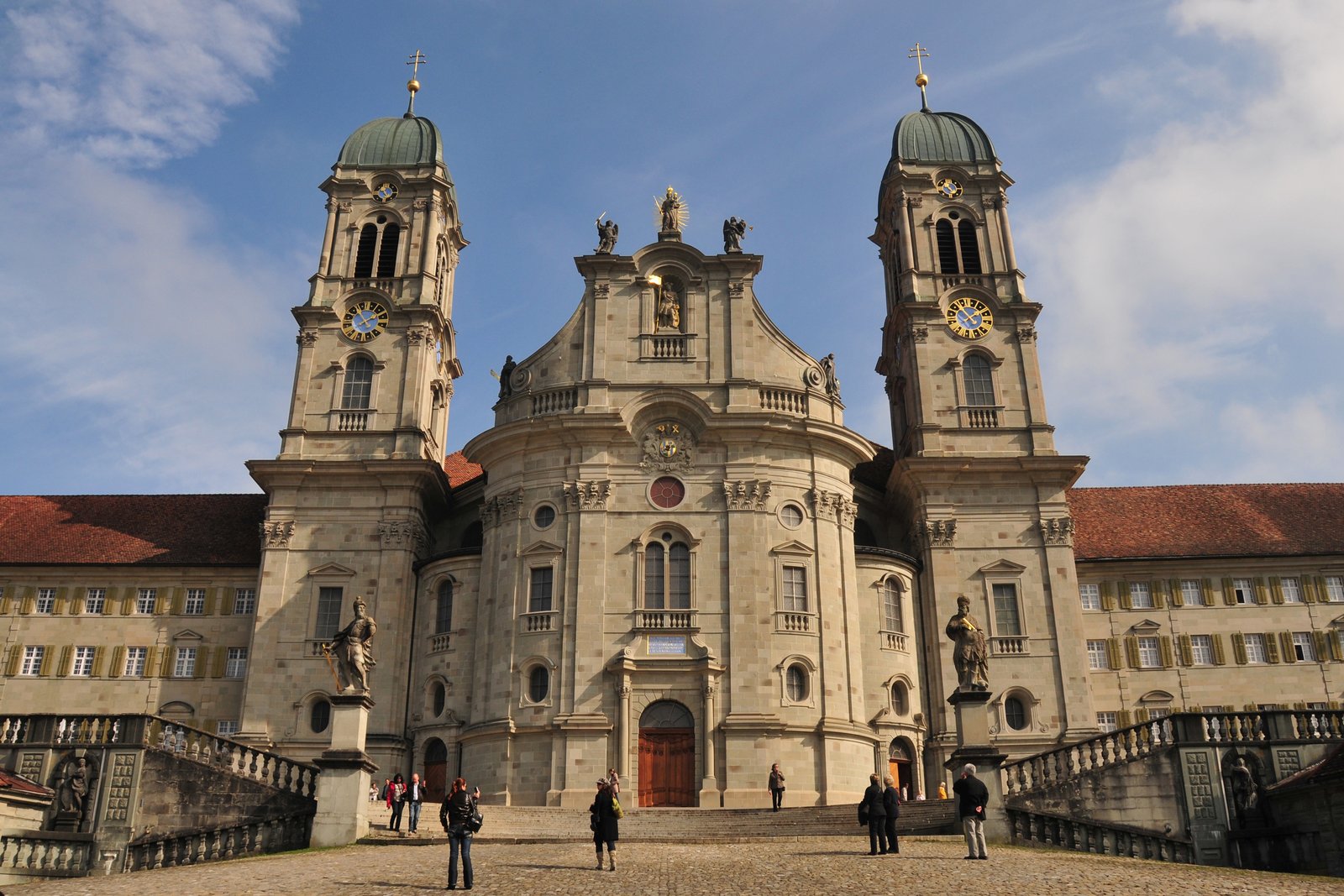
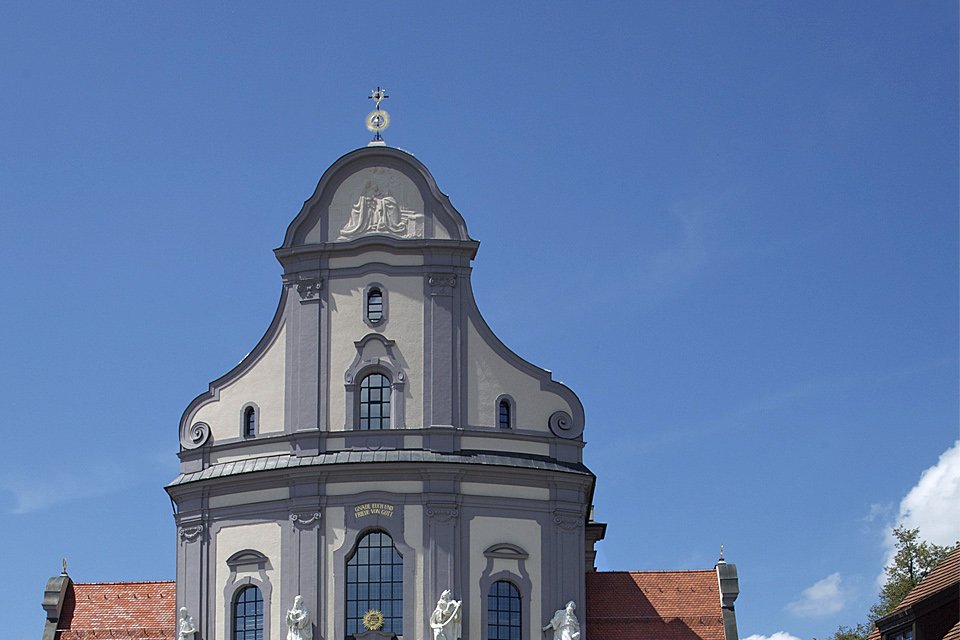
Photograph by Hofec, Einsiedeln Abbey, Switzerland, 2008 — CC BY-SA 3.0, Wikimedia Commons.
Meinrad's solitary life ended violently. Around 861, according to the traditional account, two men murdered him, apparently believing he kept valuables in his hermitage — a belief that proved almost entirely mistaken, since a hermit's cell offered little worth stealing. The killing did not end devotion to the spot; if anything, it intensified it. Other hermits and pilgrims continued to visit the site of Meinrad's death, and in 934 a formal Benedictine community was established there under Abbot Eberhard, marking the founding of the monastery that has continued, with interruptions, to the present day.
The Black Madonna
At the spiritual center of the abbey today stands its most venerated object: a wooden statue of Mary holding the Christ Child, known as the Black Madonna of Einsiedeln, kept in an elaborate freestanding chapel — the Lady Chapel, or Gnadenkapelle — inside the main basilica. The statue's dark coloring, shared with a number of other famous medieval Marian images across Europe, including those at Le Puy-en-Velay and Altötting, has several possible explanations that art historians and conservators have debated: darkening from centuries of candle and incense smoke, deliberate historical repainting choices, or some combination of both across repeated restorations. What isn't disputed is the object's continuity of veneration — pilgrims have prayed before some version of this image at this location for over a thousand years, even as the physical statue itself has almost certainly been repaired, restored, and possibly replaced in part over that span.
The current chapel housing the statue was built in the late seventeenth century in an elaborate Baroque style that contrasts sharply with the relative simplicity of Meinrad's original forest hermitage, a visual reminder of how dramatically the site's material expression of devotion changed even as its underlying object of veneration remained constant.
A monastery of European significance
Einsiedeln's importance grew steadily through the medieval period as its reputation as a pilgrimage destination spread across German-speaking Europe and beyond. The monastery weathered fires, wars, and periods of decline, and it was substantially rebuilt in its current form during the Baroque period of the seventeenth and eighteenth centuries, when its twin-towered facade and richly decorated interior — one of the finest examples of Baroque monastic architecture in Switzerland — took shape. The abbey church's interior, with its elaborate stucco work and frescoes, remains one of the most visually striking pilgrimage churches in Central Europe.
Beyond its religious role, Einsiedeln developed into a significant center of learning and culture. Its library holds an important collection of medieval manuscripts, and the monastery has long operated an associated school, along with a tradition of horse breeding — the Einsiedler horse breed takes its name directly from the abbey, which has bred horses on its lands for centuries, originally to support its agricultural and pilgrimage operations.
Einsiedeln today
Einsiedeln remains an active Benedictine community, one of relatively few historic European monasteries to have continued largely unbroken religious life into the present. The monks maintain the pilgrimage church, welcome the several hundred thousand visitors who arrive each year, and continue the community's educational and cultural work alongside their monastic routine of prayer and work — the Benedictine ora et labora that has defined the order since its sixth-century founding by Saint Benedict.
The pilgrimage itself follows a rhythm structured around the church calendar, with especially large gatherings around major Marian feasts, when the Black Madonna is processed through the abbey precincts before crowds that can number in the tens of thousands on the busiest days. For a shrine that began with one murdered hermit and a small wooden statue in a forest clearing, Einsiedeln's transformation into one of Europe's great pilgrimage destinations stands as a striking example of how local, almost accidental devotion can grow, over centuries, into something of continental significance.
The abbey's famous library, one of the oldest continuously operating monastic libraries in the world, adds a further dimension to Einsiedeln's significance beyond the pilgrimage itself, preserving medieval manuscripts and early printed books that document not only the shrine's own history but the broader intellectual life the Benedictine community has sustained alongside its more visible devotional role for well over a thousand years.
Trivia
Why was Einsiedeln Abbey built where it was?
What is the Black Madonna of Einsiedeln?
How is Einsiedeln connected to Saint Meinrad?
Is Einsiedeln still an active Benedictine monastery?
How large is the pilgrimage to Einsiedeln?
Related Reading