Saint Meinrad of Einsiedeln

Born to solitude, one step at a time
Meinrad's path toward the deep isolation that defined his life didn't happen all at once. Born around 797 into a noble Swabian family, he was educated at the monastery school on the Reichenau, an island in Lake Constance that was one of the leading centers of learning in the Carolingian world, and was ordained a priest. He might have had a comfortable career teaching or administering within the Benedictine system that had formed him. Instead, he asked for and received permission to live as a hermit — first on Etzel, a mountain pass overlooking Lake Zurich, where he spent around seven years.
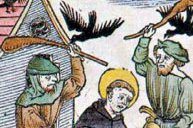
Anonymous, traditional devotional image of Saint Meinrad of Einsiedeln — public domain.
Even that wasn't remote enough. Meinrad eventually withdrew further, deep into the forested Alpine region known as the Finsterwald — the "dark forest" — in what is now the canton of Schwyz in Switzerland. The area had a reputation for danger: wolves, difficult terrain, and, as events would eventually prove, opportunistic criminals who preyed on travelers passing through. It was there, in a small hut he built himself, that Meinrad spent roughly the final twenty-five years of his life, sustained by prayer, manual labor, and — according to tradition — the company of two ravens he had tamed.
A small statue and a life of prayer
Central to Meinrad's devotional life was a small wooden statue of the Virgin Mary and Child, which tradition says was given to him by the abbess of a nearby convent, Zurich's Fraumünster, before his final withdrawal into the forest. He kept the statue in his hermitage and prayed before it daily, and it became, over the centuries that followed, the seed of what grew into one of Europe's most significant Marian shrines. The statue venerated today at Einsiedeln Abbey — known as the Black Madonna for its centuries-darkened appearance, the result of candle smoke accumulated over generations of devotion, not its original coloring — stands in direct traditional continuity with the image Meinrad kept in his forest hut.
Murder in the dark forest
On January 21, 861, according to the traditional account, two men arrived at Meinrad's hermitage. Their motive, as the story is preserved, was simple and mistaken: they assumed that a hermit living alone so far from any settlement, with visitors occasionally leaving alms and offerings, must be sitting on some hidden store of wealth. Meinrad, in keeping with the monastic obligation of hospitality, received them, fed them, and offered what shelter he could. They killed him anyway, apparently once it became clear there was no treasure to be found — a bleak irony that later tradition has never shied away from including in the retelling.
The legend adds a striking detail: Meinrad's two tamed ravens are said to have followed the fleeing murderers all the way to Zurich, drawing enough attention with their persistent presence that the men were eventually identified and apprehended. Whatever the precise historical accuracy of that detail, the ravens have remained a fixed part of Meinrad's iconography ever since, appearing alongside him in devotional art as a symbol of the hermit's death being neither hidden nor forgotten.
From hermitage to abbey
Meinrad's forest hermitage did not stay empty for long. Other hermits were drawn to the site in the years after his death, and in 934 a Benedictine monastery was formally established there under Abbot Eberhard, built around the memory of Meinrad's life and death and the small Marian shrine he had maintained. That monastery grew into Einsiedeln Abbey, which remains an active Benedictine community today and one of the most visited pilgrimage destinations in Switzerland, drawing visitors to the same forest where a solitary monk once lived and died largely unnoticed by the wider world.
The town that grew up around the abbey took its name directly from Meinrad's vocation: Einsiedeln, from the German for hermit or solitary. Few saints have left so direct and literal a mark on the map.
The legend of the Angelic Consecration
One of the most distinctive traditions associated with Einsiedeln concerns the dedication of the abbey's original church, decades after Meinrad's death. According to a legend recorded in later medieval sources, when the bishop of Constance arrived to formally consecrate the new church built at the site of Meinrad's hermitage, he heard a voice telling him that Christ himself had already consecrated the building the night before, in the company of angels — an episode that became known as the "Miraculous" or "Angelic" Consecration. Whatever one makes of the story historically, it became central to Einsiedeln's identity as a pilgrimage site, celebrated liturgically at the abbey to this day, and it reinforced, in the minds of medieval pilgrims, the sense that the ground where Meinrad had lived and died carried a sanctity that went beyond even his own personal holiness — a claim of direct divine favor unusual even among Europe's major medieval shrines.
A monastery that shaped Swiss religious life
Einsiedeln Abbey's growth from a small memorial community into one of the major religious institutions of the German-speaking world took place over many centuries, and its influence extended well beyond the immediate site of Meinrad's death. The abbey developed a significant scriptorium and later library, becoming an important center of learning in the region, and its abbots exercised real temporal authority over surrounding territory in the manner typical of major medieval Benedictine houses. Pilgrimage to Einsiedeln, drawn above all by devotion to the Black Madonna but sustained also by the memory of Meinrad's own martyrdom, made it one of the most visited shrines north of the Alps by the later Middle Ages, a status the abbey has retained into the present day, with hundreds of thousands of visitors still coming each year to the same forest where a single hermit once lived in near-total isolation.
Feast day and legacy
Meinrad's feast is observed on January 21. He's typically depicted in art as a Benedictine monk in his habit, often kneeling in prayer before a small statue of the Madonna and Child, frequently accompanied by two ravens — the fixed visual shorthand for his martyrdom in solitude. Readers drawn to the tradition of Christian hermits and solitaries who withdrew from settled society in search of deeper prayer may also want to read about Saint Gall, whose own forest hermitage in nearby Alemannic Switzerland, established roughly two centuries before Meinrad's, grew into another of the region's great Benedictine abbeys and left a comparably lasting mark on the map of Swiss monasticism.
Trivia
Who was Saint Meinrad of Einsiedeln?
Why is Einsiedeln named after Saint Meinrad?
How did Saint Meinrad die?
What is the significance of the Black Madonna of Einsiedeln?
When is the feast of Saint Meinrad celebrated?
You May Also Like
Related Reading