The Abbey of Cluny

A duke gives away everything he owns
In the year 910, William I, Duke of Aquitaine, made an unusually complete act of generosity: he founded a new monastery at Cluny, in the Burgundy region of what is now eastern France, and endowed it with his entire estate — not a portion of his land, but all of it. Crucially, William also placed the new monastery under the direct protection of the papacy rather than any local bishop or secular lord, freeing it from the political entanglements that hampered many monasteries of the period. He installed Berno, then abbot of a nearby monastery at Gigny, to lead the new community under a stricter interpretation of the Rule of Saint Benedict, the foundational guide for Western monastic life.
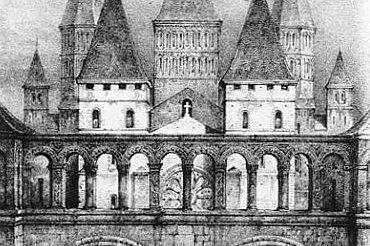
Photograph by Calips, Cluny abbaye — CC BY 3.0, Wikimedia Commons.
That combination — papal protection, a strict rule, and freedom from local interference — turned out to be exactly the formula medieval monasticism needed. William's charter of foundation went further still: it forbade any future interference from himself, his heirs, or any king, count, or bishop, and it even threatened excommunication against anyone who tried to seize Cluny's property — an unusually forceful legal guarantee for the period, and one that gave the new abbey a degree of independence few other monasteries of the tenth century could claim.
An empire of monks
Cluny's reformed model spread with remarkable speed. Rather than staying confined to its own walls, the "Cluniac" approach to monastic life expanded through two main channels: new monasteries founded directly along Cluniac lines, and existing monasteries that voluntarily reorganized themselves under Cluny's authority and customs. By the twelfth century, Cluny stood at the head of a network of roughly 314 monasteries, and at the height of its influence commanded what historians sometimes describe as a monastic "empire" of around ten thousand monks across all its dependent houses.
This wasn't simply administrative growth. The Cluniac reform is credited with restoring a level of spiritual seriousness and liturgical richness to Western monastic life that had eroded in many communities, and Cluny's abbots became genuinely influential figures in European ecclesiastical politics, advising popes and kings alike. A remarkable string of long-lived, capable abbots helped this along: Odo, Maieul, Odilo, and Hugh of Semur between them governed Cluny for well over a century, giving the reform a continuity of leadership that few medieval institutions ever achieved. Hugh of Semur alone led the abbey for some sixty years, overseeing both the network's greatest expansion and the start of construction on its most famous building.
Cluny's liturgical life also set it apart. The monks kept an elaborate daily round of prayer — the Benedictine "Opus Dei," or Work of God, referring to the structured hours of chanted psalms and prayers that punctuated a monk's entire day and night — expanded at Cluny to a degree that left comparatively little time for the manual labor Saint Benedict's original Rule had emphasized. Critics in later centuries, including the Cistercian reformers who eventually eclipsed Cluny's influence, saw this as a drift toward ceremonial splendor at the expense of the Rule's original simplicity; admirers saw it as the fullest possible expression of a life devoted to worship.
A church built to match the ambition
Cluny's growing prestige demanded a church equal to it, and the community built three successive abbey churches over the centuries, each larger than the last. The third, known to historians as "Cluny III," broke ground in 1088 and took decades to complete. When finished, it stretched approximately 555 feet in length — an almost unimaginable scale for the period — and held the title of largest church in the Christian world for roughly two centuries, until Rome finally completed the rebuilt St. Peter's Basilica in the sixteenth century. Readers curious about that later, even larger building can find its story in this blog's article on St. Peter's Basilica.
Cluny III's architecture also proved deeply influential in its own right, shaping the development of Romanesque church design across France and beyond through its innovative use of pointed arches in some structural elements — a detail some historians see as an early step toward the fully pointed-arch vocabulary of later Gothic architecture. The building carried five towers, a double transept (an unusual second set of crossing arms in addition to the main one), and an interior covered floor to ceiling with painted decoration and carved capitals — the famous Cluny capitals, depicting the seasons, the musical modes, and virtues and vices, that survive today as some of the finest examples of Romanesque sculpture anywhere in France, even though the building around them is gone.
Consecrating a church of this scale was itself an event of European importance. Pope Innocent II traveled to Cluny in 1130 to dedicate the high altar in person, and the church that resulted served for centuries afterward as a model that other builders across France and beyond consciously imitated, its scale functioning almost as an advertisement for the reach and confidence of the Cluniac network at its peak.
Decline, revolution, and near-total loss
Cluny's dominance gradually faded over the later Middle Ages, as newer reform movements — the Cistercians prominent among them — offered their own visions of monastic renewal and drew energy and recruits away from the older Cluniac network. By the early modern period, Cluny remained an important and wealthy abbey, but no longer the singular center of Western monasticism it had once been.
The abbey's true catastrophe came with the French Revolution. Monastic communities across France were suppressed in the 1790s, their property confiscated and sold as national assets. Cluny's enormous church, no longer protected or maintained by a religious community, was sold off in pieces in the early nineteenth century and largely demolished, its stone quarried away for use in other local building projects. It's a strikingly different fate from many of Europe's other great medieval churches, which survived revolutions and wars relatively intact even when neglected — Cluny was, quite deliberately, taken apart.
What's left
Today, only a fragment of the once-vast complex survives: roughly one-tenth of the original church, including one surviving transept tower, along with some later monastic buildings constructed in subsequent centuries. The site is now preserved as a historic monument, and modern visitors — aided by scale models and digital reconstructions on-site — can get a sense of just how immense the vanished church once was, even though almost nothing of the building that made Cluny famous across medieval Europe remains standing in stone.
Trivia
When was the Abbey of Cluny founded?
What was the Cluniac Reform?
Was Cluny's church really the largest in Christendom?
What happened to the Abbey of Cluny?
How much of the original abbey survives today?
Related Reading