The National Shrine of the Immaculate Conception, Washington DC

A national church built without a single patron
The Basilica of the National Shrine of the Immaculate Conception rises on a low hill in northeast Washington, DC, its central dome and campanile visible across much of the city's skyline. It is, by floor area, the largest Roman Catholic church in North America and ranks among the ten largest churches anywhere in the world — a scale that reflects its founding purpose: not a parish or a cathedral tied to one diocese, but a national shrine meant to belong, in a real financial sense, to the entire American Catholic Church.
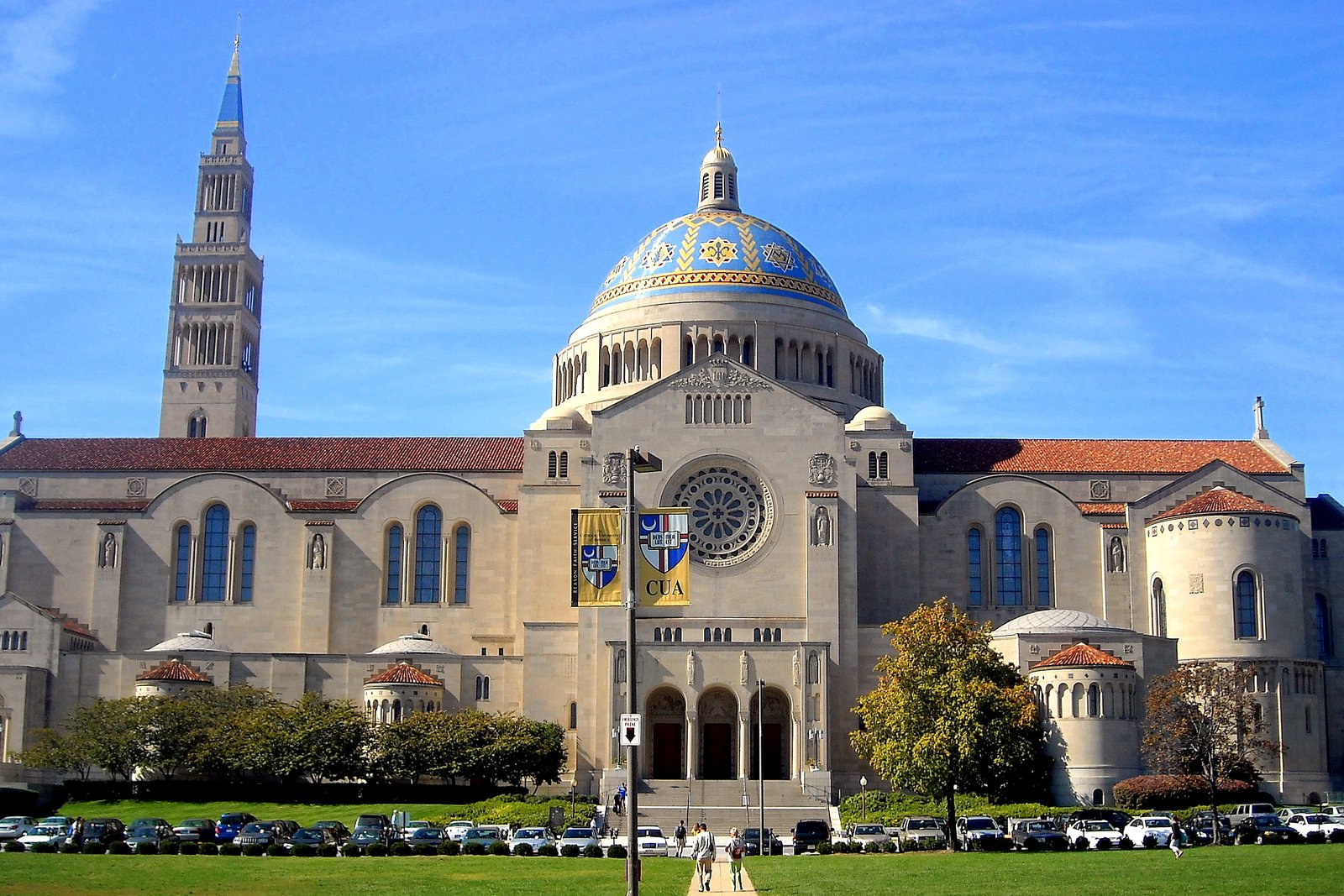
Photograph by AgnosticPreachersKid, Basilica of the National Shrine of the Immaculate Conception, Washington DC, 2008 — CC BY-SA 3.0, Wikimedia Commons.
The idea originated with Bishop Thomas J. Shahan, rector of the Catholic University of America, who traveled to Rome in 1913 and secured the encouragement of Pope Pius X for a great national church honoring Mary under her title as the Immaculate Conception, already recognized as the patronal title of the United States since 1846. Rather than seek a single wealthy benefactor, Shahan deliberately built the shrine through small donations gathered from Catholic parishes, schools, and individuals across the country — a fundraising model that shaped both the pace of construction and the building's identity as a genuinely popular, rather than aristocratic, monument.
Why the site and the title matter
The shrine's dedication connects it directly to a defined article of Catholic doctrine: the Immaculate Conception, the teaching that Mary was conceived free from original sin, formally proclaimed as dogma by Pope Pius IX in 1854. Long before that formal definition, American bishops meeting in 1846 had already chosen Mary under this title as patroness of the United States, so the shrine's later construction gave that older national devotion a physical, permanent home in the capital. Readers curious about the doctrine itself, rather than the building honoring it, can find a fuller account in the story of the Immaculate Conception.
The choice of site beside the Catholic University of America was equally deliberate. Shahan envisioned the shrine as a spiritual counterpart to the university's academic mission, a place where the national church's intellectual life and its devotional life would sit literally side by side. That relationship endures: the university and the shrine remain adjacent institutions, and the shrine continues to serve as a pilgrimage site for Catholic students, visiting bishops, and national Catholic gatherings held in the capital.
Construction in stages, over decades
Ground was broken for the shrine's crypt church in 1920, and that lower-level worship space was completed and in use by 1926, even as the massive superstructure above it remained unfinished for years afterward. The Great Depression and then the Second World War halted major construction for roughly two decades, and it was not until the 1950s that work resumed in earnest on the great upper church, with its soaring central dome finally completed and the building formally dedicated in November 1959.
Even that dedication did not mark the shrine's true completion. Its extraordinarily extensive interior mosaic program — one of the largest collections of ecclesiastical mosaic art anywhere in the world, covering vast expanses of ceiling, dome, and side chapel walls in brilliant color — continued to be added chapel by chapel for decades afterward, funded by ongoing donations tied to specific national and ethnic Catholic communities in the United States. Some of the shrine's most striking mosaic work, including its dramatic Trinity Dome depicting the Blessed Trinity surrounded by saints, was not completed and dedicated until 2017, nearly a century after Bishop Shahan first proposed the building.
Byzantine domes over an American capital
Architecturally, the shrine is a deliberate departure from the Gothic Revival style that dominated most major American Catholic church-building of the late nineteenth and early twentieth centuries. Its architects instead drew on Byzantine and Romanesque forms — a massive central dome rather than soaring Gothic spires, round arches rather than pointed ones, and an overwhelming reliance on mosaic rather than stained glass to fill its interior with color and narrative imagery. The result gives the shrine a visual identity distinct from nearly every other major American cathedral, closer in feeling to the great domed basilicas of the Mediterranean world than to the Gothic cathedrals of northern Europe that inspired most of its American contemporaries.
The shrine today contains dozens of side chapels, many donated by and dedicated to specific national and immigrant Catholic communities in the United States — Polish, Irish, Lithuanian, Filipino, and many others — each decorated in styles and with imagery reflecting that community's own devotional traditions. This patchwork of chapels, assembled gradually over a century, gives the building an unusual character among the world's great churches: rather than expressing a single unified architectural vision from a single era, it reads as a physical record of the diverse immigrant communities that built American Catholicism.
A site of national significance today
The National Shrine has hosted events of major significance to American Catholic life. Pope John Paul II visited and prayed there during his 1979 pastoral visit to the United States, and in September 2015 Pope Francis presided there over the canonization of Junípero Serra, the first canonization Mass ever celebrated on American soil — a milestone that placed the shrine, however briefly, at the center of the universal Church's attention.
Today the basilica functions both as an active parish-like worship community and as a major pilgrimage and tourist destination, drawing visitors from across the country and around the world to see its mosaics, its scale, and its role as a physical monument to the American Catholic Church's own history. Its status as the largest Catholic church in North America ensures it remains, more than a century after Bishop Shahan first proposed it, one of the most visited religious sites in the nation's capital.
Trivia
What is the National Shrine of the Immaculate Conception?
Why was the shrine built in Washington DC?
How long did it take to build the National Shrine?
What architectural style is the shrine built in?
Has a pope ever visited the National Shrine?
Related Reading