The Immaculate Conception of Mary

A feast about the wrong nine months, on purpose
Every December, churches fill their bulletins with explanations of the Immaculate Conception, and every December a good number of Catholics still walk away thinking it means Jesus was conceived without a human father. That's a real doctrine — the Virgin Birth — but it isn't this one. The Immaculate Conception is about Mary. Specifically, it's about the moment Mary herself came into existence in the womb of her mother, traditionally named Anne, roughly nine months before her own birth is celebrated on September 8th.
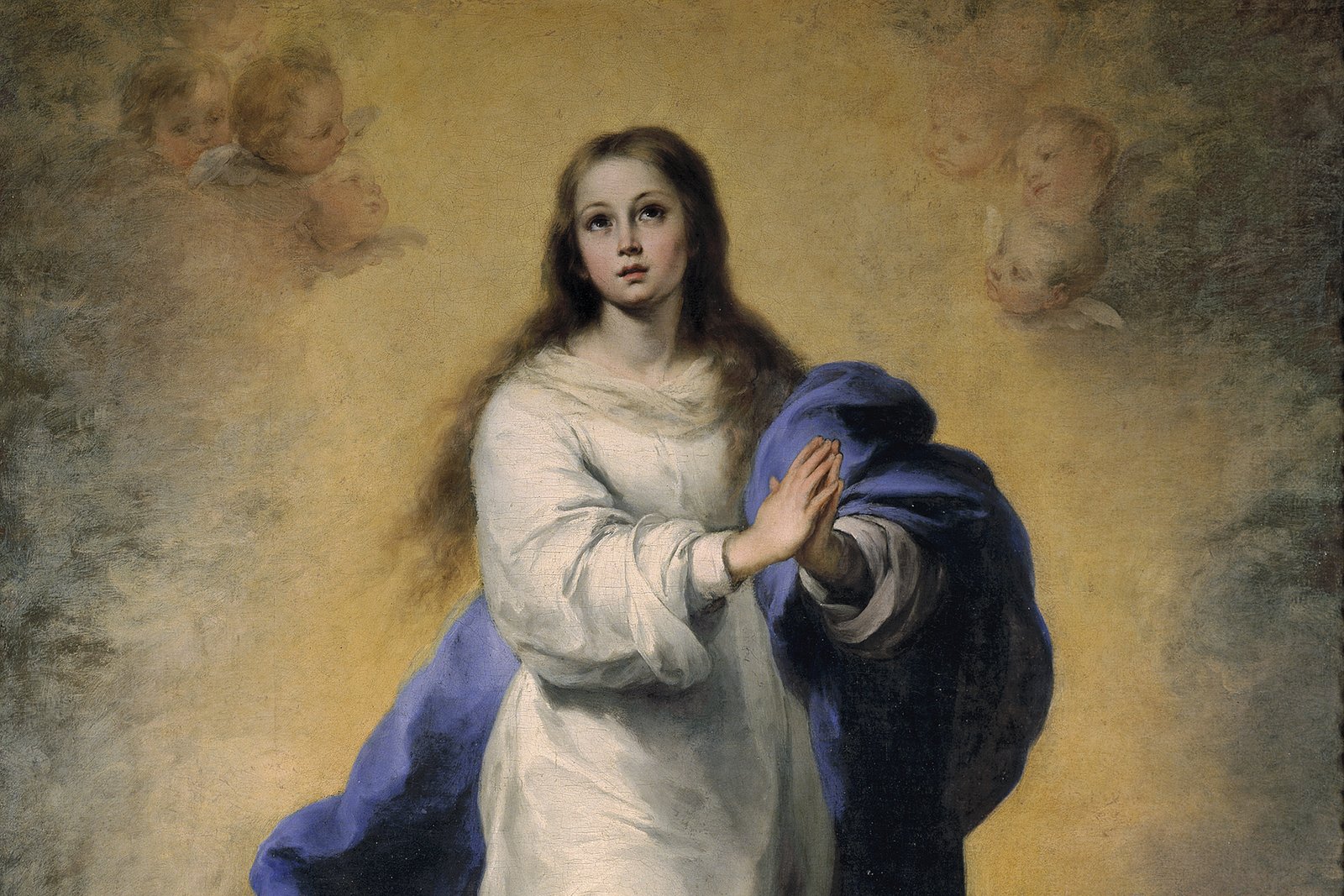
Bartolomé Esteban Murillo, The Immaculate Conception of El Escorial, c. 1660–1665, Museo del Prado, Madrid — public domain.
The claim the Church makes about that moment is a striking one: that Mary, unlike every other human being descended from Adam, was preserved from original sin from the very instant she began to exist. Not cleansed of it later, the way baptism cleanses the rest of us — preserved from it altogether, by a grace applied to her in advance, in view of the son she would one day carry.
Original sin and why it matters here
To understand why this is considered significant, it helps to know what original sin means in Catholic teaching: not a personal sin Mary would have committed, but the fallen condition inherited by every human being since Adam and Eve, a kind of default separation from the fullness of God's grace that each person is born into. The Catechism describes it as a deprivation of original holiness and justice, transmitted to the whole human race (CCC 404). Baptism ordinarily removes this stain. Mary's case, Catholic theology holds, was an exception granted uniquely to her.
The reasoning traditionally offered is that Mary needed to be a fitting dwelling place for the Son of God — that the woman who would carry Christ in her own body should not, for even an instant, have been under sin's dominion. This is sometimes described using the Latin phrase used at her Nativity feast, but the underlying logic goes back much further than any formal definition: it's rooted in a sense, present already among early Christian writers, that Mary occupies a singular place in salvation history and was prepared for it accordingly.
A doctrine centuries in the making
Belief in Mary's exceptional holiness runs deep in Christian history, but the precise, formal teaching now called the Immaculate Conception took a long time to reach its final shape. Eastern Christians had feasts honoring Mary's conception by the early medieval period, and devotion spread across Western Europe in the centuries that followed, though not without vigorous theological debate — some of the greatest medieval theologians, including Saint Thomas Aquinas, raised questions about how Mary could be preserved from original sin and still need a savior at all. It was the Franciscan theologian Blessed John Duns Scotus who supplied the answer that eventually carried the day: Mary was not exempted from needing redemption, but was redeemed in the most perfect way possible — preventively, rather than after the fact. Christ, in this view, is still her Savior; he simply saved her in advance.
The doctrine reached its formal definition centuries later, when Pope Pius IX declared in the 1854 bull Ineffabilis Deus that Mary "was preserved free from all stain of original sin" from the first instant of her conception (CCC 491) — a teaching now held as dogma, meaning Catholics are bound to accept it as revealed truth, not merely pious opinion.
Lourdes and the words a young girl couldn't have invented
Four years after that 1854 definition, something happened in a small French town that many Catholics regard as heaven's own confirmation of the new dogma. In 1858, a fourteen-year-old peasant girl named Bernadette Soubirous reported a series of apparitions of a lady in a grotto near Lourdes. When Bernadette finally pressed the figure to identify herself, the answer she reported receiving was, in the local dialect, "I am the Immaculate Conception" — a theological phrase that a poor, largely uneducated teenager would have had no obvious way to know, let alone invent. For many Catholics, the timing has always seemed too precise to be coincidence: a doctrine defined in Rome, echoed within the decade by a girl who had never heard of it. For more on that episode, see this blog's article on Our Lady of Lourdes.
Scriptural grounding and the "full of grace" greeting
Catholic apologetics for the Immaculate Conception lean heavily on a single moment in Luke's Gospel: the angel Gabriel's greeting to Mary at the Annunciation. In the Douay-Rheims translation, Gabriel addresses her as "full of grace" (Luke 1:28) — a title so unusual that some theologians read it almost as a proper name, a description of Mary's entire spiritual condition rather than a passing compliment. If Mary is, at that moment, already completely filled with grace, the argument runs, there is no room left in her for sin to have taken hold, even at the deepest, inherited level. It's not a knockdown proof text on its own — the doctrine developed through centuries of tradition and theological reasoning, not a single verse — but it has functioned as an anchor for the belief since the earliest debates. For the fuller story of that encounter, see this blog's article on the Annunciation.
Patroness of a nation, symbol on a flag
The Immaculate Conception isn't only a theological title; it's also a national patronage. In 1846, American bishops gathered in Baltimore chose Mary under this title as patroness of the United States, a choice reaffirmed in later decades and reflected today in the dedication of the Basilica of the National Shrine of the Immaculate Conception in Washington, D.C. — one of the largest Catholic churches in North America. Spain, Portugal, and several Latin American nations hold similar devotions, and the feast remains a holy day of obligation in many countries, a mark of how central this particular vision of Mary has become to Catholic identity well beyond its theological technicalities.
Trivia worth knowing
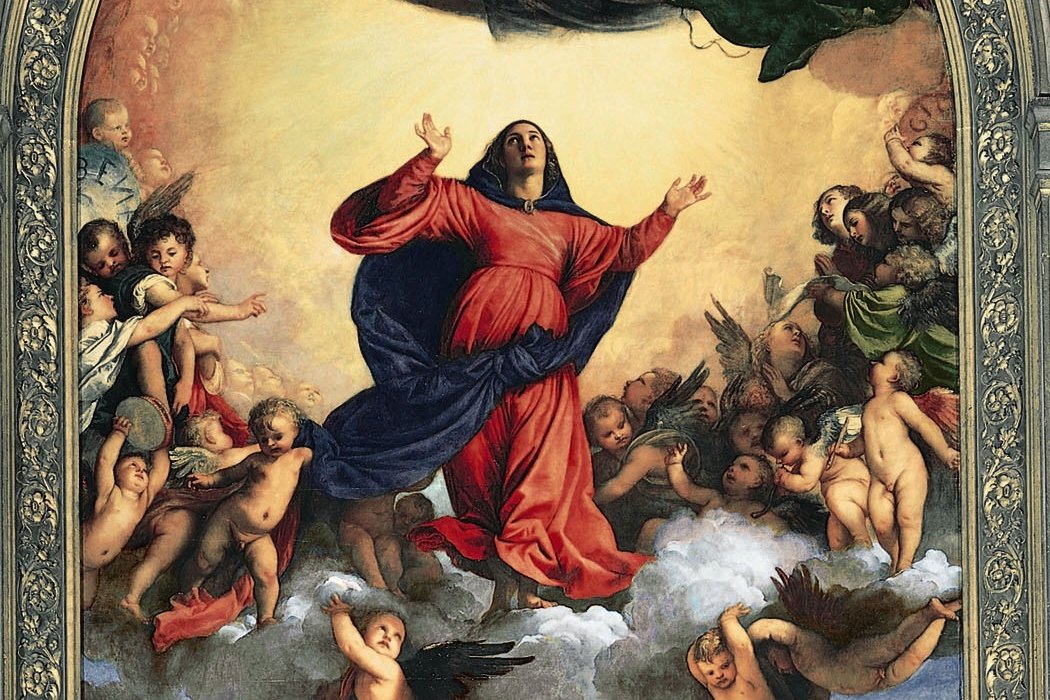
The doctrine is often confused with two other Marian beliefs it's easy to mix up: the Virgin Birth (how Jesus was conceived) and the Assumption (how Mary's earthly life ended). All three honor Mary, but each answers a completely different question. Understanding the distinction is, in a real sense, the whole point of getting to know this feast — it rewards the kind of careful attention that separates a devotional detail from sloppy shorthand, which is fitting for a doctrine that took the Church the better part of two millennia to state with precision.
Trivia
What does the Immaculate Conception actually refer to?
Is the Immaculate Conception the same as the Virgin Birth?
When did the Catholic Church officially define this teaching?
Does the Bible mention the Immaculate Conception directly?
Why December 8th specifically?
Related Reading