Dürer's Praying Hands

A study, not a finished work
In 1508, the Frankfurt cloth merchant Jakob Heller commissioned Albrecht Dürer, already the most celebrated artist working in Germany, to paint a large altarpiece for the Dominican church in Frankfurt. The central panel would show the Coronation of the Virgin Mary, surrounded by the twelve apostles and other saints in adoration — an ambitious, crowded composition that demanded careful preparation. Dürer, characteristically methodical, made dozens of individual studies before touching brush to the main panel: studies of drapery, studies of heads, and studies of hands, worked out in ink, chalk, and wash on tinted paper so he could get every gesture right before committing it to the final painting.
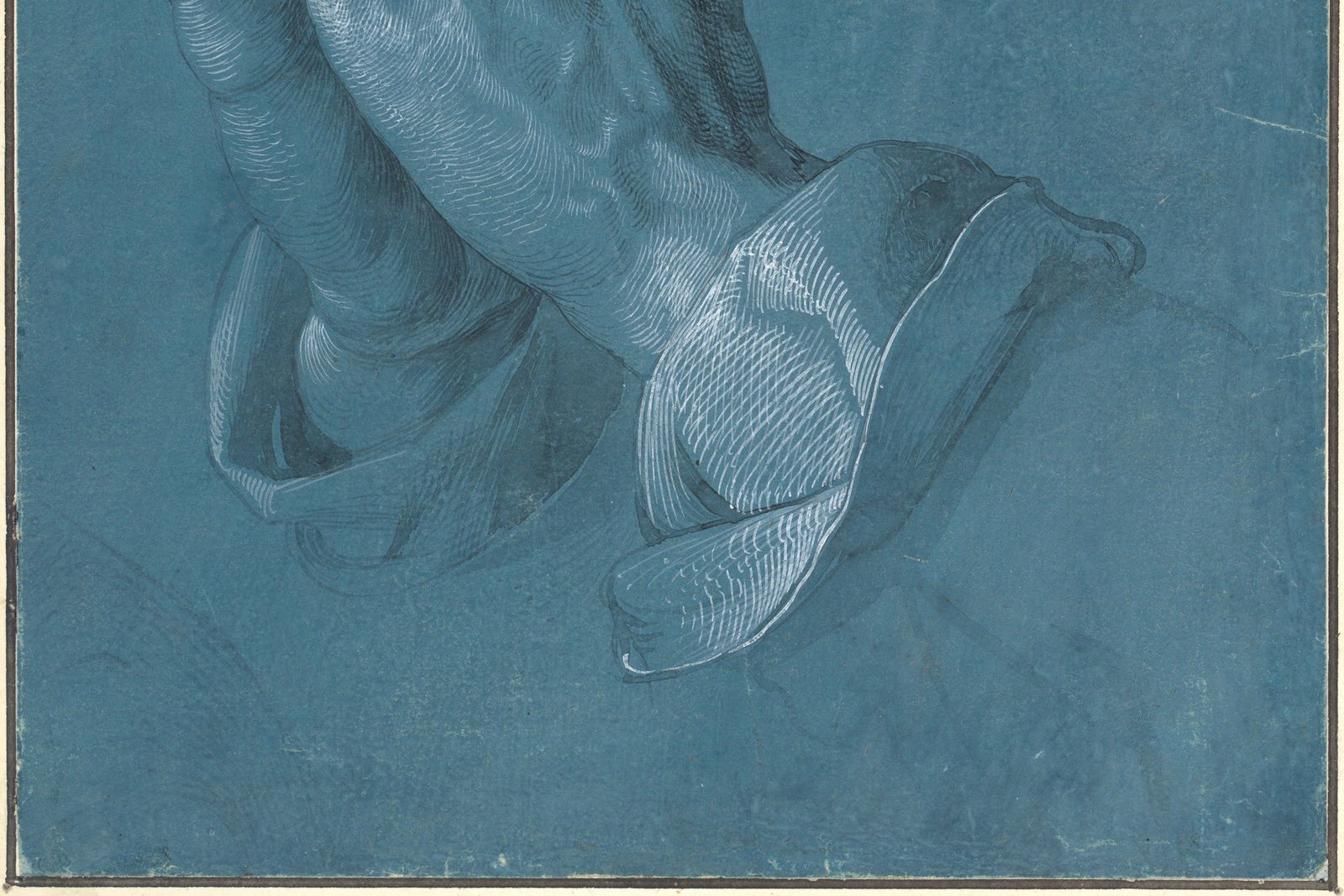
Albrecht Dürer, Praying Hands, 1508, Albertina, Vienna — public domain.
Among these preparatory drawings is the one now known simply as Praying Hands — two hands, right over left, fingers extended and slightly curled, rendered with extraordinary attention to the play of light across knuckle and tendon. It corresponds to the hands of one of the apostle figures kneeling in the finished altarpiece composition, most likely intended as a study for the hands of Saint Philip or another of the apostles depicted in adoration around the Virgin. Dürer used blue-grounded paper and a combination of brush, ink, and white heightening — a technique that let him build up both the darkest shadows and the brightest highlights with unusual precision, giving the drawing a three-dimensional quality that a simple pencil sketch could never achieve.
The technical mastery behind a simple image
What makes the drawing remarkable, beyond its devotional subject, is the sheer technical control on display. Dürer was working near the height of the German Renaissance's engagement with Italian ideas about anatomical accuracy and naturalistic light, and the hands show it: every visible vein and tendon is placed with anatomical logic, and the fall of light from the upper left creates a sense of real, physical volume rather than a flat outline. This wasn't Dürer's first or only hand study — his sketchbooks are full of them — but this particular drawing achieves a level of finish that goes beyond a rough working note. It reads almost as a completed composition in its own right, even though it was never meant to be seen independently of the larger altarpiece project.
Art historians who have studied Dürer's working methods point out that his preparatory drawings often carry more emotional immediacy than his finished panel paintings, which had to satisfy a patron's specifications and follow established compositional conventions. In a study like this one, made for his own use rather than for public display, Dürer could focus entirely on capturing a gesture that felt true — and the resulting intimacy is very likely part of why this particular drawing, out of the dozens he made in his lifetime, became the one that endured in popular memory.
The legend that isn't history
A story attached to this drawing has circulated for generations: that Dürer had a brother who sacrificed his own chance at an artistic education, taking on hard manual labor so that young Albrecht could study painting, and that this drawing depicts that brother's work-worn hands, sketched by Dürer as a private act of gratitude after learning what had been given up on his behalf. It is a moving story, and it has been repeated in sermons, greeting cards, and inspirational books for well over a century.
It is also, as far as historians can establish, not documented history. Dürer's actual biography, drawn from his own extensive surviving letters, diaries, and the detailed records of his family and training under the painter Michael Wolgemut, does not support this specific account, and no contemporary source from Dürer's own lifetime mentions it. The tale appears to be a later invention — the kind of story that attaches itself naturally to an image this personal and universal, because viewers want to know whose hands these were and why they mattered enough to draw so carefully. The honest answer is more modest and, in its own way, more interesting: they were a study, made by a working artist solving a specific compositional problem for a specific commission, that happened to capture something people have recognized ever since as the shape of prayer itself.
From altarpiece study to global icon
The finished Heller Altarpiece did not survive intact. The central panel Dürer painted was moved to Munich in the early eighteenth century and destroyed in a fire at the Residenz palace in 1729 — an enormous loss, since it had been considered one of Dürer's major achievements. What survives today in its place is a faithful copy made around 1614 by the painter Jobst Harrich, commissioned before the original was moved and before its eventual destruction, along with several of Dürer's original wing panels for the altarpiece and his preparatory drawings, including Praying Hands, which remained safely in collections and eventually reached the Albertina in Vienna.
In an odd reversal, the preparatory study has vastly outlived and outshone the finished work it was made to serve. Once prints of the drawing began circulating independently in the nineteenth century, separated from any explanation of its original context within a lost altarpiece, its meaning shifted. Divorced from the crowded biblical scene it was designed for, the image became something simpler and more universal: two hands, no face, no setting, doing nothing but praying. That absence of specific context is precisely what let it travel so far — into Protestant and Catholic devotional art alike, onto funeral cards and hospital walls, reproduced more times than Dürer himself could likely have imagined for a small working study he never intended anyone outside his own workshop to see.
Trivia
What is Dürer's Praying Hands actually a study for?
Is the popular story about Dürer's brother sacrificing his career for this drawing true?
Where is the original drawing kept today?
Why did Praying Hands become a standalone devotional image?
What happened to the original Heller Altarpiece?
Related Reading