Grünewald's Isenheim Altarpiece

A hospital chapel, not a cathedral
The Isenheim Altarpiece was painted between roughly 1512 and 1516 by Matthias Grünewald for a very specific and unusual setting: the chapel of a hospital run by the Monastery of Saint Anthony in Isenheim, a small town in the Alsace region of what is now eastern France. The Antonine monks who ran the hospital specialized in treating ergotism, a severe illness caused by consuming rye grain contaminated with a toxic fungus, which produced convulsions, gangrene, and painful burning skin lesions — a condition common enough in medieval and early modern Europe, particularly among the rural poor whose diet depended heavily on rye bread, that it earned the popular name "St. Anthony's Fire," tying it directly to the hospital order caring for its sufferers.
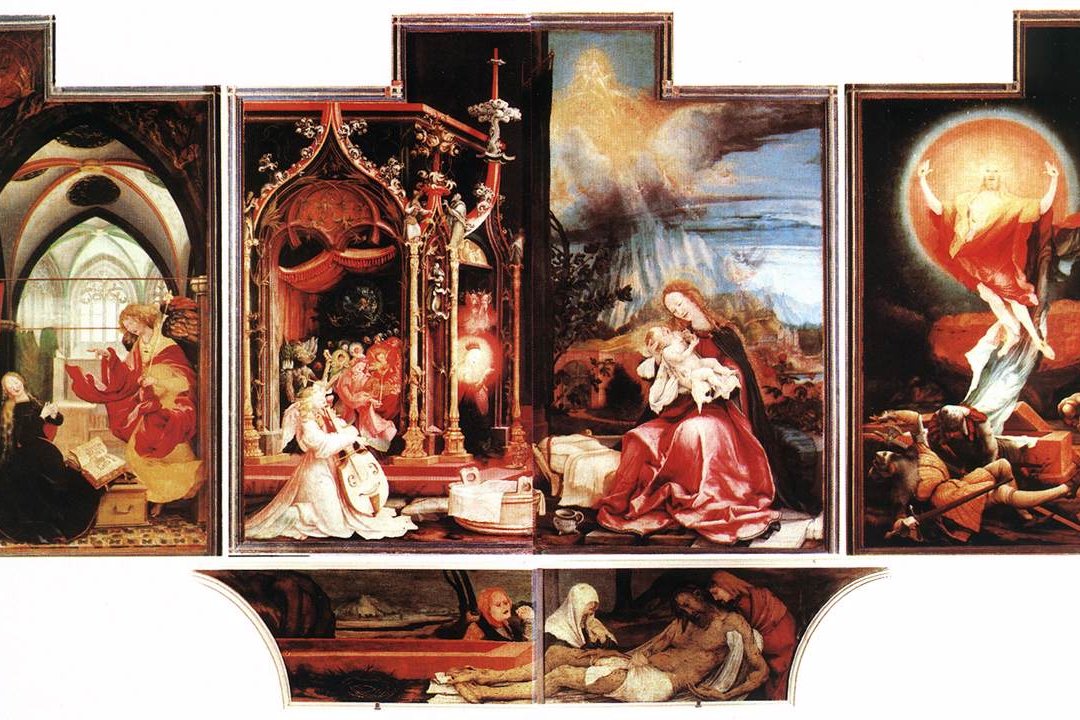
Matthias Grünewald, "The Isenheim Altarpiece," 1512-1516, Musée Unterlinden, Colmar — public domain.
This context shaped every major decision Grünewald made in the altarpiece's design. Rather than a hospital chapel offering patients gentle, idealized religious imagery meant to distract from suffering, Grünewald painted a Crucifixion scene of unflinching, almost clinical brutality — one designed specifically to meet the hospital's dying patients where they were, rather than offer them an image entirely disconnected from their physical reality.
The Crucifixion patients saw first
The altarpiece's outermost view, the first scene patients and visitors would have encountered, shows Christ on the cross in a state of extreme physical torment: his skin discolored and marked with lesions closely resembling the symptoms of ergotism, his body contorted, fingers splayed rigidly outward in visible agony, a crown of thorns rendered with unusual, almost naturalistic violence. This is a dramatically more brutal treatment of the Crucifixion than most contemporary German or Italian religious art of the period typically offered, departing sharply from the more composed, idealized suffering seen in many earlier depictions of Christ's death on the cross, described briefly across all four Gospels but most extensively in John 19:16-30.
Flanking the cross, John the Baptist points toward Christ with an elongated, almost unnaturally long finger — an anachronistic detail, since John the Baptist died before the Crucifixion, but included deliberately as a symbolic figure of prophecy and testimony rather than a strictly historical presence, accompanied by a Latin inscription translating to "He must increase, but I must decrease." On the opposite side, Mary Magdalene kneels in visible anguish, while the Virgin Mary, supported by John the Evangelist, appears pale and near collapse — her grief given equal visual weight to Christ's physical suffering, reinforcing the devotional focus on shared, embodied pain that runs through the entire altarpiece.
A polyptych built for changing scenes
Unlike a single fixed panel, the Isenheim Altarpiece consists of multiple hinged wings that could be opened in stages, allowing the hospital's monks to display different scenes depending on the liturgical calendar and the needs of the moment. Opening the outer Crucifixion wings reveals a strikingly different inner sequence: a joyful Annunciation, a Nativity scene featuring a radiant concert of angels, and a Resurrection in which Christ rises from the tomb wrapped in brilliant, almost luminous light — his skin now shown healed and glowing, a deliberate visual counterpoint to the diseased, tormented body shown on the outer wings, offering patients a direct, visible promise of restoration to set against the suffering depicted just outside. A further innermost layer, carved in wood rather than painted, presents Saint Anthony himself flanked by other saints, tying the entire altarpiece back to the hospital order's own patron and mission.
This structural complexity — a devotional object designed to be physically reconfigured according to season and need — sets the Isenheim Altarpiece apart from more static single-panel altarpieces of the same era, and it reflects a specific, practical theology built directly around the hospital's mission of caring for the suffering, in a way quite different from the more purely commemorative purpose behind an altarpiece like van Eyck's Ghent Altarpiece, completed roughly eighty years earlier for a very different setting and purpose.
From a dissolved monastery to a French museum
The hospital and monastery at Isenheim continued using the altarpiece for its original devotional purpose for nearly three centuries, until the French Revolution's dissolution of religious orders in the late eighteenth century led to its removal and eventual relocation to nearby Colmar, where it has remained on public display at the Musée Unterlinden ever since. Once seen only by hospital patients and the monks caring for them, the altarpiece today is viewed by a very different audience of art historians, tourists, and visitors, most of whom encounter it as one of the most emotionally intense and technically accomplished works of German Renaissance religious art — still carrying, even outside its original hospital context, an unusually direct confrontation with physical suffering that few other altarpieces of its era attempted. Twentieth-century artists and critics, writing in the aftermath of the First World War, frequently returned to Grünewald's unflinching Crucifixion as a touchstone for their own attempts to depict suffering honestly rather than decoratively, giving the five-hundred-year-old altarpiece an afterlife in modern art criticism far beyond its original devotional purpose.
Trivia
Who commissioned the Isenheim Altarpiece and why?
Why does the Crucifixion scene show Christ's body covered in sores and wounds?
How is the Isenheim Altarpiece structured?
Who was Matthias Grünewald?
Where can the Isenheim Altarpiece be seen today?
Related Reading