Hans Memling: The Quiet Master of Flemish Devotional Painting

An outsider who became Bruges's favorite painter
Hans Memling was not a native of the Netherlands. Most scholars place his birth around 1430 near Seligenstadt in what is now Germany, and his earliest documented artistic training likely took place in the workshop of Rogier van der Weyden in Brussels, one of the most influential Netherlandish painters of the mid-fifteenth century. By 1465, Memling had settled in Bruges, then among the wealthiest trading cities in Northern Europe, home to a resident community of Italian bankers and merchants alongside its own prosperous Flemish citizenry. Within this environment of concentrated wealth and cosmopolitan taste, Memling built one of the most successful painting careers of the era, becoming a citizen of Bruges and, by tax records that survive from the period, one of its more substantial property owners.
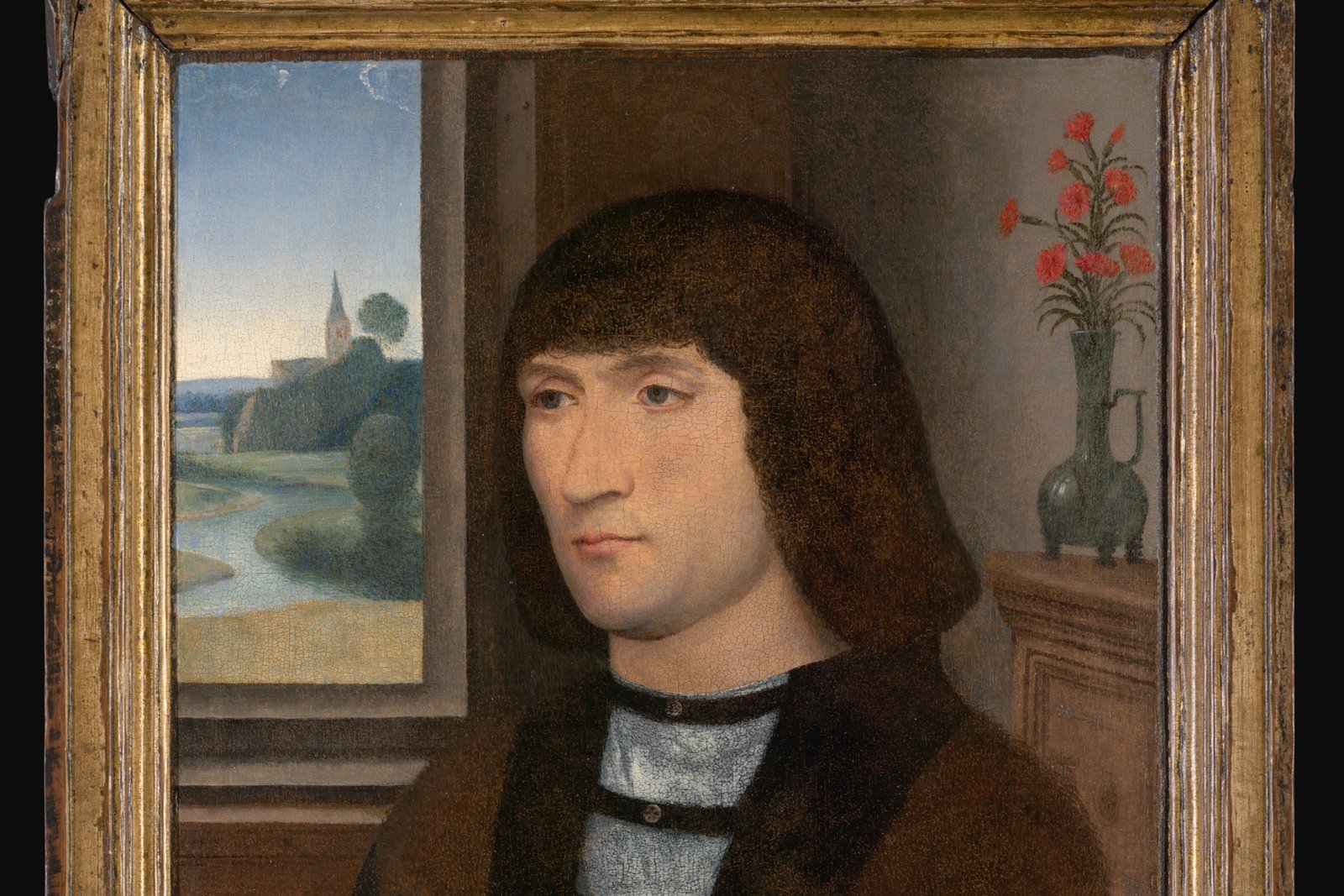
Hans Memling, "Portrait of a Man in Prayer," c. 1480-1490, Art Institute of Chicago — public domain.
A calmer inheritance from a dramatic teacher
If Memling did train under Rogier van der Weyden, as most art historians believe based on strong stylistic parallels, he inherited a great deal — compositional structure, technical polish, a command of oil painting's capacity for fine detail — while quietly setting aside his teacher's taste for emotional intensity. Van der Weyden's figures often convey visible anguish or theatrical grief; Memling's rarely do. His Madonnas gaze downward with gentle composure, his donor figures kneel with folded hands and untroubled expressions, and even his more complex narrative scenes tend to unfold with a kind of hushed order rather than dramatic urgency. This shift in temperament became, in effect, Memling's signature: a devotional art built around serenity rather than confrontation, well suited to patrons who wanted to be depicted at prayer looking composed, dignified, and at peace.
The Shrine of Saint Ursula
Among Memling's surviving works, the Shrine of Saint Ursula stands out as an unusually ambitious commission: a small, house-shaped wooden reliquary designed to hold relics associated with Saint Ursula, painted on its exterior panels with scenes narrating her legendary pilgrimage and martyrdom alongside her companions. The work, completed around 1489 for Saint John's Hospital in Bruges, combines Memling's gift for landscape and architectural detail with sustained narrative storytelling across multiple small painted scenes, each rendered with the same meticulous care he brought to individual portraits. It remains on display today at what is now the Hans Memling Museum, housed in the historic hospital building itself, allowing visitors to see the work essentially where it has resided for over five centuries.
Portraits woven into devotion
One of the most historically valuable aspects of Memling's output is how consistently he blended portraiture with devotional subject matter. Wealthy patrons across Bruges, including resident Italian merchants and bankers, commissioned diptychs and triptychs in which their own painted likenesses knelt in prayer beside or before a depiction of the Madonna and Child or another sacred scene. These works served a double purpose: a genuine act of pious commission, intended to place the patron in perpetual visual proximity to the sacred figures they venerated, and simultaneously a display of wealth, taste, and status within Bruges's competitive merchant society. Surviving examples, including portraits now held internationally, give art historians an unusually rich record of how fifteenth-century individuals wanted to be seen — composed, sincere, and visibly at peace with their faith, a mood that echoes the broader devotional culture explored in our guide to Catholic sacred art.
Technical mastery in oil
Memling worked in the Netherlandish oil-painting tradition pioneered a generation earlier by artists including Jan van Eyck, a technique that allowed for extraordinarily fine layering of translucent color and minute detail — the individual threads of a brocade robe, the texture of distant foliage, the soft transitions of light across a face. Memling brought this technical vocabulary to a level of consistent, almost jewel-like polish across a large surviving body of work, and his paintings are frequently noted by conservators for their excellent state of preservation, a testament to both his technical skill and the careful patronage that has protected many of his panels over the centuries.
A legacy of quiet influence
Memling died in Bruges in 1494, by which point the city's role as a dominant commercial center was already beginning to decline in favor of Antwerp, a shift that would reshape the following generation of Netherlandish painting. Yet Memling's own reputation endured, and his serene, technically precise devotional style continued to influence religious painting in the Low Countries well after his death. Today, his work is recognized less for dramatic innovation than for a kind of sustained excellence — an artist who found, in quiet composure, a devotional language that fifteenth-century patrons found deeply persuasive, and that still reads, five centuries later, as remarkably serene.
Modern museums have only reinforced that reputation. Because so much of Memling's surviving output remained in Bruges institutions rather than being scattered piecemeal across private collections, visitors today can still see a substantial concentration of his work in something close to its original civic context, an unusually intact record for a painter of his period. Art historians researching the wider Netherlandish tradition often cite Memling precisely because his output is so consistent and so well documented, offering a stable point of comparison against which the more turbulent, experimental work of contemporaries can be measured. That stability was never accidental — it was the deliberate result of a painter who understood exactly what kind of calm, dignified image his patrons wanted of themselves, and who delivered it with remarkable consistency across a career spanning nearly three decades in one of Europe's wealthiest cities.
Trivia
Who was Hans Memling and where did he work?
What is Memling best known for painting?
What made Memling's painting style distinctive?
Did Memling paint anything besides religious subjects?
Where can Memling's work be seen today?
Related Reading