The Divine Mercy Jesus

A vision on a February night
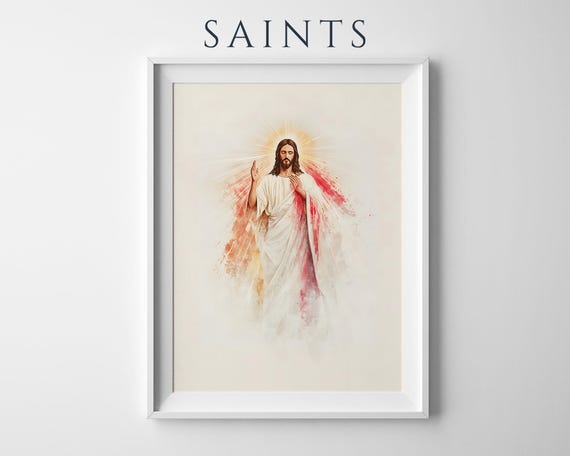
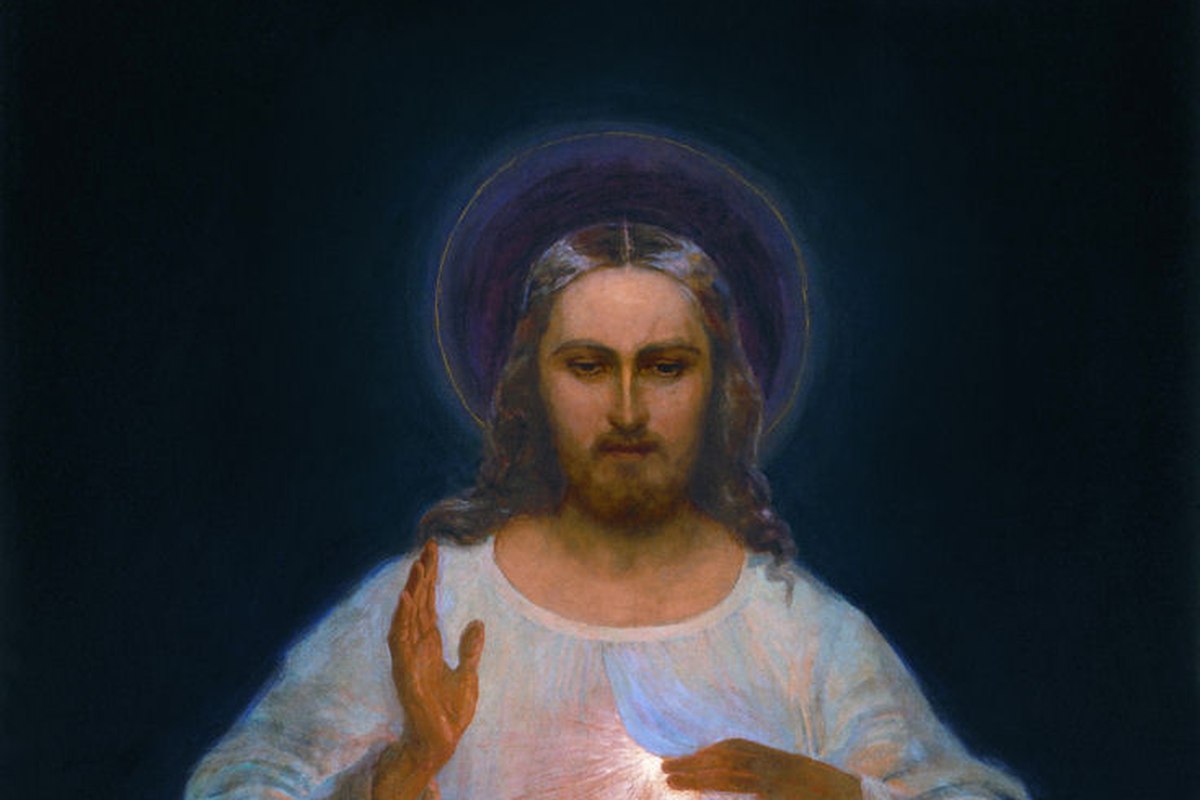
The Divine Mercy image traces back to visions reported by Faustina Kowalska, a Polish nun who had joined the Congregation of the Sisters of Our Lady of Mercy in Warsaw in 1925, drawn to religious life from a poor farming family despite having only a few years of formal schooling. On the night of Sunday, February 22, 1931, while praying alone in her convent cell, she wrote that Jesus appeared to her as the "King of Divine Mercy," robed in white with one hand raised in blessing and the other touching his garment near his heart — the first of what would become years of visions and private revelations that she went on to record in painstaking detail in a diary later published as "Divine Mercy in My Soul." Kowalska reported that Jesus told her, "Paint an image according to the pattern you see, with the signature: Jesus, I trust in You," a phrase that has since become one of the most repeated prayers of the devotion built around the image.
Traditional depiction of the Divine Mercy image, public domain.
A painting made under close supervision
Kowalska struggled for years to find anyone willing to take her visions seriously, since a barely literate nun claiming private conversations with Christ was, understandably, treated with caution by Church authorities of the time. Her confessor, Father Michael Sopoćko, a professor of theology at the University of Vilnius, eventually introduced her to Eugeniusz Kazimirowski, a Polish realist painter who taught art at the same university. At Sopoćko's request, Kazimirowski began painting the image on January 2, 1934, working under the direct supervision of both Kowalska and Sopoćko, who met with him regularly to check his progress against what Kowalska insisted she had actually seen. Kowalska herself reportedly wept after seeing the finished canvas for the first time, feeling that no painted image could fully capture the vision — a disappointment she recorded in her diary even as she came to accept the painting as faithful enough to its purpose.
Rays that recall the crucifixion
The painting's most distinctive feature — pale and red rays streaming from Christ's heart — is traditionally understood, based on Kowalska's own written account, to represent the blood and water that flowed from his side after a Roman soldier pierced it with a spear, an event recorded in the Gospel of John (John 19:34). The pale ray was described by Kowalska as symbolizing the water that justifies souls, and the red ray the blood that is the life of souls — theological imagery tied to the sacraments of baptism and the Eucharist, though this interpretation rests on Kowalska's private revelation rather than a formal doctrinal statement of the Church. That image of mercy pouring outward from the wound became the visual center of the devotion built around it, distinct in tone from other widely known depictions of Christ's heart such as the Sacred Heart of Jesus, though the two devotions share a common focus on divine love expressed through Christ's wounded body.
From a convent wall to worldwide veneration
After its completion, the Kazimirowski painting first hung privately in the Bernardine Sisters' convent near the church of St. Michael in Vilnius, largely unknown outside a small circle of clergy and nuns. Its first public exhibition came April 26-28, 1935, at the Church of the Gate of Dawn, timed to coincide with celebrations marking the end of the Jubilee of the Redemption. Kowalska died of tuberculosis in 1938 at only thirty-three, before the devotion she had championed gained any wide following, and for a period the Vatican itself restricted its spread over concerns about the reliability of her reported visions. Those restrictions were lifted decades later, and Pope John Paul II — himself Polish and deeply devoted to Kowalska's writings — canonized her in 2000 and established Divine Mercy Sunday, observed the Sunday after Easter, as an official feast on the universal Church calendar. Since then, numerous other versions of the image have been painted by other artists, most notably a widely reproduced rendition by Adolf Hyła in Kraków, and the image is now venerated worldwide, central to a devotion that has grown from one nun's private diary into one of the most recognized pieces of twentieth-century Catholic art.
A diary that shaped modern Catholic devotion
Beyond the image itself, Kowalska's diary went on to shape Catholic devotional life well beyond the painting she had commissioned. It includes the Chaplet of Divine Mercy, a set of prayers recited on ordinary rosary beads that Kowalska described receiving instructions for during another of her visions, meant to be prayed especially at three o'clock in the afternoon, the hour she associated with Christ's death on the cross. The diary's central theme — that no sin is beyond God's mercy so long as a person turns back to him with trust — struck a particular chord in the decades following the devastation of the Second World War, a conflict that had swept directly through Kowalska's own Poland only a few years after her death. Pope John Paul II, who as a young priest had worked in Kraków not far from where Kowalska's remains rest, spoke often of how deeply her writings had shaped his own spirituality, and it was under his papacy that a private nun's wartime-era visions became a formally recognized feast on the universal calendar of the Church.
Trivia
Where does the Divine Mercy image come from?
Who painted the first Divine Mercy image?
What do the rays in the image represent?
When was the image first publicly displayed?
Related Reading