Caravaggio's The Calling of Saint Matthew

A commission that launched a career
In 1599, a young and still relatively unknown painter named Michelangelo Merisi — called Caravaggio after his family's hometown in Lombardy — received his first major public commission: three large canvases for the Contarelli Chapel in the French national church of San Luigi dei Francesi in Rome, depicting scenes from the life of Saint Matthew the Apostle. The Calling of Saint Matthew, completed by 1600, was one of the two side paintings flanking an altarpiece of Matthew and the angel, and it established almost immediately the dramatic style that would make Caravaggio one of the most influential and controversial painters of his era. This painting depicts a specific moment in Matthew's life rather than a general portrait; for the broader story of the apostle himself, see Saint Matthew the Apostle.
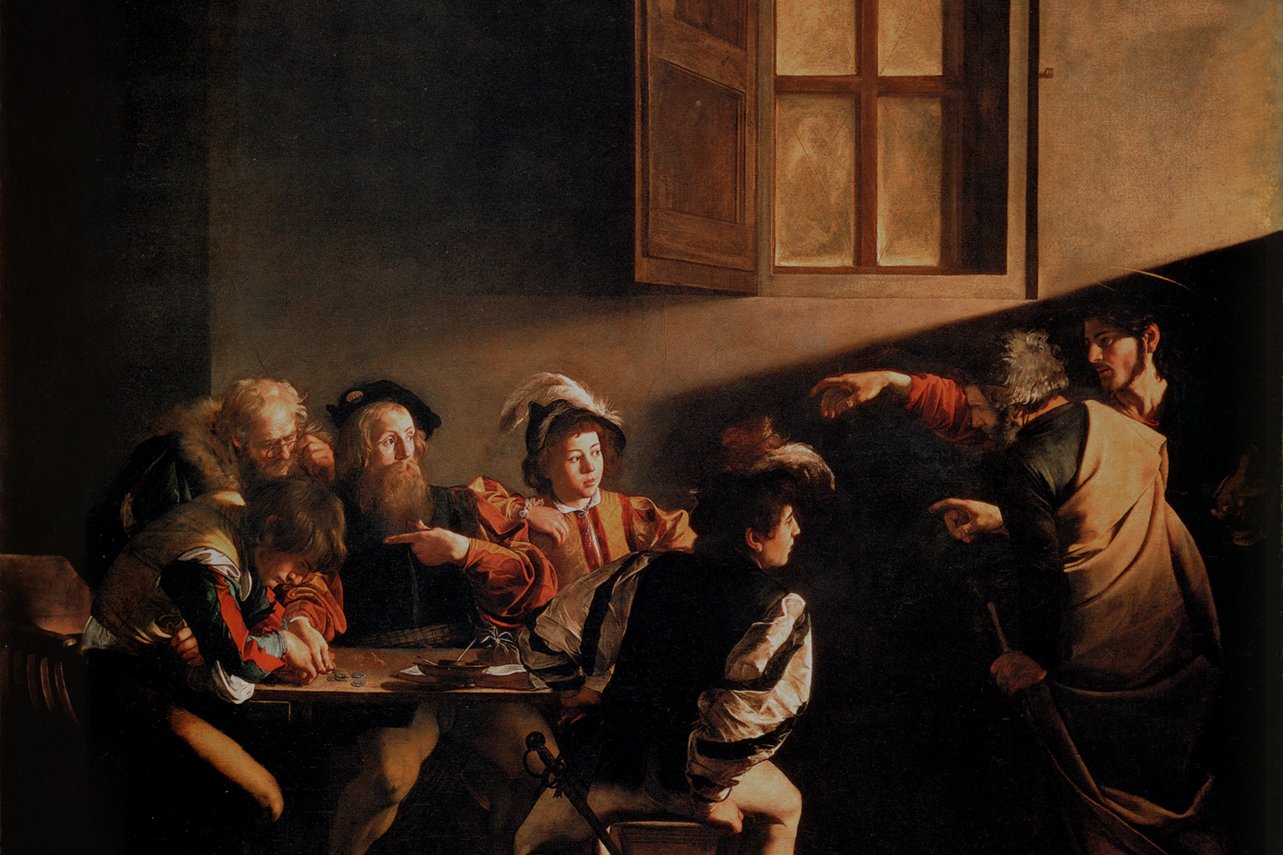
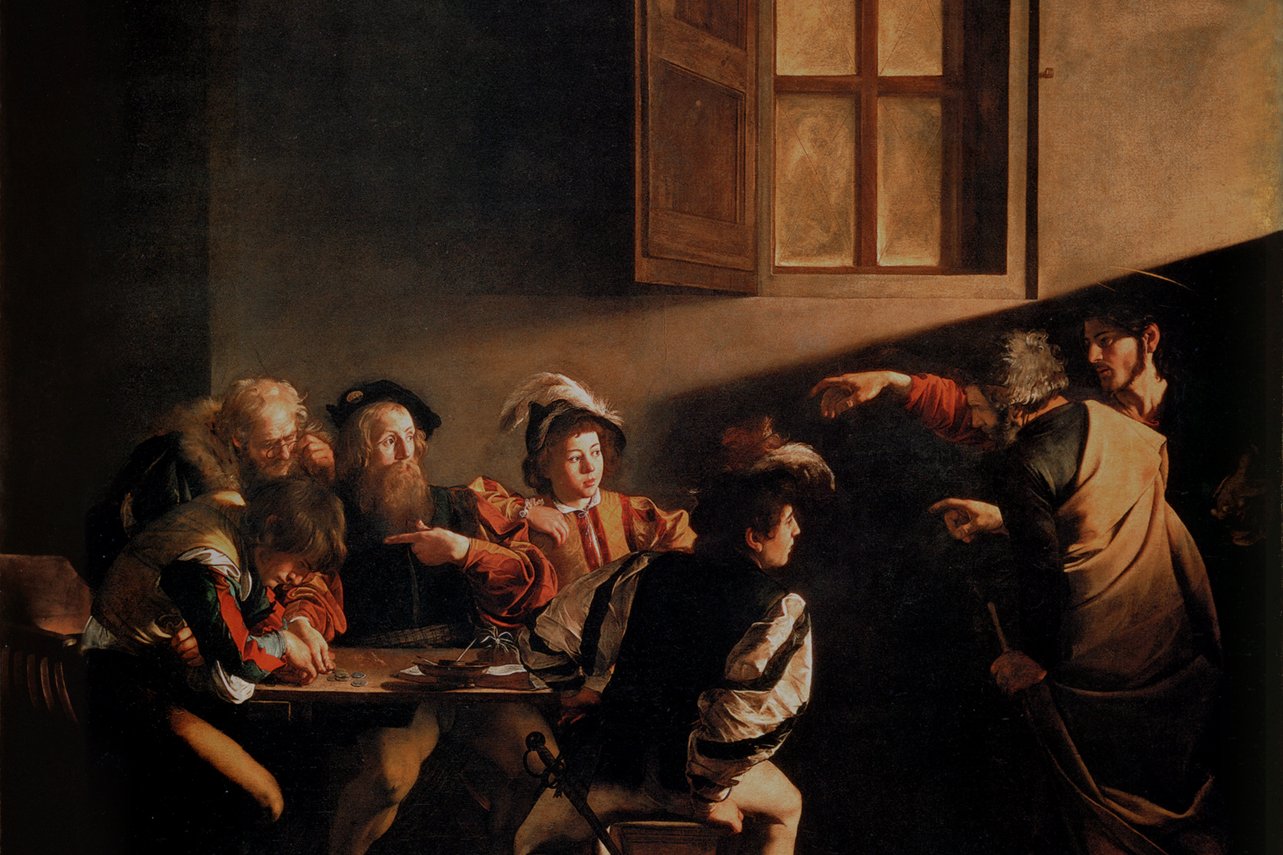
Caravaggio, "The Calling of Saint Matthew," 1599-1600, Contarelli Chapel, San Luigi dei Francesi, Rome — public domain.
The Gospel account itself is remarkably brief: "As Jesus passed on from there, he saw a man named Matthew sitting at the customs post. He said to him, “Follow me.” And he got up and followed him." (Matthew 9:9, RSV-CE). No other Gospel detail describes the scene — no dialogue beyond those two words, no description of the room or the other men present. Caravaggio built an entire, psychologically charged composition almost entirely from his own imagination, working from that single spare sentence.
Light as the true subject
Caravaggio set the scene in a dim, contemporary Roman interior rather than an idealized biblical landscape, with Matthew and several companions gathered around a table counting money — visually establishing his profession as a tax collector, a role that carried strong connotations of moral compromise and social contempt in first-century Judea, since tax collectors worked for the occupying Roman authority and were widely viewed as collaborators and extortionists. Christ enters from the right, mostly in shadow, his face partly obscured, with only his extended arm and pointing hand catching full light — a gesture art historians have long connected visually to Michelangelo's Creation of Adam on the Sistine Chapel ceiling, though here the outstretched hand offers a calling rather than the spark of life itself.
The single most celebrated element of the composition is its light source: a strong diagonal beam that appears to enter from a window outside the painted scene, following almost exactly the same angle as Christ's pointing arm, illuminating faces and coins at the table while leaving much of the room in deep shadow. This technique — chiaroscuro, the dramatic manipulation of light and dark — was not new to painting in general, but Caravaggio pushed it further than his predecessors, using it not merely to model three-dimensional form but to direct the viewer's eye and carry the scene's entire narrative and emotional weight. The light effectively becomes a second, wordless articulation of Christ's spoken command, arriving at the table exactly where his hand points.
Modern dress in an ancient story
Unlike most religious painters of his era, who typically dressed biblical figures in generalized robes meant to evoke a distant, idealized past, Caravaggio clothed the men at the table in the fashionable doublets, feathered hats, and swords of contemporary Roman street life around 1600. This choice startled contemporary viewers accustomed to more conventionally reverent, historically distanced religious imagery, but it also served a clear devotional purpose consistent with the aims of the Counter-Reformation Church, which encouraged art that made sacred events feel immediate and personally relevant to ordinary worshippers rather than remote historical episodes. By placing the calling of an apostle inside what looks like a contemporary Roman tavern or counting house, Caravaggio suggested that such a moment of divine intervention could happen to anyone, at any table, in any ordinary room — not only to a figure safely distant in biblical antiquity.
A debate over which man is Matthew
Art historians have long debated exactly which figure at the table represents Matthew himself. The traditional and most widely accepted reading identifies the bearded, older man at the center of the group, pointing at his own chest with a questioning expression as if to ask "who, me?" as Matthew — an interpretation supported by his central position and direct engagement with Christ's gesture. A minority of scholars have argued instead that the young man at the far end of the table, head bent over the coins and seemingly uninvolved in the exchange, is the true Matthew, with the older man merely gesturing toward him rather than at himself. The ambiguity, whether intentional or not, has kept the painting a subject of active scholarly discussion for decades, adding a layer of interpretive tension to a scene already built around the moment of recognition and response.
An enduring model for religious drama
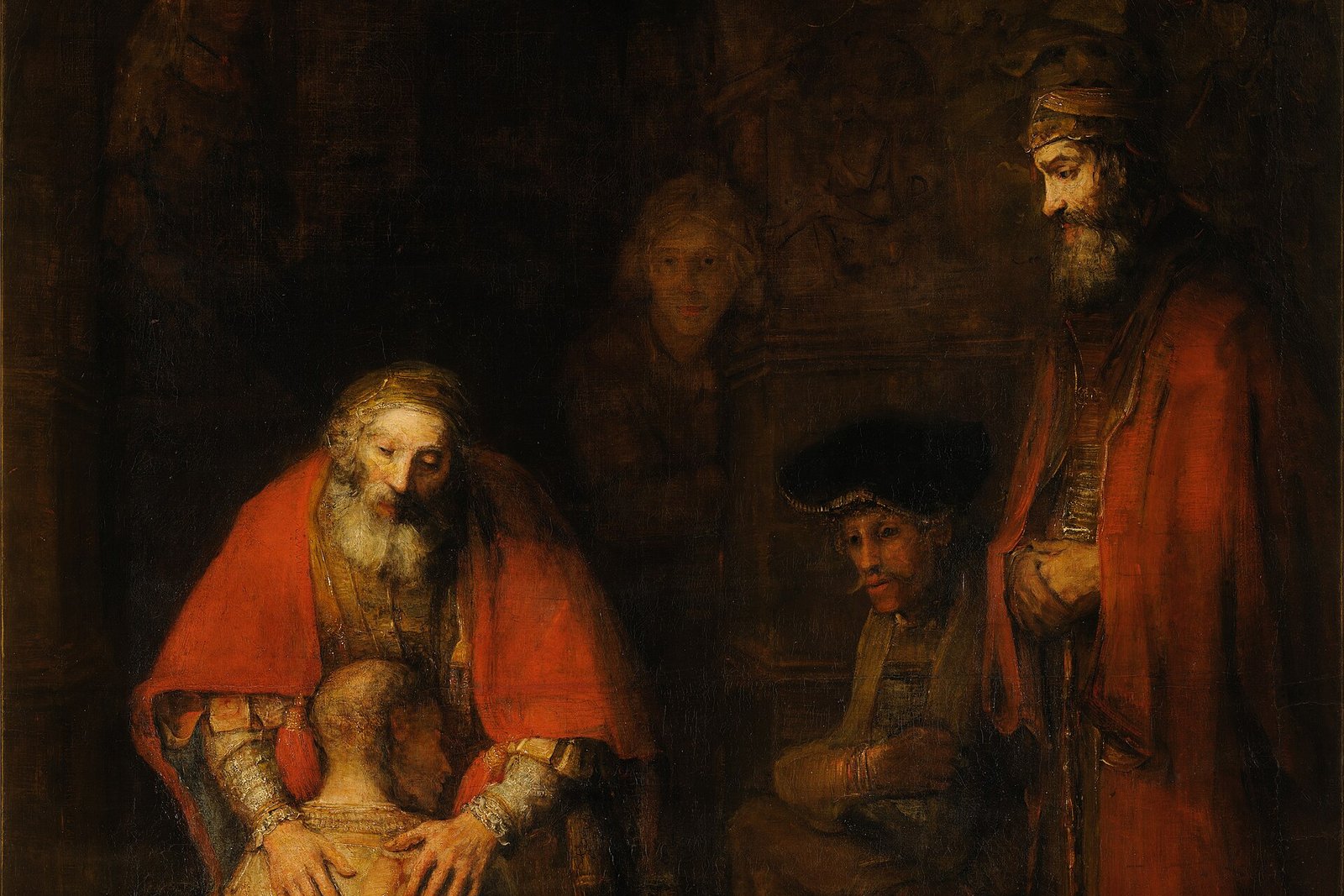
The Calling of Saint Matthew, along with its companion pieces in the Contarelli Chapel, established a visual language — stark light against deep shadow, contemporary dress, ordinary settings for extraordinary moments — that influenced generations of Baroque painters across Europe, from Caravaggio's direct followers in Rome to artists as far away as the Dutch Republic, where Rembrandt would later apply related lighting techniques to his own religious scenes, including The Return of the Prodigal Son. More than four centuries after its completion, it remains in its original chapel setting, still lit today largely by the same natural light Caravaggio painted it to catch.
Trivia
Where is Caravaggio's The Calling of Saint Matthew located?
What moment from the Bible does the painting depict?
Why is Matthew shown wearing contemporary 17th-century clothing instead of biblical-era robes?
Which figure at the table is actually Matthew?
What technique is Caravaggio best known for in this painting?
Related Reading