Piero della Francesca's Resurrection: A Fresco Saved by Its Own Fame

A painter-mathematician's hometown commission
Piero della Francesca was born in Sansepolcro, a small town in eastern Tuscany, and though his career took him to work in courts and churches across central Italy, he maintained lasting ties to his birthplace throughout his life. The Resurrection, generally dated to sometime between 1463 and 1465, was painted for the audience chamber of Sansepolcro's town hall, a civic rather than strictly ecclesiastical setting, reflecting the close intertwining of religious and civic identity common in Italian towns of the period. Piero was, alongside his painting career, a serious mathematician who wrote treatises on geometry and perspective, and that intellectual rigor shows clearly in the Resurrection's composition, built around careful geometric structuring and a calm, almost architectural sense of pictorial order rarely matched by his contemporaries.
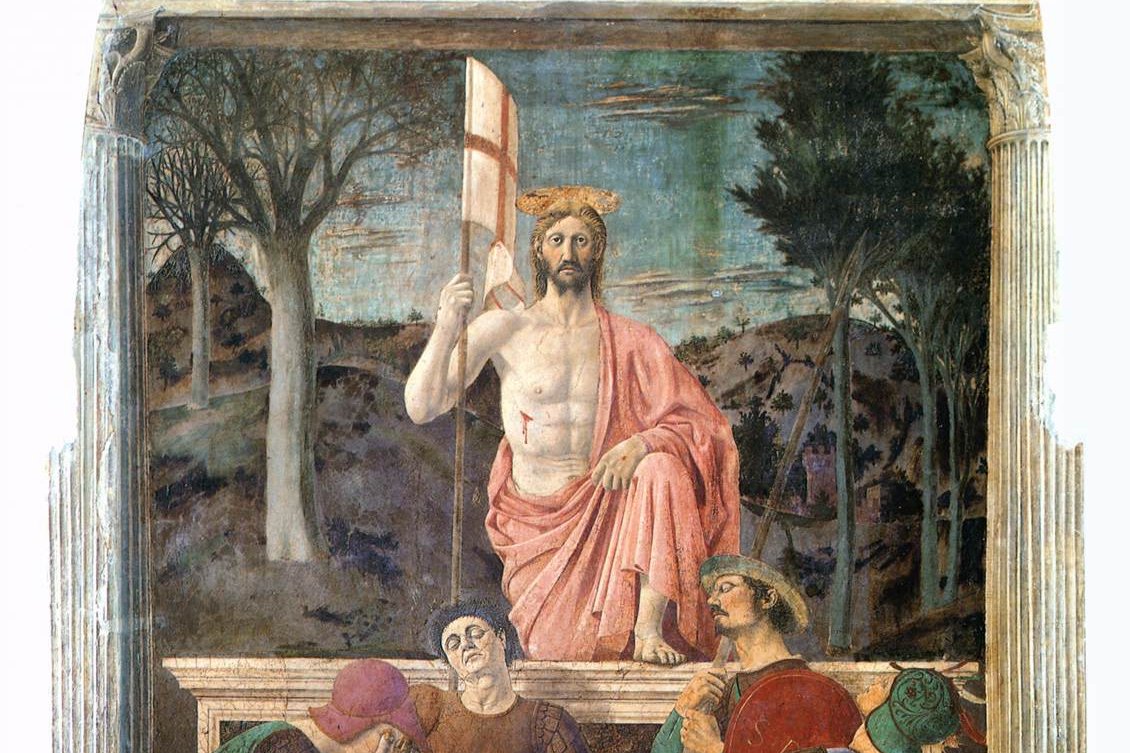
Piero della Francesca, "The Resurrection," c. 1463-1465, Museo Civico, Sansepolcro — public domain.
Christ as an immovable, monumental presence
At the center of the composition, Christ stands frontally, directly facing the viewer, one foot planted on the edge of the tomb he has just risen from, holding a banner marked with a red cross symbolizing his triumph over death. Unlike more dynamic depictions of the Resurrection that emphasize dramatic upward movement or theatrical gesture, Piero's Christ conveys authority through stillness and geometric solidity, his body positioned at the exact vertical and horizontal center of the composition, anchoring the entire scene with an almost architectural weight. Below him, the Roman soldiers assigned to guard the tomb sleep in awkward, foreshortened poses, entirely unaware of the miracle occurring directly above them, a contrast between divine event and human obliviousness that adds a note of quiet, understated irony to the otherwise solemn composition.
A landscape that tells its own story
One of the fresco's most quietly sophisticated details lies in its background landscape, which shifts noticeably in character from one side of the composition to the other: bare, leafless trees appear on the left side behind the sleeping soldiers, while full, leafy vegetation fills the right side behind the risen Christ. Art historians widely read this asymmetry as a deliberate symbolic device, contrasting the deathly winter associated with the soldiers' spiritual blindness against the springtime renewal signified by Christ's resurrection, woven into the painting's naturalistic landscape rather than announced through any explicit allegorical figure. This kind of subtle, integrated symbolism characterizes much of Piero's work, rewarding the kind of sustained, careful looking that his mathematically structured compositions seem almost designed to encourage.
A face possibly the artist's own
Long-standing local tradition holds that Piero included a self-portrait among the sleeping soldiers in the foreground, a detail that, if accurate, would place the artist himself as an unwitting witness, literally sleeping through, the central miracle of Christian faith. While this identification cannot be definitively confirmed, the tradition reflects a broader Renaissance practice of artists inserting themselves, sometimes prominently and sometimes more obliquely, into their own religious commissions, a device also found in works discussed elsewhere on this site, including Masaccio's Holy Trinity fresco, where donor portraits similarly bridge the gap between the painted sacred scene and the lived world of the patrons and artists who produced it.
Nearly lost to war
The fresco's survival through the Second World War has become one of the most frequently retold anecdotes in art history. In the summer of 1944, as Allied forces pushed German troops back through central Italy, a British artillery officer, Captain Anthony Clarke, was reportedly ordered to bombard Sansepolcro. According to the widely circulated account, Clarke recalled an essay by the writer Aldous Huxley, published some years earlier, that had praised the Resurrection as possibly the finest painting in the world, and he held his fire long enough for German forces to withdraw from the town without a fight, sparing both Sansepolcro and its treasured fresco from destruction. Whatever the precise details of that decision, the town has never forgotten it, and a street in Sansepolcro today bears Clarke's name in gratitude.
A quiet masterpiece, still in its original home
Unlike so many celebrated works of Renaissance art that were long ago relocated to major national museums, Piero della Francesca's Resurrection remains today essentially where it was painted, in the same small Tuscan town that shaped the artist's early life and drew him back throughout his career. That continuity gives visitors an unusually direct connection to the original context of the work's creation, a rare privilege in the history of Renaissance painting, and one that helps explain why this quietly monumental fresco continues to draw admirers from around the world to a town most travelers might otherwise pass by entirely.
Later generations of artists and critics have continued to single out the painting's peculiar combination of intellectual restraint and emotional power. Where many Renaissance depictions of the Resurrection lean toward dramatic movement or ornate detail, Piero offers something closer to a mathematical proof of divine triumph, stated once, plainly, and never repeated with the same force. That severity is precisely what critics from Huxley onward have found so compelling: a painter capable of the most rigorous geometric planning choosing, at the most decisive moment of Christian narrative, to let stillness itself carry the entire weight of the miracle.
Trivia
What does Piero della Francesca's Resurrection depict?
Where is the Resurrection fresco located?
Why is this fresco considered so important art-historically?
How did the fresco survive World War II?
What is unusual about the landscape shown in the background?
Related Reading