Perugino's Delivery of the Keys

A fresco with an argument to make
Before the Sistine Chapel became famous for the ceiling Michelangelo would paint more than two decades later, it was already one of the most important decorated spaces in Christendom. Pope Sixtus IV, who had the chapel built and gave it his name, commissioned a cycle of frescoes for its side walls depicting parallel scenes from the life of Moses and the life of Christ — a visual argument that the Old Covenant given through Moses found its fulfillment in the New Covenant established by Christ. Among the artists Sixtus assembled for this ambitious project, alongside Sandro Botticelli, Domenico Ghirlandaio, and Cosimo Rosselli, was Pietro Perugino, then one of the most sought-after painters in Italy and, not incidentally, the young Raphael's future teacher.
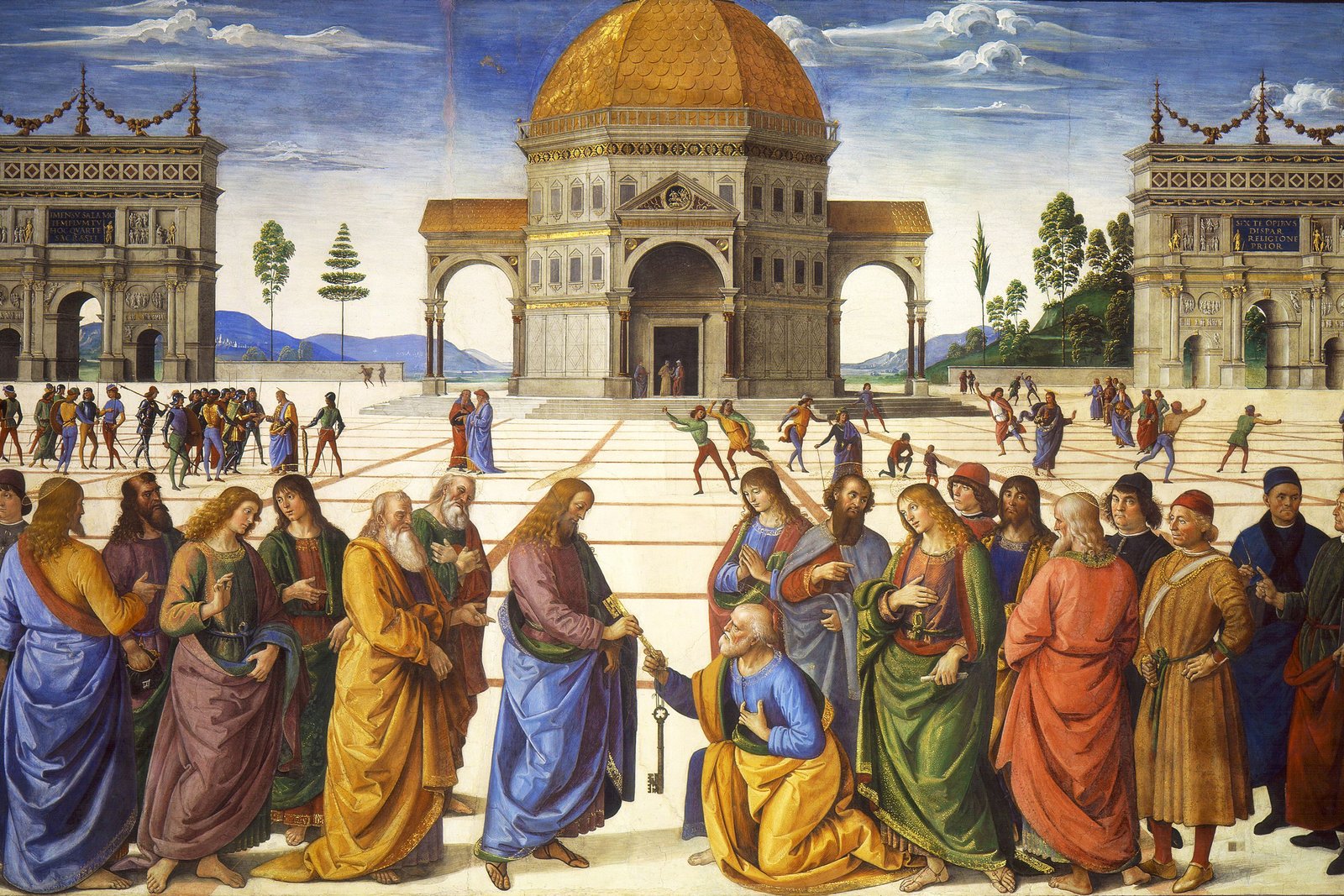
Pietro Perugino, The Delivery of the Keys, 1481-82, Sistine Chapel, Vatican City — public domain.
Perugino's contribution, The Delivery of the Keys, occupies a central position in the cycle and carries perhaps the most direct institutional message of any fresco in the room. It depicts the moment described in the Gospel of Matthew when Christ tells Peter he will receive "the keys of the kingdom of heaven" — words the Catholic Church has long understood as the scriptural foundation for Peter's unique authority among the apostles, and by extension for the authority of every pope who has succeeded him as Bishop of Rome.
Reading the composition
The painting's structure rewards close attention. In the foreground, Christ stands at the center, extending two keys — one gold, one silver — toward a kneeling Peter, who receives them with visible reverence. The two keys are themselves significant: medieval and Renaissance theology often read them as representing complementary powers, one to bind and loose on earth, one tied to the authority of heaven, drawn from the same Matthew passage. Flanking this central exchange, Perugino arranged rows of the other apostles and a scattering of contemporary figures, some identified as portraits of people connected to the commission, all watching the moment unfold with careful, individualized attention rather than generic crowd-filler expressions — a hallmark of Perugino's mature style.
Behind this crowded foreground, Perugino opened up an enormous, airy piazza, paved in receding geometric patterns that showcase his mastery of linear perspective, a technique still relatively new and prized in Italian painting of this period. At the center of that piazza stands a domed, centrally planned building, flanked by two triumphal arches modeled on ancient Roman monuments. Art historians have generally read this building as an idealized vision of the Temple of Jerusalem, rebuilt and perfected — though the resemblance to later designs for a rebuilt Saint Peter's Basilica has struck many viewers as a kind of prophetic irony, since the actual rebuilding of Saint Peter's along similar centralized lines would begin only a few decades after Perugino completed this fresco.
Placing scripture inside a working chapel
What separates The Delivery of the Keys from a purely devotional altarpiece is where it hangs and what happens beneath it. The Sistine Chapel isn't simply a museum space; it remains the room in which the College of Cardinals gathers to elect a new pope, sealed off from the outside world for the duration of the conclave. Every cardinal casting a ballot beneath these walls does so under a painted reminder, executed in the chapel's earliest decorative campaign, of the doctrine of apostolic succession: that the authority they are about to confirm in a new pope traces back, without interruption, to the moment depicted directly above them.
This is part of what distinguishes Perugino's fresco from other Renaissance treatments of the same biblical episode. It isn't only a narrative scene illustrating a Gospel verse; it is an argument embedded into the architecture of governance itself, painted at the direct request of the pope who built the room specifically so that argument would be visible to everyone who would ever gather there to choose his successors.
A quieter legacy, painted over the door
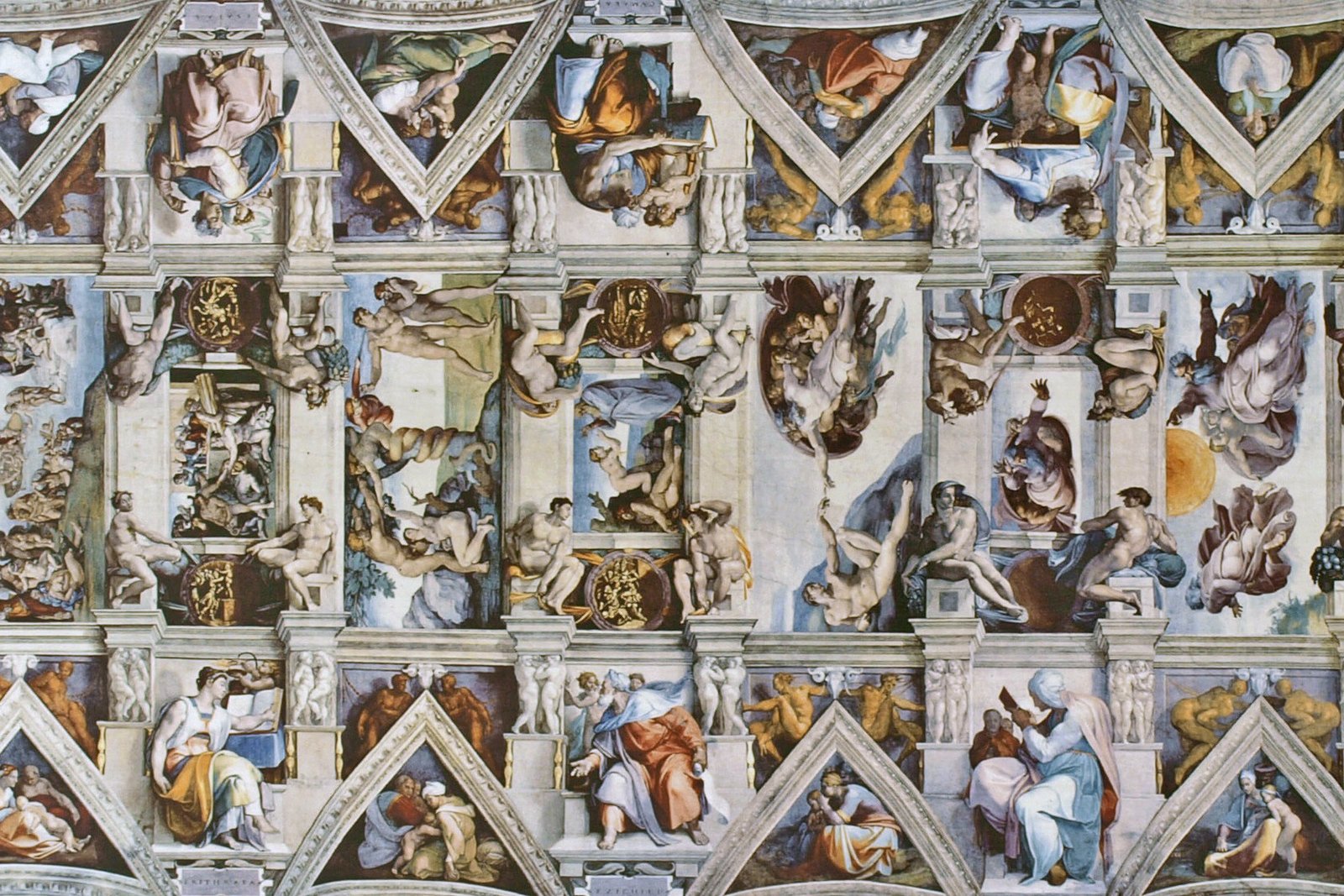
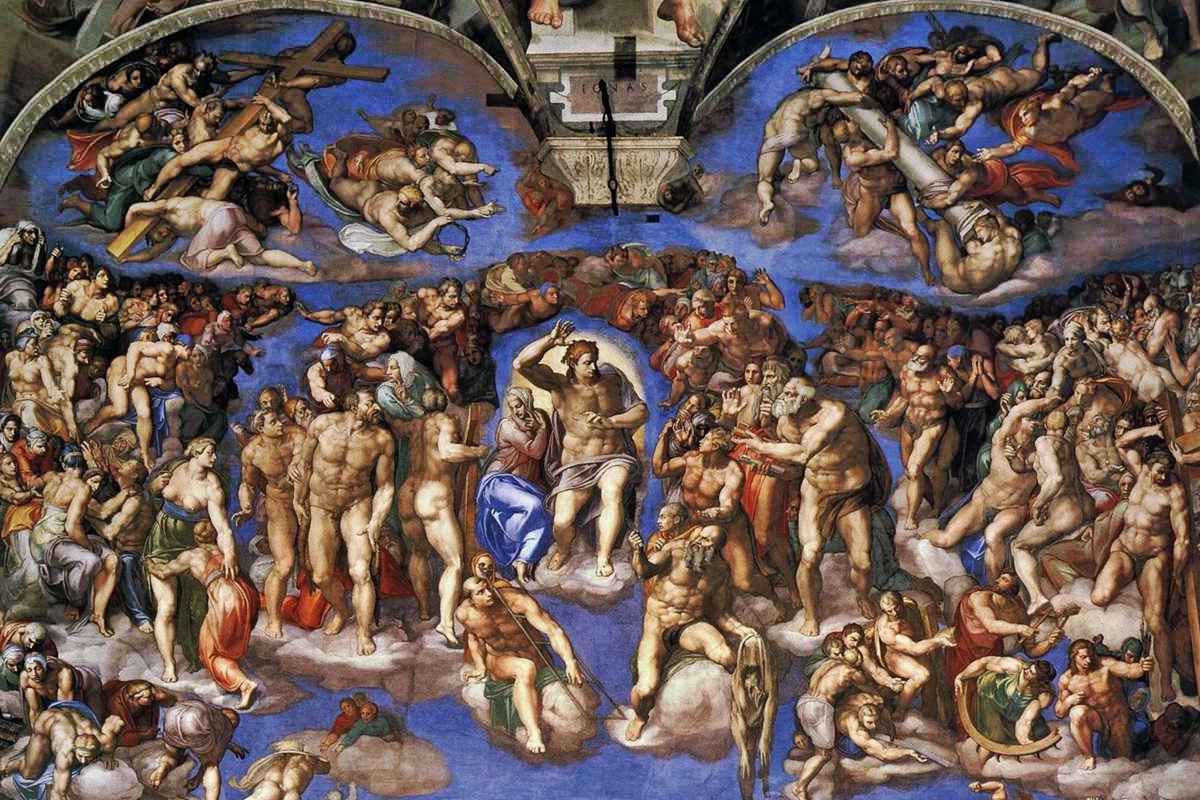
Perugino's fresco survived the chapel's later, more famous decorative campaigns largely intact, though it was not without incident — the wall directly above it, along with two other frescoes, was later demolished and replaced during Michelangelo's Last Judgment commission decades afterward, a decision that has occasionally frustrated art historians who wish more of the original cycle had survived complete. What remains of The Delivery of the Keys, however, is still considered one of Perugino's finest achievements, prized for its serene, mathematically balanced composition and its confident handling of architectural space — qualities that would go on to shape his most famous pupil. Raphael studied under Perugino during roughly this period, and the clarity, calm symmetry, and architectural depth visible in Perugino's Sistine fresco can be traced directly into Raphael's own mature compositions a generation later.
Visitors to the Sistine Chapel today often move quickly past the wall frescoes on their way to Michelangelo's ceiling and Last Judgment, the two works that dominate most accounts of the room's significance. Lingering instead at eye level, in front of Perugino's calm, orderly rendering of Christ and Peter, offers a useful reminder that the chapel's decorative program was never meant to be read as a single artist's achievement — it is a layered, decades-spanning collaboration, and Perugino's contribution helped establish the visual and theological groundwork that everything painted above it, years later, would eventually answer to.
Trivia
What biblical scene does Perugino's Delivery of the Keys depict?
Where is this fresco located?
Who commissioned the Sistine Chapel wall frescoes?
What is unusual about the background architecture in the painting?
Why is this particular fresco considered important to papal authority?
You May Also Like
Related Reading