Masaccio's Holy Trinity: The Fresco That Invented a New Space

A wall that isn't a wall anymore
Walking into Santa Maria Novella and encountering the Holy Trinity fresco for the first time, a Florentine viewer in the 1420s would have seen something genuinely disorienting by the visual standards of the period: a painted architectural space — barrel-vaulted ceiling, classical Corinthian columns, a coffered recession into apparent depth — rendered with such mathematical consistency that it seemed to punch straight through the church's actual flat wall into a real chapel beyond it. Inside that illusory space, God the Father stands supporting the crucified Christ, the Holy Spirit represented as a dove between them, with the Virgin Mary and Saint John flanking the cross and two kneeling donor figures positioned just outside the painted architecture, in a space that reads as closer to the viewer's own physical world.
Masaccio, "Holy Trinity," c. 1425-1428, Santa Maria Novella, Florence — public domain.
The mathematics behind the illusion
What made this convincing wasn't just skilled draftsmanship — it was a newly systematized mathematical technique, linear perspective, credited to the Florentine architect Filippo Brunelleschi, who had developed the underlying geometric principles only shortly before Masaccio painted this fresco. Every line of the painted architecture converges toward a single vanishing point, positioned at the base of the composition roughly at the eye level of a viewer standing before it, creating an internally consistent illusion of receding three-dimensional space calculated with a precision that had no real precedent in earlier Italian painting. Masaccio's willingness to apply that technique with such rigor, still very early in its development and use, marks the Holy Trinity as one of the founding demonstrations of what linear perspective could achieve in service of religious storytelling.
A memento mori beneath the vision of eternity
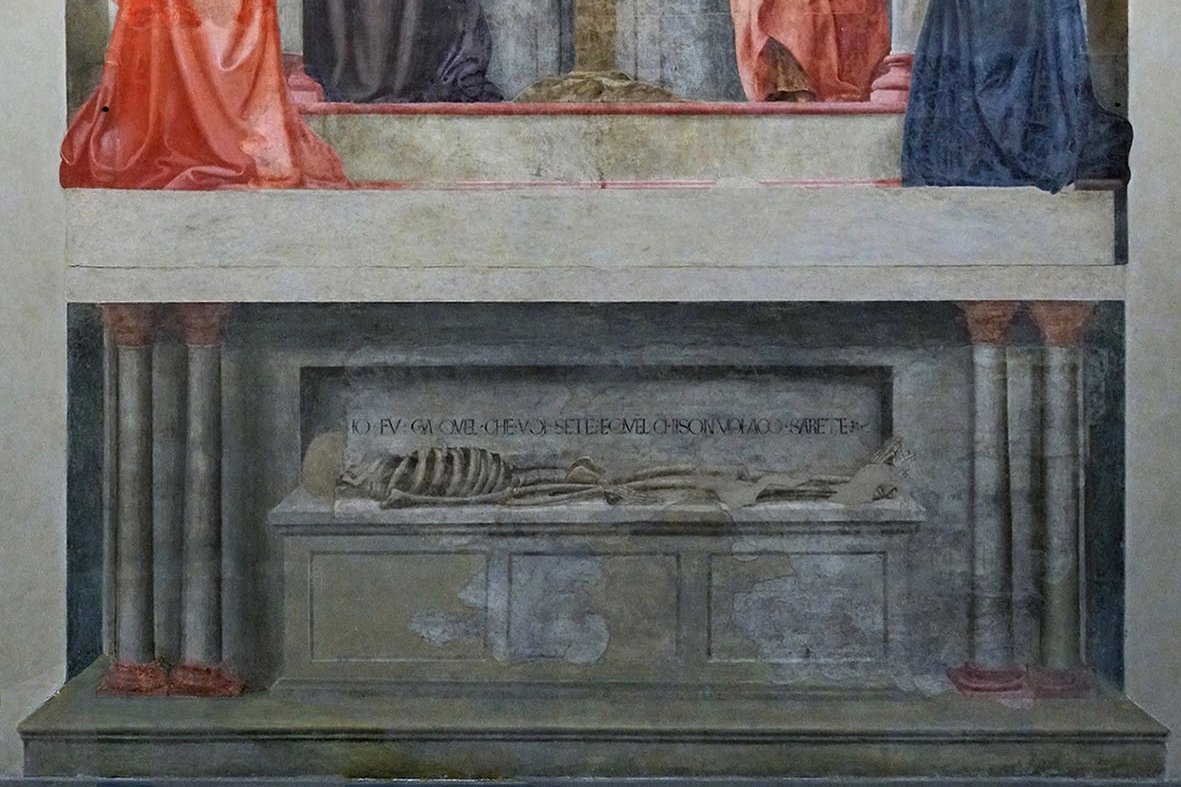
Below the depicted Trinity and donor figures, Masaccio painted a skeleton lying in an open tomb, accompanied by a Latin inscription usually translated as "I was once what you are now, and what I am, you will also be" — a blunt, unavoidable memento mori positioned directly beneath the image of divine glory above it. That juxtaposition wasn't accidental: the skeleton's message of mortality sits in exactly the same painted space as the viewer's own physical position in the church, reinforcing that the donor figures kneeling nearby, and by extension every viewer standing before the fresco, occupy the same uncertain ground between death and the hope of eternal life depicted above. It's a theologically direct pairing, using the same technical illusion of real space to collapse the distance between the viewer's mortality and the promise of salvation.
Masaccio's brief but decisive career
Masaccio died at only twenty-six or twenty-seven years old, in 1428, having worked as an active painter for barely six years, yet his surviving output — including the Holy Trinity and his fresco cycle in the Brancacci Chapel — had an influence on Florentine painting wildly disproportionate to his short career. Contemporaries and later artists alike, including Michelangelo, are recorded as having studied his frescoes directly, particularly his handling of weighty, physically convincing human figures and his confident command of the new perspective system. His premature death cut short what many art historians consider one of the most consequential single careers in the early Italian Renaissance, a period whose visual innovations are explored further in the evolution of Renaissance Madonnas.
Lost behind an altar for three centuries
The fresco's own later history nearly erased it entirely. Sometime in the sixteenth century, a stone altar and decorative screen were installed directly in front of the Holy Trinity, completely covering it from view for roughly the next three hundred years. It was only rediscovered in the nineteenth century when that later altar was removed, and significant restoration work followed, including a major twentieth-century campaign that stabilized the surviving paint layers and clarified long-obscured details. That the fresco survived at all behind centuries of physical concealment, largely undamaged, is itself a small piece of good fortune in the painting's remarkable history.
An unusual reading of the Trinity itself
Beyond the technical achievement, the fresco makes an unusual theological choice in how it depicts the three divine Persons together. Rather than showing the Father, Son, and Spirit as three separate figures of comparable scale — a common approach in earlier and contemporary art — Masaccio shows God the Father standing directly behind the cross, arms outstretched to support it, so that the composition folds the Father and the crucified Christ into a single, continuous visual unit rather than two distinct figures side by side. The Holy Spirit's dove hovers in the narrow space between the Father's face and Christ's bowed head, completing the three Persons within a tight, vertically stacked arrangement rather than a horizontal one. Art historians have read this compressed, layered composition as a deliberate visual argument for the unity of the three Persons in one God, achieved through spatial arrangement rather than through symbolic attributes alone — a solution distinct from the seated, circular arrangement Andrei Rublev would use a few years later in his own icon of the Trinity for the Orthodox tradition.
Its lasting place in art history
The Holy Trinity is now regarded as one of the pivotal works marking the transition from late medieval to early Renaissance painting in Florence, prized as much for its technical mastery of perspective as for its theological content. It remains on view at Santa Maria Novella today, still performing the same trick it did nearly six centuries ago: convincing a viewer standing in a real Florentine church that the wall in front of them has quietly opened onto another, deeper space entirely.
Trivia
Where can you see Masaccio's Holy Trinity fresco?
What makes Masaccio's use of perspective in this fresco so historically important?
Who are the figures shown in the fresco besides the Trinity?
What does the skeleton and inscription at the bottom of the fresco mean?
Was Masaccio's Holy Trinity fresco ever lost or hidden?
Related Reading