The Holy Grail: Legend, the Last Supper Cup, and Catholic Teaching

A cup without a description
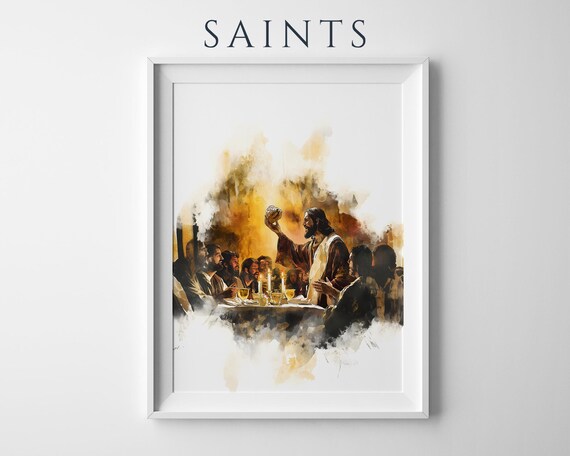
Start with what Scripture actually says, because it is less than most people assume. At the Last Supper, all three Synoptic Gospels and Saint Paul's own account describe Jesus taking a cup during the meal and speaking words over it that would become central to Christian worship ever after. Luke's version is the most quoted: "This cup is the new covenant in my blood, which will be shed for you" (Luke 22:20). Whatever vessel held that wine — clay, wood, stone, metal — it isn't named, described, or mentioned again anywhere in the New Testament. No Gospel writer records what happened to it afterward. That silence is the empty space the entire Grail tradition would eventually fill.
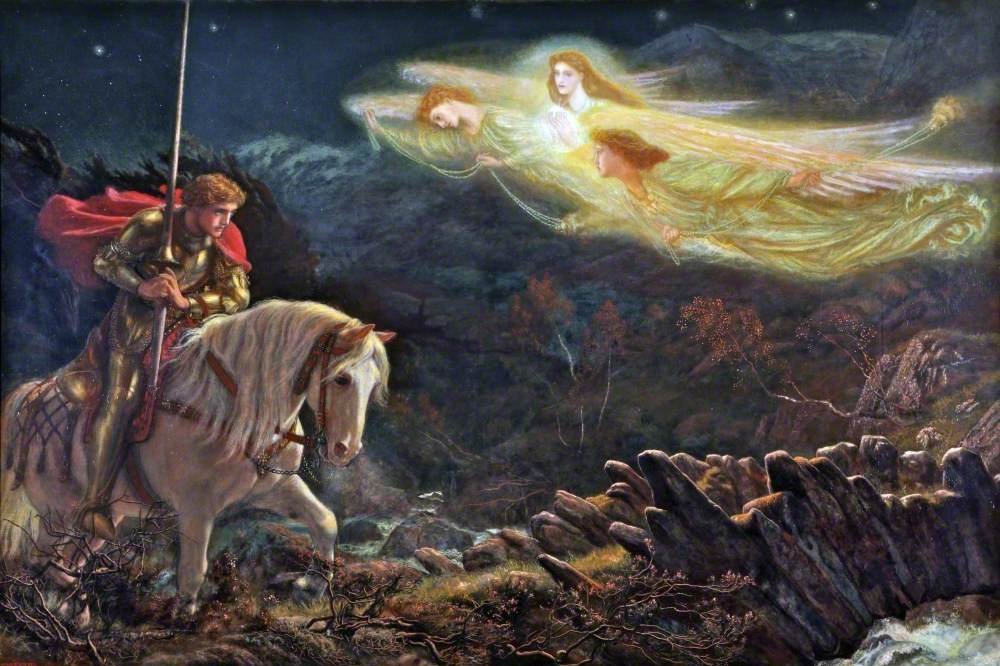
Arthur Hughes, Sir Galahad — The Quest for the Holy Grail (1870), Walker Art Gallery, Liverpool. Public domain, via Wikimedia Commons.
For the first thousand years of Christianity, nobody filled it with anything resembling the legend we know today. Relics of the Passion — fragments of the cross, the crown of thorns, the lance that pierced Christ's side — developed their own venerated histories early, often within a few generations of the events themselves. The cup of the Last Supper did not. It simply isn't part of the documented early cult of relics the way those other objects were, which is itself a telling absence given how thoroughly the early Church tracked and transported Passion relics across the Mediterranean world.
Chrétien de Troyes and the birth of a legend
The Grail as a named, storied object enters history abruptly, in literature, around 1180. The French poet Chrétien de Troyes was composing a long Arthurian romance, "Perceval, le Conte du Graal" ("Perceval, the Story of the Grail"), when he introduced a scene that would obsess European writers for the next sixty years: the young knight Perceval, visiting a mysterious castle, watches a radiant vessel — a "graal," a wide serving dish — carried past him in a ceremonial procession, accompanied by a bleeding lance. Perceval, following an earlier warning against asking too many questions, says nothing, and the story strongly implies he has failed some unspoken test by his silence.
Chrétien died before finishing the poem, and critically, he never explains what the Grail actually is or means. There is no claim in his text that it's the cup of the Last Supper — it's simply a wondrous object in a knightly adventure, closer in spirit to the magical vessels of Celtic folklore than to anything liturgical. The specifically Christian, Eucharistic Grail that most people now take for granted was built afterward, by other writers filling in the blank Chrétien left behind.
From serving dish to the cup of Christ
That transformation happened fast. Robert de Boron, writing his own trilogy of Grail romances within a generation of Chrétien, made the decisive move: he identified the Grail explicitly as the vessel Joseph of Arimathea used to catch Christ's blood at the Crucifixion, and tied it directly to the cup of the Last Supper, giving the object a sacred biography it never had in the Gospels themselves. Later and more elaborate versions, especially the sprawling French prose cycle known as the "Vulgate Cycle" (including the "Queste del Saint Graal," which Thomas Malory would later fold into his English "Le Morte d'Arthur"), pushed the story further still — turning the search for the Grail into a test of spiritual purity so demanding that, in some versions, only a knight who is literally a virgin, Galahad, can complete it.
By the time these cycles were finished, around 1240, the Grail legend had become something distinctly medieval: an imaginative, moralizing adventure story that borrowed the Eucharist's sanctity for dramatic weight, written by courtly poets rather than theologians, and never submitted to the Church as doctrine or endorsed by it as devotion. It's worth being plain about what this means: the romance that gave the world Camelot's holiest quest was, from the start, closer to literature inspired by faith than to faith itself.
The real chalices people point to instead
Set the Arthurian romances aside, though, and there's a separate, far less mythical question: are there any actual ancient cups with a documented claim to being used at the Last Supper? A handful of real objects have drawn that claim across the centuries, and they deserve to be considered on their own terms, apart from the Grail legend's literary trappings.
The most seriously regarded is the Holy Chalice kept today in Valencia Cathedral in Spain — a small cup carved from dark red agate, its bowl roughly 9 centimeters across, later mounted on a jeweled gold stem and base added long after the bowl itself was made. According to the cathedral's own tradition, the cup traveled from Jerusalem to Rome with Saint Peter, was later sent to Spain for safekeeping during Roman persecution, passed through a succession of monasteries, and reached Valencia Cathedral in 1437, where it has remained ever since. Its bowl's material and workmanship have struck some researchers as plausibly consistent with a vessel from the Eastern Mediterranean of roughly the first century — a claim that, notably, no Arthurian-legend candidate can make, since those were never physical objects to begin with. Both Pope John Paul II, during his 1982 visit to Valencia, and Pope Benedict XVI, at the 2006 World Meeting of Families, celebrated Mass using the Valencia chalice — a gesture of honor toward the tradition surrounding it, though not a Vatican declaration of its authenticity.
A second, very different candidate is the so-called Antioch Chalice, a sixth-century silver-gilt vessel excavated near Antioch in 1910 and now held by the Metropolitan Museum of Art in New York. When it surfaced, some early owners promoted it specifically as the Holy Grail, pointing to its elaborate vine-and-figure decoration as Eucharistic imagery. Scholarship since has moved away from that identification: the object's shape and ornament are now generally understood to fit an Early Christian lamp stand or a later liturgical chalice from the Byzantine period, centuries after the Last Supper, rather than a first-century original. It remains a genuinely ancient and beautiful piece of Christian art — just not, in the judgment of the museum that now displays it, the cup from the Gospel account.
What the Church actually says
Put the legend and the relics side by side, and the Catholic Church's position turns out to be notably restrained on both counts. The Arthurian Grail has never been treated by the Church as anything other than what it plainly is: a body of medieval romance literature, imaginative and theologically rich in places, but never proposed for belief or veneration. No pope, council, or catechism treats "the Holy Grail" as a real object requiring a position at all.
The real chalices are a different matter, and here the Church's caution is more a statement about evidence than about devotion. As with the Shroud of Turin or fragments of the True Cross, the Church has never dogmatically certified the authenticity of any specific cup — including the one at Valencia — as the literal vessel of the Last Supper. What it has done, at Valencia specifically, is allow and even personally participate in the local veneration surrounding the relic, the same posture it takes toward many ancient objects whose exact origin can't be proven but whose long devotional history is itself meaningful to the faithful who have gathered around it for centuries. That's a considered middle ground, not an endorsement: a Catholic can honor the tradition at Valencia, visit the chapel built to house it, even feel moved standing before it, without the Church asking anyone to treat its first-century origin as settled fact.
What endures past all of it — the French romances, the agate cup in Spain, the silver vessel in Manhattan — is the moment none of them can improve on: a meal in an upper room, a cup passed from hand to hand, and words that still open every Catholic Mass said over bread and wine today. The search for the actual object has occupied poets and historians for eight centuries. The thing it points to was never really lost.
Trivia
Is the Holy Grail mentioned in the Bible?
Where does the word 'Grail' come from?
Who invented the Holy Grail legend?
Does the Catholic Church teach that the Holy Grail is real?
What is the Holy Chalice of Valencia, and why do some people call it the 'real' Grail?
Related Reading