The Holy Tunic of Trier: The Seamless Robe Two Cities Both Claim


A garment that wouldn't tear cleanly
Crucifixion, as the Romans practiced it, came with a grim bit of bureaucracy: the soldiers carrying it out kept whatever the condemned man had been wearing. John's Gospel records the moment at Golgotha with an odd amount of specificity for what might otherwise seem a minor detail. "They also took his tunic, but the tunic was seamless, woven in one piece from the top down," the Evangelist writes — and rather than cut a garment that valuable into four worthless strips, the soldiers cast lots for it instead, an act John connects directly to a line from the Psalms about the just man's garments being divided and gambled over (John 19:23-24, NABRE).

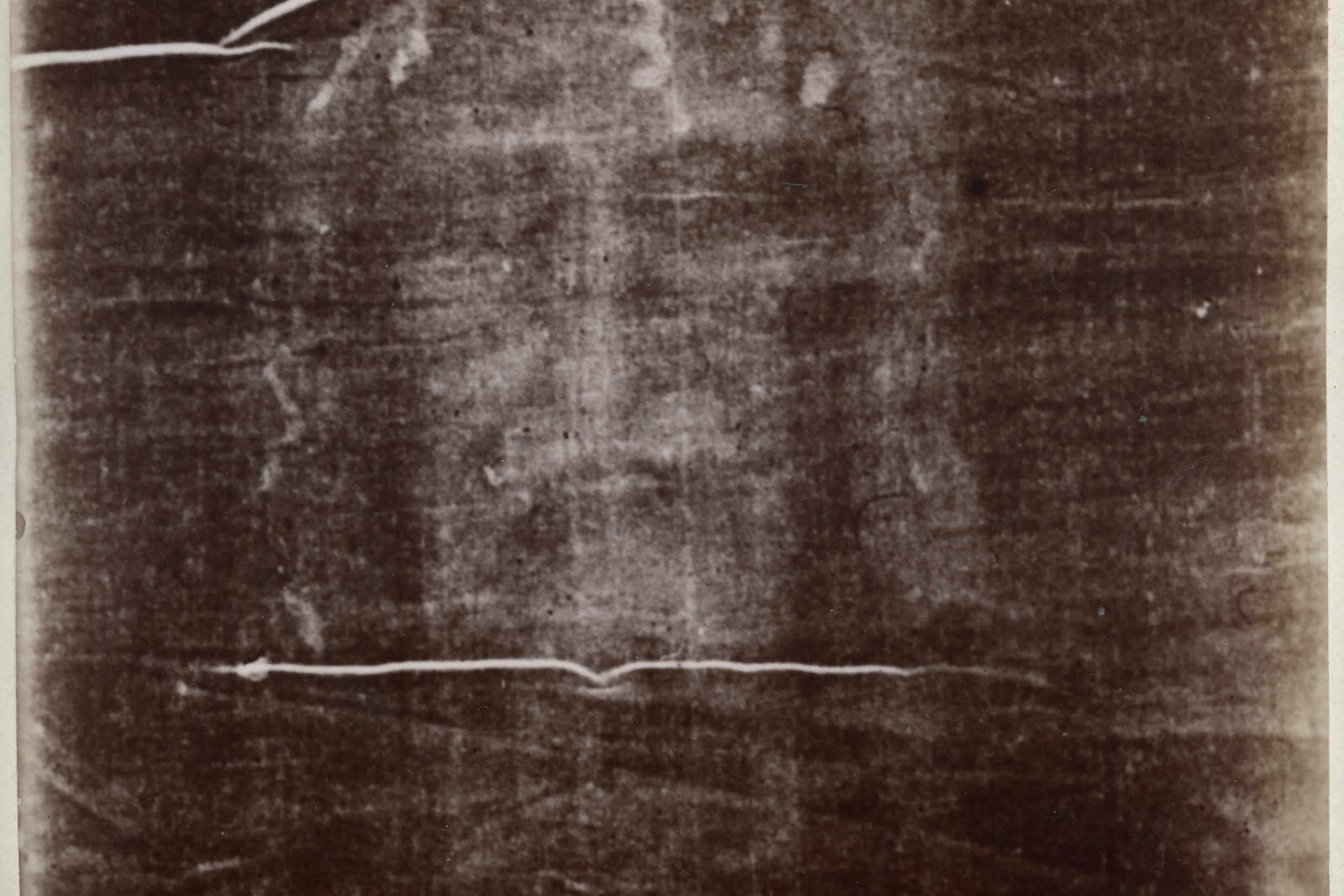
Kurz & Allison, commemorative lithograph of the 1891 exposition of the Holy Robe at Trier Cathedral (1891). Public domain, via Wikimedia Commons.
It's a throwaway logistical detail in the middle of the Passion narrative. But Christian memory, over the centuries that followed, did not treat it as throwaway at all — it became one of the most persistently claimed physical relics connected to the Crucifixion itself, with two separate European churches today each maintaining that their garment is the one those soldiers argued over.
Trier's claim: a gift from Saint Helena
The cathedral of Trier, in western Germany near the border with Luxembourg, holds the older and better-documented of the two traditions. According to that tradition, the tunic arrived in Trier in the fourth century as a gift from Saint Helena, mother of the emperor Constantine, who — according to a separate and equally venerable tradition discussed in connection with relics of the True Cross — had traveled to the Holy Land and sent sacred objects back to churches across the empire. An eleventh-century life of Trier's early bishop Saint Agritius already mentions relics sent by Helena during his lifetime, including, according to "the reliable tradition of the forefathers," a garment of the Lord kept among the cathedral's treasury. An even older witness — an ivory relief preserved in the cathedral treasury, dated by some scholars to the fifth or sixth century — is read by local tradition as a depiction of that very transfer of relics under Helena's direction.
What's firmly documented, rather than merely traditional, is that by around the year 1100 the people of Trier were already fully convinced the cathedral held Christ's seamless garment. In 1196, Archbishop Johann I solemnly transferred the relic into the cathedral's high altar — and there it stayed, unseen and untouched, for more than three centuries.
A relic almost nobody gets to see
If there's one thing that distinguishes the Trier tunic from most relics that draw regular pilgrim traffic, it's how rarely anyone is actually permitted to look at it. After that 1196 enshrinement, the garment wasn't exhibited again until 1512, when Emperor Maximilian I, attending an imperial assembly in the city, asked to see it and Archbishop Richard von Greiffenklau had the altar opened. For a few years afterward expositions were annual, and Pope Leo X then set a seven-year cycle — but that pattern broke down almost immediately amid the religious upheavals of the sixteenth century, and exhibitions since have come at wildly uneven intervals: 1655, 1810, a famous 1844 exposition that drew over a million pilgrims (and, notoriously, provoked a public controversy that helped spark a breakaway "German Catholic" movement), 1891, 1933, 1959, 1996, and most recently 2012, which again drew roughly half a million visitors over a month-long exposition. Between some of those dates, more than sixty years passed with the relic sealed from public view entirely — a rhythm closer to a solar eclipse than a parish feast day.
Argenteuil's rival claim
A few hundred miles west, the Basilica of Saint-Denis in Argenteuil, near Paris, keeps its own version of the story — one that doesn't reach back to Helena at all, but to Charlemagne. Tradition there holds that the Byzantine empress Irene gave the garment to Charlemagne around the year 800, possibly as part of a failed proposal to marry him and unite the Byzantine and Frankish empires, and that Charlemagne in turn gave it to his daughter Theodrada, abbess of the convent at Argenteuil. The earliest solid documentary evidence is a mid-twelfth-century charter, the so-called Charta Hugonis, in which the Archbishop of Rouen testifies to having personally examined the relic in the Argenteuil treasury and found it to be, in the community's ancient belief, the tunic Christ wore at his Passion.
Argenteuil's tunic has had a far rougher physical history than Trier's. Huguenot raiders partially burned it in 1567. During the French Revolution, in 1793, the parish priest reportedly had it cut into pieces and hidden with trusted parishioners to keep it from destruction, and the fragments were only later reassembled. It was even stolen outright in 1983 and recovered some months afterward. Despite — or perhaps because of — that turbulent history, Argenteuil has drawn enormous crowds at its own periodic expositions; a 2016 showing reportedly brought roughly half a million pilgrims to the basilica over several weeks.
What it means that two churches claim the same relic
A reasonable question follows naturally: can both be telling the truth? Almost certainly not in the strictest sense — a single first-century garment cannot simultaneously be the one object kept continuously at Trier since antiquity and the one given to Charlemagne by Irene four centuries later. Nineteenth-century textile examinations of the Trier relic found a plain, undyed fabric without detectable seams, which is consistent with the tradition but doesn't prove it; Argenteuil's garment, battered by fire and deliberately dismembered for its own protection, presents an even harder case for straightforward scientific dating, though it has drawn comparison, inconclusive so far, to bloodstain patterns associated with the Shroud of Turin.
The Catholic Church, notably, has never stepped in to adjudicate between the two, nor certified either garment as the authentic first-century original. That's consistent with the Church's broader approach to relics generally: the Catechism of the Catholic Church lists the veneration of relics among its encouraged forms of popular piety (no. 1674) without requiring, as a condition of that devotion, forensic certainty about any specific object's material origin. A pilgrim can travel to Trier, or to Argenteuil, and venerate what's shown there as a sign pointing toward Christ's Passion — a devotional act the Church has long permitted and encouraged — without that act depending on settling which, if either, city holds the literal garment four soldiers once gambled over at the foot of a cross outside Jerusalem.
What both traditions preserve, whatever the historical truth about the cloth itself, is the same small, human detail John's Gospel bothered to record: that even in the middle of an execution, something about one plain, seamless garment struck the men standing guard as worth keeping intact rather than tearing apart.
Trivia
What does the Bible actually say about Christ's tunic?
Where is the Holy Tunic kept today?
How often is the Holy Tunic of Trier shown to the public?
Has either tunic ever been scientifically tested?
Does the Catholic Church say which tunic, if either, is authentic?
Related Reading