The Sudarium of Oviedo: The Face Cloth of Christ's Burial

A cloth with no face, and a longer paper trail
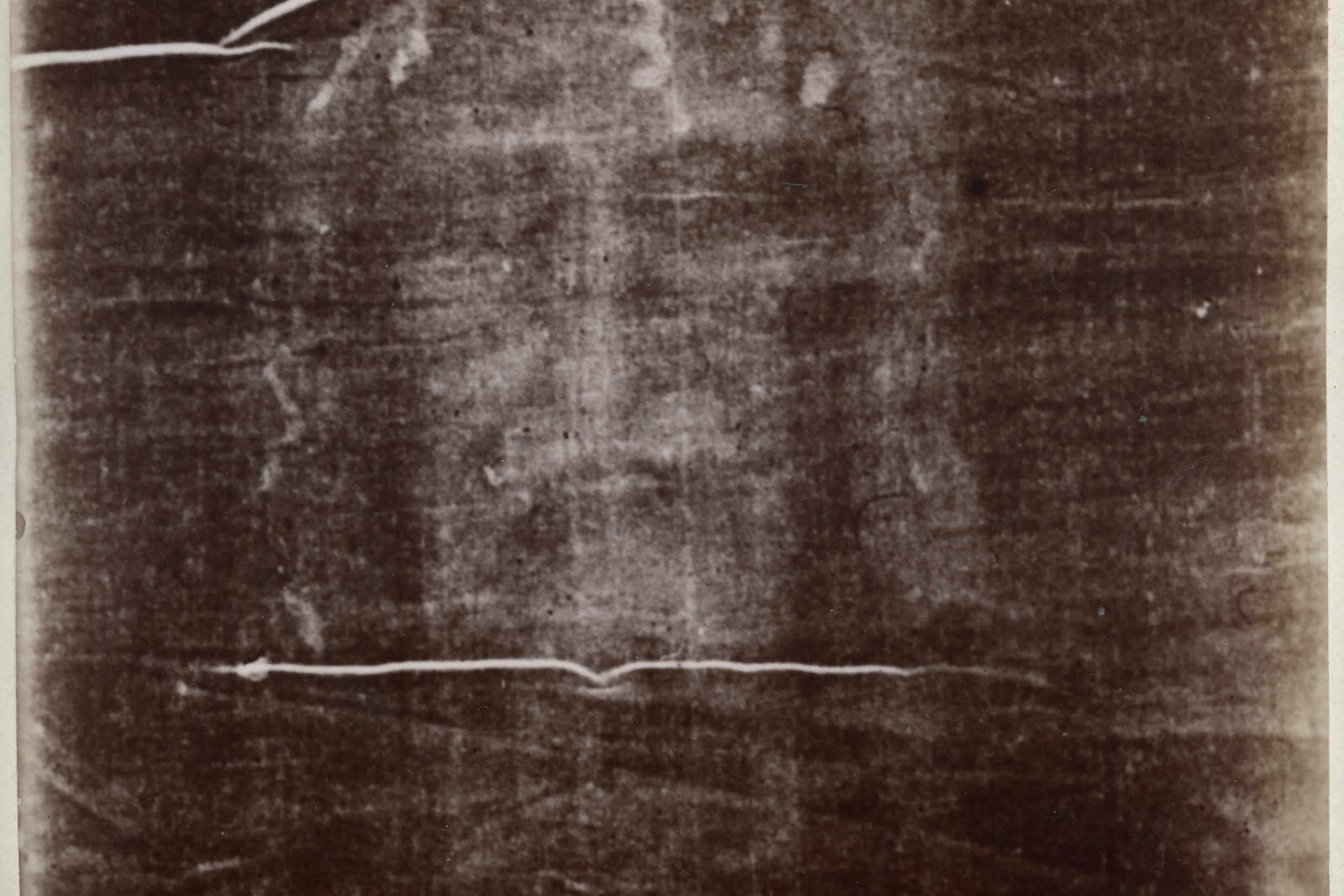
Inside the Cámara Santa — the "Holy Chamber," a small Romanesque room built into Oviedo Cathedral specifically to safeguard the diocese's most prized relics — sits an ornate wooden chest called the Arca Santa. Among its contents is a piece of linen that, unlike the Shroud of Turin, shows nothing resembling a human figure. No face, no outline, no photographic-negative effect. Just a dense constellation of reddish-brown stains, mapped and re-mapped by forensic researchers who believe those stains encode a story about exactly how a man died.
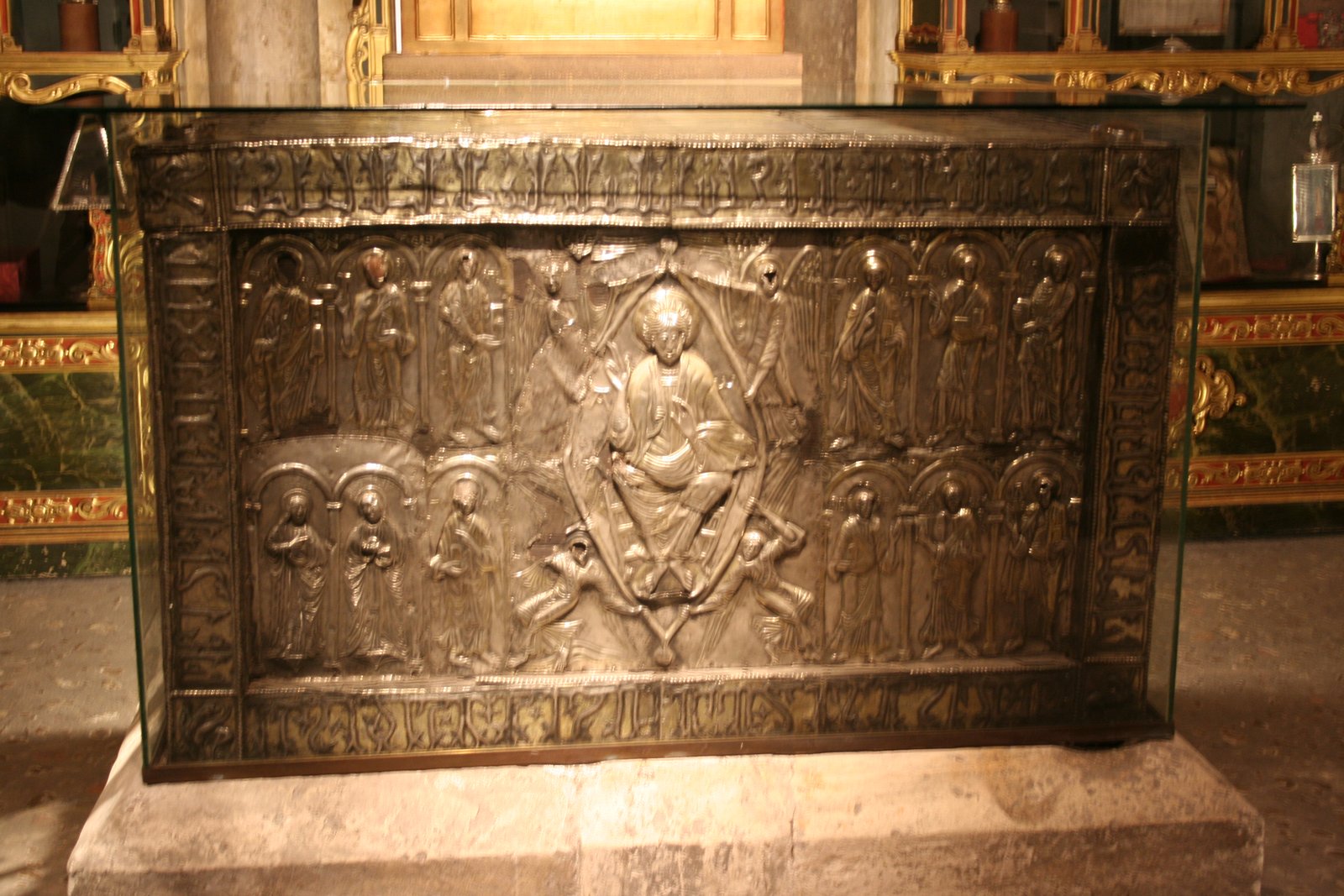
Sitomon, Arca Santa de Oviedo (2007). Public domain, via Wikimedia Commons.
The Gospel of John describes the morning Peter and the beloved disciple reached Jesus's empty tomb: "When Simon Peter arrived after him, he went into the tomb and saw the burial cloths there, and the cloth that had covered his head, not with the burial cloths but rolled up in a separate place" (NABRE, John 20:6-7). That separate head cloth — distinct from the larger burial wrappings — is the detail Spanish tradition has long attached to the Sudarium of Oviedo. The Latin word sudarium simply means "sweat cloth," the kind of cloth used to cover or wipe a face.
A documented trail that predates the Shroud's
One of the more striking things about the Sudarium, discussed at length in the Shroud of Turin article, is that its paper trail in Spain runs measurably further back than the Shroud's own well-known 14th-century starting point in France. According to the tradition preserved by the cathedral and summarized by Shroud researcher Mark Guscin, the cloth is said to have left Jerusalem before the Persian king Khosrow II's conquest of the city in 614 AD, traveling first to Alexandria and then across North Africa before reaching Spain — a journey that, by its nature, is far harder to verify archivally than a relic's movements within medieval Western Europe.
What can be documented with more confidence is the cloth's presence in the Visigothic and later Asturian royal treasury by the 8th century, and its installation inside the Arca Santa reliquary chest, where it has remained ever since. The key dated event in its Spanish history is March 14, 1075, when the chest was formally opened in the presence of King Alfonso VI of León and Castile and his famous military commander Rodrigo Díaz de Vivar — better known to history as El Cid. That opening, and the subsequent inventory of relics it occasioned, is the anchor point historians return to when discussing the Sudarium's documented custody, even though — as with the Shroud — the centuries before that anchor point rely on tradition rather than an unbroken paper trail.
What the bloodstains are said to show
The Sudarium's real scientific interest lies almost entirely in forensic blood-pattern analysis, since there is no image to study. The most detailed examination was carried out in 1989 by a team from the Centro Español de Sindonología (Spanish Centre for Sindonology, an organization devoted to the scientific study of relics associated with Christ's Passion), whose investigative arm, EDICES, spent three days examining the cloth directly. Researchers identified dozens of distinct bloodstain and serum patterns, consistent, they argued, with a man who had suffered puncture wounds to the scalp (as from a crown of thorns), a flow of blood and fluid from the nose and mouth consistent with pulmonary edema, and marks suggesting the body had been held upright for a period before being laid down — details researchers connected to the physiological effects of asphyxiation during crucifixion.
Using overlay and comparative photographic techniques, Spanish researchers went further, arguing that specific bloodstain locations on the Sudarium correspond, point for point, to wound locations documented on the Shroud of Turin — the same pattern of facial and scalp wounds appearing on both cloths. This is the foundation of the "two relics, one man" argument sometimes made by researchers who study both objects together: if the correspondences hold up, the Sudarium and the Shroud may be witnesses to the same crucified body, even though the two cloths have entirely separate, independently documented histories and have never, as far as the historical record shows, been reunited.
It is worth being careful here, in the same spirit the Shroud article urges about the 1988 carbon dating controversy. A forensic correlation between two stain patterns is not the same thing as an independently verified scientific consensus, and it is certainly not the same as a Church ruling on authenticity. The EDICES findings have been influential within Shroud-and-Sudarium research circles and are frequently cited by researchers sympathetic to both relics' authenticity, but they have not been replicated by a broader, independent scientific body in a way that would settle the historical question. The honest summary is that the bloodstain analysis is a genuinely interesting line of forensic research, pointing toward — but not proving — a connection between the two cloths.
A yearly act of veneration
The Sudarium is not kept permanently on public display. It is shown to the faithful on specific days tied to the Church's calendar, most notably the Feast of the Triumph of the Holy Cross on September 14 — the same feast day connected to the recovery of the True Cross relics discussed in our article on fragments of the True Cross — as well as on Good Friday, when its association with Christ's Passion and burial makes the timing especially pointed. Pilgrims who travel to Oviedo for these expositions are, in a real sense, continuing a chain of veneration that researchers trace back at least to the Asturian court of the early Middle Ages, long before either forensic photography or radiocarbon dating existed to argue about it.
Caution, tradition, and what's actually being venerated
As with so many relics connected to Christ's Passion, the responsible way to describe the Sudarium of Oviedo keeps two things distinct: the documented history of veneration, which is genuinely long and well attested from the 8th century onward, and the underlying question of material authenticity, which remains a matter of scholarly argument rather than settled fact. The Catholic Church has never dogmatically certified that the cloth in Oviedo Cathedral's Cámara Santa is, beyond question, the specific fabric that touched Christ's face after his death. What the Church does affirm, in its general teaching on relics, is that veneration directed at an object connected to Christ's Passion is a legitimate form of devotion whose spiritual value does not hinge on forensic certainty.
For the pilgrims who line up in Oviedo each September 14, that distinction rarely feels like a complication. The cloth, whatever its precise material origin, has functioned for well over a thousand years as a tangible point of contact with the most sorrowful moment in the Gospel narrative — a scrap of stained linen asking to be taken, at minimum, as seriously as the grief it represents.
Trivia
What is the Sudarium of Oviedo?
How is the Sudarium different from the Shroud of Turin?
Can the Sudarium's history be traced further back than the Shroud's?
What did the Centro Español de Sindonología find when it studied the bloodstains?
Is the Sudarium's authenticity officially recognized by the Catholic Church?
Related Reading