The Weeping Statue of Our Lady of Akita: A Vatican-Approved Marian Sign


A statue nobody expected to matter
The wooden figure now known around the Catholic world as Our Lady of Akita began its life as an ordinary piece of devotional art. A local woodcarver, working in the early 1960s, carved it from a single block of katsura wood for the small convent chapel of the Institute of the Handmaids of the Sacred Heart of Jesus in the Holy Eucharist, perched on a hillside at Yuzawadai, on the outskirts of Akita City in northern Japan. The sculptor gave the Virgin's face distinctly Japanese features — a detail several accounts of the statue note with some wonder, since it meant this image of Mary looked, quite deliberately, like a woman of the country where it stood. There was nothing about the carving itself that suggested anything unusual was coming. It was a Pietà-style figure, arms open rather than cradling a body, meant simply to give the small community of sisters something to pray before.
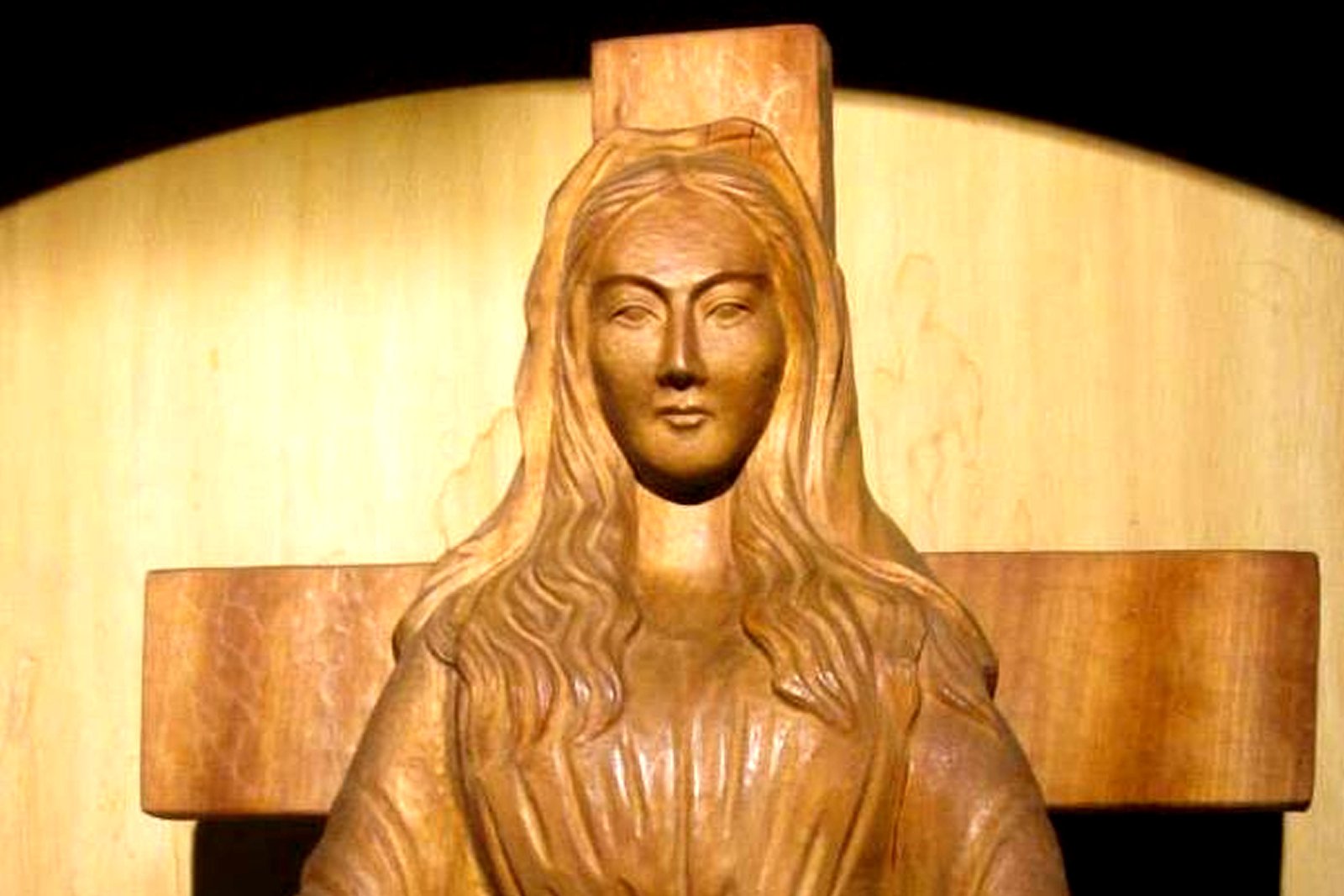
SICDAMNOME, Virgin Mary of Akita Japan, photograph, 2015. CC BY-SA 4.0, via Wikimedia Commons.
A deaf novice, a wounded hand, and a voice
The events that would make this statue famous began in 1973, centered on a young novice named Sister Agnes Sasagawa, who had entered the convent only recently and who had been completely and, according to her doctors, incurably deaf for several years. On June 28 of that year, Sasagawa reported a painful, cross-shaped wound opening on the palm of her own hand. Then, on July 6, 1973 — by her account, through her deafness — she heard a voice she took to be coming from the statue of Mary in the chapel, addressing her directly about her hearing, her suffering, and a message she was to carry to her religious superior. That same day, the statue's own right hand developed a wound identical in shape to the one on Sasagawa's hand, and it reportedly began to bleed, witnessed by the bishop of the diocese himself when he visited the convent weeks later to check the claim in person.
Two more messages followed that same year, on August 3 and October 13 — the third containing a lengthy warning about division within the Church and a call to prayer and penance, language that several later commentators have compared to the tone of the 1917 messages reported at Fátima, Portugal. Our article on Our Lady of Fátima covers that earlier, far better-known case in full.
One hundred and one tears
The phenomenon that drew the most outside attention, though, wasn't the wound or the voice — it was what happened to the statue's wooden face starting on January 4, 1975. On that morning, a sister at the convent noticed water pooling at the statue's base and realized its eyes were wet. Over the next six years and eight months, the statue reportedly wept in the same way 101 separate times, the final occasion falling on September 15, 1981, the feast of Our Lady of Sorrows. Bishop Ito, in his own later account, wrote that he personally witnessed four of these episodes and that roughly 500 people in total — Catholics and non-Catholics, including, by his own account, the town's Buddhist mayor — saw the statue weep at one time or another.
Bishop Ito also wrote that he tasted the liquid himself twice and found it salty, "truly human tears" as he put it. That impression was tested rather than simply taken on faith: Professor Sadaji Sagisaka, a forensic medicine specialist at Akita University's medical school, analyzed samples and reported that the fluid matched human tears. The statue was also reported to sweat, at times giving off a noticeable sweet scent, strongly enough that sisters needed to wipe it away.
Why a careful distinction matters here
It's worth pausing on exactly what kind of approval this case eventually received, because the terminology the Church uses gets blurred easily in casual retelling. Bishop Ito spent eight years — two separate commissions of inquiry, a discouraging 1981 letter from Rome that he says contained factual misunderstandings, and a personal 1983 trip to meet with Vatican officials — before issuing his own formal pastoral letter on April 22, 1984. In it, he stated plainly that he found nothing in the events contrary to Catholic faith or morals, and he authorized public veneration of "the Holy Mother of Akita" throughout his diocese of Niigata, "while awaiting that the Holy See publishes definitive judgment on this matter."
That is a diocesan-level approval — the same category of recognition given to Lourdes and to Fátima before any pope ever spoke on either of them — not an infallible Church teaching binding on the universal Church. Bishop Ito himself underlined this in his own letter, reminding the faithful that even a favorable Vatican judgment on a private revelation like this one would still concern only "private Divine revelation," distinct from the public revelation that closed with the death of the last apostle, which alone Catholics are bound to believe.
The second stage came in June 1988, when Cardinal Joseph Ratzinger — then Prefect of the Congregation for the Doctrine of the Faith, and the future Pope Benedict XVI — communicated that Bishop Ito's own investigation and conclusions were considered valid, and that the Akita messages contained nothing contrary to the Catholic faith. This, too, is a confirmation of the local bishop's process rather than a separate, independent Vatican declaration of a new public miracle — but taken together, the two statements are about as far as Church procedure for a reported private revelation of this kind typically goes.
One of Asia's few recognized Marian sites
What makes Akita genuinely unusual isn't just the Ratzinger connection to Fátima-style language, but geography. Formally Church-recognized apparitions or Marian phenomena are rare anywhere, and overwhelmingly concentrated in Europe and the Americas — Lourdes, Fátima, Guadalupe. A diocesan-approved case in Japan, a country where Catholics remain a small minority, stands out simply for where it happened. Pilgrims, including non-Japanese visitors, still travel to the small chapel at Yuzawadai today, where the original statue remains in place, its carved face — modeled, as it was from the start, on the features of a Japanese woman — still watching over the quiet hillside convent that gave the Catholic world one of its more carefully documented twentieth-century Marian signs.
Trivia
What exactly happened at the convent in Akita, Japan?
Was the liquid from the statue ever scientifically tested?
Did the Catholic Church officially approve the Akita events?
Is Akita considered as important as Fatima or Lourdes?
Was Sister Agnes Sasagawa's deafness really healed?
Related Reading