Saint Angela of Foligno, the Mistress of Theologians

A comfortable life, cut apart
Angela was born around 1248 in Foligno, a prosperous town in the Umbrian region of central Italy, into a family wealthy enough that she married well and lived, by her own later admission, a life of considerable comfort and, in her own blunt self-assessment, considerable sin — she describes her earlier years with unusual candor as vain and self-indulgent, without the softening a hagiographer might have applied on her behalf.
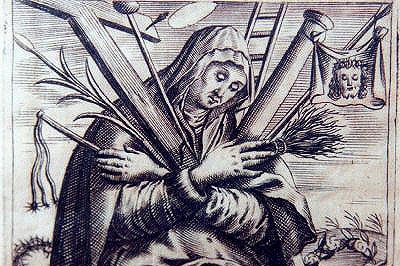
Unknown engraver, 17th-century print of Blessed (now Saint) Angela of Foligno — public domain (Wikimedia Commons)
That life ended abruptly. Sometime in her late thirties, within what her own account describes as roughly a single year, Angela lost her husband and every one of her children. It is one of the more startling admissions in medieval spiritual writing that Angela does not describe this loss with simple grief alone — she says candidly that she initially felt a kind of relief, freed from the domestic obligations that had structured her life, before that reaction gave way to a much deeper spiritual reckoning with what had happened to her and why. Modern readers, used to a more clinical vocabulary for grief and trauma, often find this part of her account startlingly modern in its psychological honesty, coming from a woman writing more than seven hundred years ago.
A pilgrimage, a conversion, and a Franciscan path
Angela's spiritual transformation accelerated around a pilgrimage to Assisi, drawn by the still-recent legacy of Saint Francis, who had died only a few decades earlier and whose radical embrace of poverty and direct encounter with God had already reshaped religious life across central Italy. Angela became a Franciscan tertiary — a member of the Third Order, a formal path allowing laypeople, married or single, to live according to Franciscan spiritual principles without taking the full vows of a friar or cloistered nun. It was, like the path chosen by later tertiaries such as Rose of Viterbo and Margaret of Cortona, a way for a woman without access to formal religious authority to pursue an intense spiritual life while remaining technically outside the Church's clerical and monastic structures.
What followed was a series of increasingly intense mystical experiences, which Angela described later in life to her cousin and confessor, a Franciscan friar named Arnaldo, who transcribed them in Latin over a period of roughly two decades. The resulting text, known today as the Book of Visions and Instructions (or sometimes the Memorial), stands out even among medieval mystical literature for its psychological detail and its unflinching honesty about doubt, spiritual dryness, and periods when Angela felt entirely abandoned by God, alongside its accounts of ecstatic union — a combination that gives the work a credibility and depth theologians have continued studying for over seven centuries.
One episode from that pilgrimage to Assisi illustrates why Arnaldo found her so difficult to transcribe faithfully: Angela describes standing before a stained-glass image of Saint Francis in the basilica and being seized by an ecstasy so overwhelming that she screamed aloud, to the visible alarm of the pilgrims around her, then repeatedly cried out that she could not put into ordinary words what she was experiencing of God's presence. Arnaldo himself, by his own admission in the text, sometimes refused to write down what she told him, finding certain passages either incomprehensible or too theologically unsettling to commit to paper on first hearing — a rare instance of a scribe's own resistance becoming part of the historical record of the mystic he was recording.
A title almost no other medieval woman received
The nickname history has attached to Angela — Magistra Theologorum, "Mistress of Theologians" — reflects a genuinely unusual reception. In an era when formal theological training and authority belonged almost exclusively to ordained men working within university faculties like that of Paris, Angela's dictated teaching was studied seriously by clerics and, according to long-standing tradition, discussed even in university theological circles, an extraordinary degree of intellectual respect for the recorded words of an uneducated laywoman working entirely through her confessor as scribe.
It's worth being precise about what this title does and doesn't mean within Catholic tradition. It is not a formal Church office or degree — no woman held a theological faculty position in this period — but rather a mark of the exceptional respect her theological insight earned among the clergy and scholars who encountered her work, several of whom, tradition holds, sought her out directly for spiritual counsel despite her lack of any formal education or ecclesiastical standing.
Seven centuries of local devotion, then universal recognition
Angela died in Foligno in 1309, and local veneration of her as "Blessed" began almost immediately and continued, essentially uninterrupted, for the next seven centuries — an unusually long gap between grassroots devotion and formal universal recognition, even by the standards of the Church's often slow canonization processes. Pope Francis closed that gap in 2013, canonizing her through an equivalent canonization, the same streamlined process later used for Marie of the Incarnation, which recognizes saints whose holiness and veneration are already firmly and historically established without requiring a new investigation into miracles.
Angela's story resists the tidiest version of a conversion narrative — one where tragedy simply and immediately produces holiness. Her own testimony insists on the messier truth: relief before grief, doubt braided through ecstasy, and a spiritual life built not around certainty but around an unusually honest record of how uncertain and difficult the path to God actually felt, even for someone later credited with teaching university theologians how to think about it.
Trivia
Who was Saint Angela of Foligno?
What happened to Angela's family, and how did it change her life?
What is the 'Book of Visions and Instructions'?
Why is Angela of Foligno called the 'Mistress of Theologians'?
When was Angela of Foligno canonized?
You May Also Like
Related Reading